Showing posts with label Hrishikesh Mukherjee. Show all posts

Tuesday, December 29, 2015

50 YEARS OF CHEMMMEEN / COLUMN PUBLISHED IN THE HINDU BUSINESSLINE

JINE CHEMMEEN NAI VEKHYA

Fifty years since Chemmeen’s release, could we please ponder over why more Indians outside Kerala have not seen this landmark National Award-winning film?
By Anna MM Vetticad

The story goes that Thakazhi Sivasankara Pillai wrote Chemmeen in eight days. But even a lifetime is not enough to process this 1956 novel by the legendary Jnanpith-winning Malayalam writer, or its film adaptation from 1965.

I was introduced to Chemmeen early in life although as a child growing up in Delhi in the pre-DVD, pre-Internet era, non-Hindi cinema was always difficult to access. It is a measure of the success of Hindi language politics in our country that it was (and still is) hard to learn to read and write our mother tongues — unless that mother tongue is Hindi or English — if we attend school anywhere other than in the state of our origins.

Sadly, as a result, I still cannot read or write Malayalam, and though I have read Anita Nair’s English translation of Thakazhi’s book, I have not yet read the novel in its original language (I will, some day). My parents, fortunately, ensured that Malayalam was extensively used at home, so I speak it with confidence and understand it well enough. I am telling you all this to help you fully appreciate the circumstances in which I was introduced to this screen epic by Doordarshan.

Set in a fishing community in Kerala, Chemmeen revolves around a lower-caste Hindu fisherman’s daughter Karuthamma (played by Sheela), her love for the Muslim fish trader Pareekutty (Madhu), and her subsequent marriage to the Hindu fisherman Palani (Sathyan).

Never before or since has the ocean been so beautifully captured on screen as a benevolent yet fearsome creature. In Chemmeen, the waters of Kadalamma (Mother Ocean) are intrinsically linked to a belief among fisherfolk that Her largesse is tied to the sexual conformism of women in their society and that She would swallow up a man whose wife was unfaithful to him while he was at sea.

Years after watching the film, I read that Thakazhi was criticised in his lifetime by rationalists who felt his book perpetuated superstitions. To me though, even as a child, Chemmeen was an indictment of society’s determination to curb a woman in every conceivable way including using the fear of divine retribution and linking her family’s fate to her morality as defined by society.

Karuthamma is ridden with guilt all her life and is treated as if she cheated on her husband, when all she did was have feelings for a man long before she even knew of Palani.

Chemmeen is also about how the threat of ostracism and the fear of religion/nature are used to restrict people’s choices; and how superstitions can be a weapon to those who do not necessarily buy into these delusions but will cite them when it suits their convenience, as “the devil” might “cite scripture for his purpose”.

In Chemmeen, Karuthamma’s people seem not to care so much about her affair with Pareekutty until her father’s rivals get jealous when he purchases a new boat and nets. Likewise, when women in Palani’s neighbourhood feel threatened by her success at selling fish, they initiate a boycott of her, claiming to be concerned about how her morals could affect the entire community.

Thakazhi’s story is so layered, that it seems to be speaking of the times we live in as much as about eras gone by. Note for instance that the Hindu in his story is the heroine, not the hero. What point might that literary decision make to today’s ‘love jihad’ campaigners who object to mixed marriages mostly if the girl in the relationship is from their community? Note too that the fisherfolk in Chemmeen make no mention of a woman’s fate if the husband cheats on her.

The brilliant book was supplemented by the film’s team of geniuses. Director Ramu Kariat’s collaborators included Hrishikesh Mukherjee as an editor, Salil Chowdhury as music director and Manna Dey as a singer, making Chemmeen a rare, truly pan-India project.

Why then is this National Award-winning film barely known outside Kerala? Several factors are at play here. First, Malayalam cinema has not promoted itself across India as well as Hindi. Second, the Malayalam industry’s defeatist attitude on this front is compounded by the fact that it has lower budgets (ergo, lower marketing budgets) than India’s three richest industries: Hindi, Tamil and Telugu. Third, a mix of political propaganda and irresponsible journalism has led to false notions that Hindi is India’s national language, that the Hindi film industry i.e. Bollywood is India’s largest industry and rightfully deserves more attention than the rest.

Which came first, the poor marketing or the misconceptions, the misconceptions or media indifference? It’s hard to tell, but there is no doubt that if Chemmeen was a great Hindi film marking its golden jubilee, it would have been universally celebrated by the so-called ‘national’ media across India rather than almost entirely on Malayalam platforms and southern-India-based English outlets.

That Chemmeen is not better known to Indian audiences outside Kerala is the country’s loss as well as the film’s. Allow me to borrow an old Punjabi saying to let off steam on the subject: Jine Lahore nai vekhya o jamya-e-ni (if you have not seen Lahore you have not lived). Jine Chemmeen nai vekhya

(Anna M.M. Vetticad is the author of The Adventures of an Intrepid Film Critic. Twitter: @annavetticad)

(This column was first published in The Hindu Businessline newspaper on November 21, 2015)

Original link:

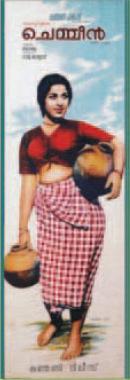
Photo captions: (1) Sheela and Madhu as Karuthamma and Pareekutty on the cover of Chemmeen’s music album (2) Sheela as Karuthamma on the poster of Chemmeen


Previous instalment of Film Fatale: “It Matters, Naseersaab”

Friday, September 19, 2014

REVIEW 290: KHOOBSURAT

Release date:
September 19, 2014
Director:
Shashanka Ghosh
Cast:


Language:

Sonam Kapoor, Fawad Khan, Ratna Pathak Shah, Aamir Raza Hussain, Kirron Kher
Hindi

It takes a brave man to remake a much-loved Hrishikesh Mukherjee classic. Director Shashanka Ghosh’s Khoobsurat matches the mood of the 1980 original, but he wisely borrows just the bare bones of the story to come up with something that’s uniquely 2014 and uniquely his own.

This Khoobsurat then is the story of a bubbly, guileless, kind, successful young Delhi-based physiotherapist called Milli Chakravarty (Sonam Kapoor) who is hired to treat a wheelchair-bound erstwhile Rajasthan royal. ‘Maharaja’ Shekhar Rathore (Aamir Raza Hussain) is a tough nut to crack. Milli is his 40th doctor so far but she soon realises it’s his spirit that needs reviving, not his legs, for reasons this review won’t reveal. The Rathores live a strict, regimented life in their lavish palace overseen by the propah disciplinarian ‘Maharani’ Nirmala (Ratna Pathak Shah). Making up the rest of the family are their son, the dashing but boring workaholic ‘Yuvraaj’ Vikram (Pakistani actor Fawad Khan), and conflicted school-going daughter Divya.  

Like Maria in Sound of Music, Manju (Rekha) in the old Khubsoorat (different spelling) and other films in a similar mould, we know from the start here too that Milli will win everyone over by the end. It matters not, because the journey to that point makes for a sweet romantic comedy.

This may seem blasphemous to Hrishida’s fans, but if you set aside those rose-tinted glasses of nostalgia for a moment, you might agree that Manju/Rekha’s antics in her sister’s marital home, especially her loudness when she first entered there, defied believability. Milli’s exuberance never once resembles Manju’s early idiocy and is, therefore, more credible. This is a chirpy girl brought up in a happy, informal middle-class household by supportive parents, her convention-defying Punjabi mother Manju (Kirron Kher) and her quiet Bengali father (Kaizad Kotwal). Thrown into unfamiliar environs, Milli refuses to put a lid on her joie de vivre yet never comes across as being unaware of her surroundings or of how she sticks out like a sore thumb.

Sonam here does something she should do more often: she does NOT play a designerwear-addicted ultra-glam shopaholic and/or spoilt rich kid whose on-screen character mirrors her off-screen persona; quite the opposite and she looks stunning despite that. To find her Milli though, she reaches not into a wardrobe but into her self for that X-factor we saw in Saawariya’s Sakina, to deliver effusiveness and innocence tempered with sensitivity and wisdom.

Fawad’s staid Vikram is a perfect foil to her effervescence. It doesn’t hurt that he fits well into those suits and gives us a glimpse of a sexy torso in his bedroom one night, without strutting around like a peacock as some Bollywood heroes do these days. The supporting cast is strong, and the sweet chemistry between Ratna and Aamir merits a mention.


By now Kirron Kher could probably do the over-wrought Punjabi mom with her eyes closed. It’s to her credit that despite the burden of playing a cliche, she manages to be funny.

For the most part, Indira Bisht’s screenplay is consistent and realistic. One major grouse: the writing of Vikram’s character. We see him a lot, meet him often, yet don’t get to know him much. It’s easy to understand why Vikram falls in love with Milli. It’s also easy to see why she would be sexually attracted to him – c’mon, he’s cute! – but what evoked love? Can’t quite tell.

The writing does get occasionally lazy, with one particular situation of convenience being drawn up just to fit plot requirements. I mean, how likely is it that a royal Rajasthan household would offer a room with one bed to two guests, one male and the other female?

Early on in the film, another hard-to-believe scenario is unthinkingly thrown in to establish Milli’s egalitarianism. I can imagine a woman like her being kind to household staff, but how likely is it that the crazy-yet-sensible Milli would party, drink and dance wildly with them without stopping for a moment to wonder if the male employees might misunderstand her, considering the gender segregation prevalent in so much of traditional Indian society?

The film also unnecessarily slows down in the last half hour, feels stretched in Vikram’s interactions with Milli’s family and could have done without the generic song Abhi toh party shuru hui hai accompanying the end credits. The spotlight is almost entirely on Sonam in that number. Unfair to Fawad? Yes. But her family is co-producing the film and well, this is what Bollywood’s male stars do to heroines in entire films most of the time, so therefore ergo...

That song apart, Sneha Khanwalkar’s pleasant compositions with lyrics by Kausar Munir are unobtrusively stitched into the story; they are not lip synced but play in the background. The chosen locations show us a Rajasthan beyond sand dunes, and DoP Tushar Kanti Ray delivers eye-pleasing visuals without trying to impress with the grandeur of natural scenery or palaces.

Besides being fun, this is a sensible film. It’s non-judgmental towards Nirmala Rathore despite her harshness. The humour is never raucous and often used to convey an important point: note Milli’s response to Nirmala’s confusion on discovering that Ms Chakravarty considers herself a Punjabi. Except for some rough patches I’ve already grumbled about, this is a well-told story. There you go Sajid Khan, frothy does not have to mean foolish. Khoobsurat is proof of that.

PS: (1) Nice opening credits with visuals of the characters in gilded frames, against the backdrop of what looks like jacquard silk. (2) Is Manju named thus in a bow to Hrishida’s heroine?

Rating (out of five stars): ***

CBFC Rating (India):

U/A
Running time:
130 minutes