Showing posts with label Yashpal Sharma. Show all posts

Saturday, April 5, 2014

REVIEW 254: JAL

Release date:
April 4, 2014
Director:
Girish Malik
Cast:


Language:

Purab Kohli (credited here as Purab H Kohli), Kirti Kulhari, Tannishtha Chatterjee, Saidah Jules, Yashpal Sharma, Mukul Dev
Hindi

There is much that holds out promise in Jal, debutant director Girish Malik’s fable-like film about the terrifying fallout of water scarcity in a remote rural desert location: the Rann of Kutch (where the story is set) is stunning and DoP Sunita Radia painstakingly exploits its disturbing beauty; the costumes are as eye-catching and dramatic as you would expect in this part of the country; leading man Purab Kohli is as sincere as they get; Kirti Kulhari is as striking here as she was in Shaitan (2011); the rest of the Indian cast are all respected talents; Sonu Nigam and Bickram Ghosh as music directors give us a haunting background score and the goosebump-inducing Jal de in Shubha Mudgal’s voice; and oh those pink flamingoes, what a sight they are to behold! Besides, water politics and the consequent violence are more real than we privileged folk would like to believe. This is a story that needs to be told.

Purab plays a “water diviner” in the Rann called Bakka, a man who can tell where the precious liquid is to be found below that parched, cracked earth. The villagers have for long depended on him, but some have begun to doubt his skills. Bakka is the object of affection of a local girl (Tannishtha Chatterjee). A Russian bird enthusiast (Saidah Jules) lands up in their midst with a team of scientists to save the flamingoes from death by poor quality water. Her arrival stirs up the community since there is money to be earned from the rich Westerners plus all the men want to leer at the gori mem’s legs. Thrown into the mix is an enmity with a neighbouring village where water is not as scarce and where Bakka finds his one true love (Kirti Kulhari).

There’s potential for an epic here, and Malik manages to lend an intriguing mystical air to the initial proceedings in Jal. Everything about this film screams out its aspirations to grandeur and a massive scale, and it’s got a basic framework in place to fulfill its ambitions. After a point though, those ambitions dwarf everything else and Jal ends up feeling insubstantial, visually breathtaking but soulless.

Having started out raising a crucial issue, Malik and his co-writer Rakesh Mishra also proceed to arrive at a rather silly, unthinking conclusion that we often hear from uninformed members of the public: that environmentalists care more about animals and plants than human beings. Feature films aren’t lecterns from which sermons need to be delivered, but if a film positions itself as a green crusader, then it had damned well be more responsible with the point it makes. Mr Malik, there’s no either/or in environmental matters: even from a selfish point of view, humans need to save animals and plants from extinction to save themselves. Why did the foreigners in Jal refuse to provide succour to the thirsty villagers? Why didn’t the Indian authorities care? Neither question is explored with any depth.

This is a story that needed to be told. But it needed to be told better.

Rating (out of five stars): *1/2

Footnote: Since the location, cinematography and costumes are Jal’s big pluses, I thought I’d give you a shorter than usual review, and post a photo album here instead. Hope you enjoy it.


CBFC Rating (India):
U/A
Running time:
136 minutes

Photographs courtesy: Effective Communication


Saturday, June 16, 2012

REVIEW 137: ROWDY RATHORE


Release date:
June 1, 2012
Director:
Prabhudeva
Cast:
Akshay Kumar, Akshay Kumar, Sonakshi Sinha, Paresh Ganatra, Nassar, Yashpal Sharma


Going by the sympathetic messages I received when I tweeted that I was watching Rowdy Rathore yesterday – a couple of weeks after its release – I assume I will be royally trolled for this review. Well, say whatever you wish in response, but make darned sure you “don’t angry me”!

All right, all right, I wanted an excuse to throw that line into this write-up. Because I had fun watching RR despite its loudness, the indifference to its heroine and evident disinterest in smoothening out its rough patches although that could have been easily done. On the bright side, this is Akshay back in his groove, aiming at that combination of action and comedy with which Salman Khan’s Dabangg hit the jackpot in 2010. Director Prabhudeva’s outing with Akki is not as cohesive or as well-thought-out as Abhinav Kashyap’s Salman-starrer, but there’s enough here to make Rowdy Rathore an enjoyable – even if illogical – film.

The story is so 1970s/’80s Bollywood that it’s easy to forget that RR is a remake of a 2006 Telugu hit called Vikramarkudu. Two men who look identical – save for the difference in the shape of their respective moustaches – suddenly find their paths crossing. One is a small-time crook and clown-about-town, Shiva (Akshay Kumar). The other is Vikram Rathore (Akshay again), an upright and unsmiling cop in a small town that is being terrorised by the politician Baapji (Nassar). Shiva falls for Paro (Sonakshi Sinha) and promises to give up thieving, but then plans one final con job that brings into his life a little girl who insists he’s her dad.

It’s a story with all the ingredients for an old-style Bollywood potboiler: a premi, a premika, a hamshakal, imaandaari, a menacing villain with ominous hangouts, some good ol’ naach-gaana and dishum dishum and some throwaway lines. Shiva’s “don’t angry me” is in the promos. When a bad guy inadvertently gets hanged by the belt of a policeman he had just humiliated, Vikram Rathore tells us that even the uniform of an honest officer does its duty. Clever dialogues flow as freely as punches and blood. And the songs Chinta ta chita chita and Aa re pritam pyaare are catchy and well choreographed (but of course, it’s Prabhudeva!); the latter is visually lovely too.

What works for Rowdy Rathore is that it does not take itself seriously and does not demand that we do either. That’s why it’s possible to pardon the film its many transgressions. Chief among them is the fact that it seems to forget many of its own gimmicks. For instance, Shiva initially enjoys rewinding to scenes he likes. No kidding, he actually touches an imaginary knob on the side of his head and turns back time. This gimmick is soon discarded for the next one. Shiva uses a particular hand movement in the choreography of Chinta ta chita chita a few times as a sort of signature. Paro too repeats it on a couple of occasions to refer to Shiva … but this too does not run all the way through. We are briefly introduced to Shiva’s hatred for kids, but once the little girl comes into his life, the animosity is gone in a few short scenes – it’s as though the writer inserted it in as an additional element much after the entire script had been written, to add drama to the child’s entry, but then didn’t know how to carry it through effectively.

In short, there’s much laziness and silliness in the writing and telling of this story. Rowdy Rathore takes us back to a time in Bollywood when medicine was not really a science. Remember when docs would feel a woman’s pulse and say, “Yeh toh maa banne waali hai”? In RR, water droplets falling on a man’s head prevent brain haemorrhage! The film also mindlessly chucks songs into the mix not caring whether they match the mood of the moment; and equally mindlessly chucks a couple of star guest appearances into a song, which is all very well if you have a stunning Kareena Kapoor going Chinta ta chita chita, or Prabhudeva showing us his incredible moves, but why did the director ask a Tamil superstar completely unknown to north Indian audiences to appear in the same song? Vijay deserves better than to have viewers asking, “Yeh kaun hai, yaar?” as did several people in the hall where I watched Rowdy Rathore.

And don’t get me started on the treatment meted out to Sonakshi Sinha who: (a) looks young enough to be Akshay’s daughter, (b) disappears for long periods while the hero goes about the business of being a hero, and (c) seems to only serve the role of a decoration piece whose kamar Shiva lusts after. All this could have been excused since Rowdy Rathore does not pretend to be anything but an Akshay Kumar vehicle with everyone else relegated to the background, but Shiva leering at Paro and saying “Mera maal” was downright offensive!

When I watched that scene, I was actually glad the heroine is hardly around. Because the rest of Rowdy Rathore is surprisingly entertaining despite its flaws. Unlike the directors of Salman’s Bodyguard and Ready, Prabhudeva thankfully does not seem to worship Akshay. There’s even a point at which a woman asks why Shiva thinks he’s so hot considering that he does not have SRK’s charm, Hrithik’s looks, Aamir’s cuteness or Salman’s body. Nice to know that Akshay can laugh at himself. Nice to know too that Akshay can still bash up large groups of baddies in style, goof around and display impeccable comic timing, all in the same film to such good effect that even a cynic like me came away smiling. The high point of RR is Shiva impersonating Vikram Rathore, adding a swagger to the deadly serious cop’s personality. This part of Rowdy Rathore is so hilarious that it almost made me forget everything that angried me in the film!

Rating (out of five): **3/4

CBFC Rating:                       U/A

Language:                              Hindi


Tuesday, January 3, 2012

REVIEW 119: SAHI DHANDHE GALAT BANDE

Release date:
August 19, 2011
Director:
Parvin Dabas
Cast:
Parvin Dabas, Kuldip Ruhil, Vansh Bhardwaj, Ashish Nayyar, Sharat Saxena, Neena Kulkarni, Anupam Kher, Kiron Juneja Sippy, Yashpal Sharma, Tena Desae, Udit Khurana, Preeti Jhangiani


Opening scene ... A voiceover tells us that when gangsters want to finish off a member of a rival gang, there’s no better time to choose than the day of his incarceration or release from jail. You can’t be sure of the person’s location at any other time. The camera takes us to Rajbir (Parvin Dabas) who is leaving jail. While Narendra Pehelwan’s people wait for him at the front gate, he exits from the back where his friends are waiting for him. “Rajbirbhai, pichhwaade ke raaste se nikalne ke liye kitna diya?” one of them asks. “Bas, pichhwaada hi nahin diya,” he replies.

The tone is set. Actor Parvin Dabas makes a remarkably assured debut as the writer-director of Sahi Dhandhe Galat Bande produced by Preeti Jhangiani. This is the story of four small-time gangsters operating in the village of Kanjhawla on the outskirts of Delhi – Rajbir and his friends who are nicknamed Doctor (Kuldip Ruhil), Ambani (Ashish Nayyar) and Sexy (Vansh Bhardwaj). Rajbir’s release from jail coincides with an agitation taking place in Kanjhawla in protest against the acquisition of farmers’ land by the Delhi government under Chief Minister Jaya Gulati (Kiron Juneja Sippy) for a factory being built by industrialist Aggarwal (Anupam Kher).

I’d recommend that you pick up a DVD of Sahi Dhandhe to find out how the bad guys try to do the right thing for their people. What’s most appealing about this film is its simplicity and Dabas’ no-frills approach to his story that lends it a quality of realism despite being entertaining. Every episode in this film had the potential to go over-the-top, but at no point does Dabas cross that invisible line. And though the issue at hand is grave, Sahi Dhandhe has an understated and appropriate sense of humour, clever dialogues that don’t sound like dialoguebaazi or the kind of clichéd crudity that we’ve come to expect in all gangster flicks, and just enough elements to keep it both enjoyable and meaningful, emotional yet light.

My favourite scene involves Rajbir trying to make a speech to the farmers, which had me chuckling at the start but left me with a lump in my throat. Later, in one of the film’s most telling moments, a TV journalist from the city sticks her mike into a villager’s face and asks, “Aapke hisaab se Land Acquisition Act mein kya tabdeeli honi chahiye?” to which she gets silence and a blank stare in response. And one night during a boisterous drinking session, when the gang is trying to figure out ways of helping the villagers who don’t want their help, Ambani laments farmer leader Malik’s insistence that he will keep the movement non-violent and apolitical. “Na politics na thod-phod. Yeh toh saale sharaafat mein hi mar jayenge,” he says. Nice.

The unusually long actors’ list (above) that I’ve given in this review is my way of saluting casting director Honey Trehan. The gang of four are remarkable though I’m torn between Ashish Nayyar and Kuldip Ruhil as my pick of the quartet. Among the talented supporting cast, a special word needs to be said for Neena Kulkarni who looks, talks and feels the part of Rajbir’s foster mother who does not want him anywhere near her agitation; Kher who metamorphoses from the faintly oily fellow chatting with the CM on the phone to the dignified businessman imperceptibly making a pass at a troublesome female journalist; Sippy as the politician whose son is her weakness; Sharat Saxena as Rajbir’s boss Fauji in a role that is a departure from the slimy villain he’s played a zillion times; and Yashpal Sharma (Malik) thankfully playing something other than a bad cop or goon here.

Cinematographer Anshul Choubey matches the tone of subtlety that Dabas evidently wanted to achieve with this film. His camera moves from a suburban village to the CM’s upmarket residence to Delhi University and back without giving us any grand sweeping shots of the city, yet managing to capture its feel. I wish the lyrics of the film’s songs were a little clearer, but I enjoyed the unobtrusive use of the background score by Siddhartth-Suhas. And the sound design by Subash Sahoo is so clean that we actually hear Malik’s nails scratching his stubble in one scene.

Sahi Dhandhe is not without its flaws. The end struck me as too simplistic and not entirely credible considering what we’ve witnessed in Singur, Bhatta Parsaul and other long-drawn-out farmers’ struggles. And once the lead four had arrived at a decision about their exact strategy, I felt the film should have approached its climax more rapidly, for a greater impact. Also, while most of the primary characters have shades of gray, the farmers are all painted as uniformly good folk which to me was a jarring reminder of the regular Hindi film stereotype about big bad city folk and bechare kisaan. Still, Sahi Dhandhe Galat Bande is a gently engaging film, and I hope Parvin Dabas gets to write and direct many more films in the future.

Rating (out of five): ***

 CBFC Rating:                      U/A with three audio cuts (The Censor Board really needs to stop reading casteism into the inoffensive use of words describing professions. They actually got the film maker to remove the word “dhobi” from a song!)
Running time:                        120 Minutes
Language:                              Hindi


Tuesday, June 7, 2011

REVIEW 50: A STRANGE LOVE STORY

Release date:
June 3, 2011
Director:
Tarique Khan, Sahil Seth
Cast:
Eddie Seth, Riya Sen, Ashutosh Rana, Yashpal Sharma, Raj Zutshi


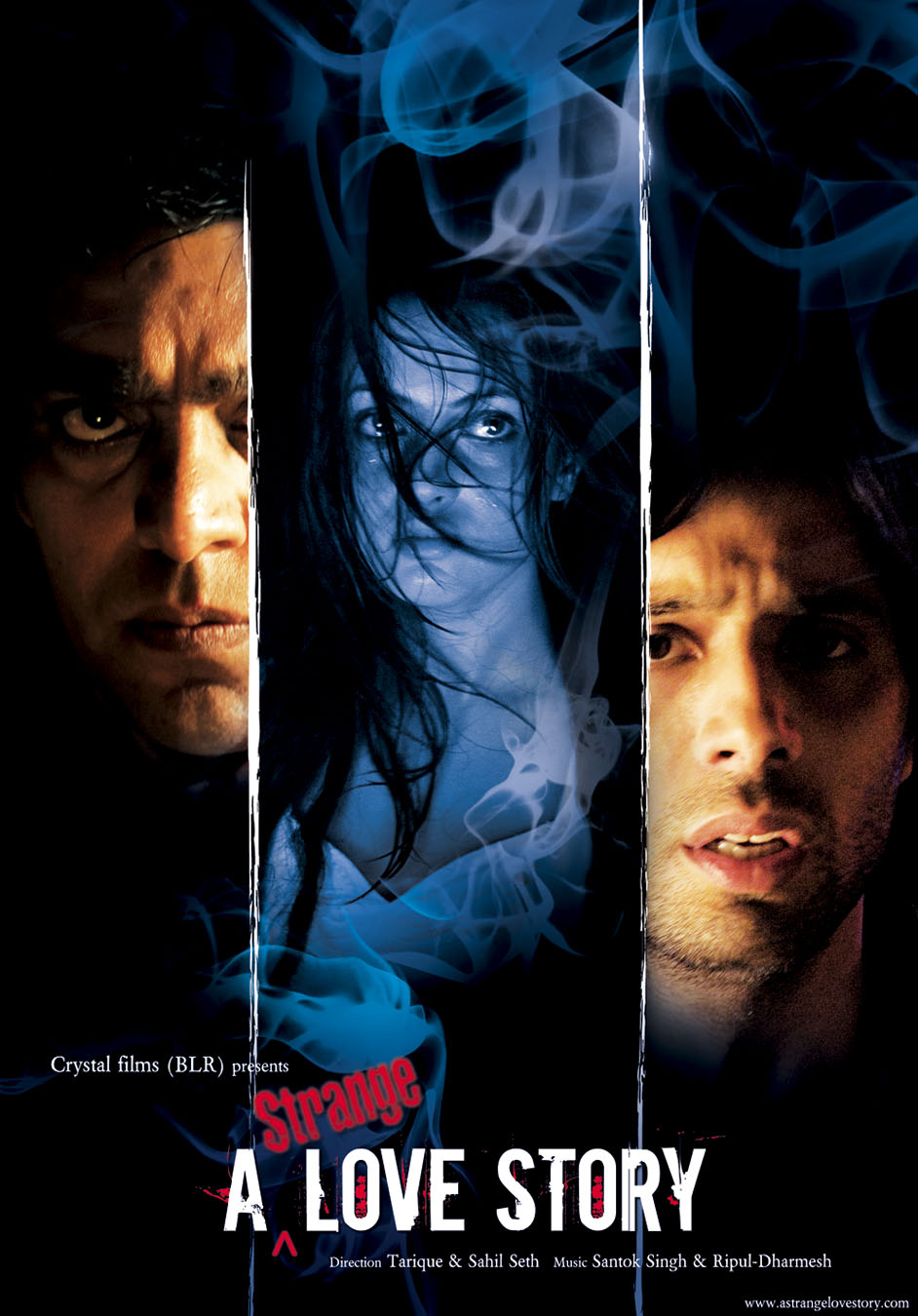
It took two full human beings to direct this film! Well, I’d like to compliment them because A Strange Love Story must rank as one of the most aptly named films of the year. It truly is strange. The film stars Riya Sen and Ashutosh Rana, if you insist on knowing the known names in the cast first. But the one I’d really like you to meet is Eddie Seth who plays “world famous photographer Kabeer” (not my words, it’s on the film’s official website). Kabeer meets pretty Jennifer a.k.a. Jia (Riya Sen) at a party. The two subsequently visit a lonely dargah at night, because … well, how else would the horror story unfold? While they are there, a spirit falls in love with Jia and before you know it, odd things start happening to her and to the people around her.

Never mind what the rest of the story is. Since the film’s website is quite delightful, please allow me to quote from it again: Jia is apparently “a wild and bohimian (sic) girl”. How does A Strange Love Story illustrate that point? Well, she wears short dresses, drinks, attends parties at nightclubs and smokes joints. When chided by a friend for the latter bad habit, Jia asks: If your mother died and your father hooked up with a girl your age, what would you do? Ah, the world’s drug problems explained!

The film must be lauded for its secular approach to horror. The lead couple visit Hindu, Muslim and Christian holy men to solve their problems. The Hindu priest is a lecherous sort whose lust for Jia gets him into trouble with her bhoot boyfriend while a Muslim cleric (whose flunkey plays football with ghosts) finally utters some mumbo jumbo that scares the spook away. Jia by the way is a Goan Christian who says “Jijjus” for “Jesus” in Rakhi Sawant style. Since I’ve just seen Riya Sen deliver a fine performance in Rituparno Ghosh’s Noukadubi, I’m tempted to be kind to her and blame it all on M/s Tarique Khan and Sahil Seth.

Other humungously entertaining things happen in this film. We are told that the world is divided into humans and animals, and then there is another species: ghosts. The one who falls for Jia takes human form to woo her. This Jinn-nath befriends Kabeer in the bargain. Towards the end of the film, when a policeman asks Kabeer about that friend, Kabeer replies absolutely straight-faced: “He’s not X, he’s a Jinn-nath.” Oh, that explains it all, says the policeman nonchalantly, as though it is the sort of sentence he’s used to hearing every day.

This is the kind of story that could swing either way – it could come across as silly or quirky, depending on the treatment. A ghost falling in love with a human being was the theme of Vijaydan Detha’s charming little story which Amol Palekar made into the film Paheli (yes, kill me if you must, I know I’m one of the few people in this country who found that film sweet). But A Strange Love Story is constrained by lacklustre direction, an even more lacklustre hero who, coincidentally, is the producer’s son, and an absolute lack of energy, all of which add up to a silly product! There are precisely two genuinely eerie moments in the film – yes, I counted. The only other things I remember liking about it are Riya Sen’s wardrobe and smooth complexion, and the interiors of the various houses she visits. There is also a hilarious song picturised on the hero featuring lots of Caucasian women and a central female figure in silver silk (or was it satin?) flailing her arms and the fabric around as though she’s a bird. It reminded me of the songs with gori ladies in that other classic I watched earlier this year, Happy Husbands, though to be fair, that film was even stranger than A Strange Love Story.

So it’s confession time: while watching this film, I amused myself by pretending not to notice the amorous couple in the row just ahead of me in the hall and wondering about a solo female viewer at another end who watched the film with such concentration that I found her intriguing. Arrey, stop judging me! I spent Rs 150 on my ticket, and I have a right to seek out my money’s worth!

Rating (out of five): 1/2

CBFC Rating:                       A
Running time:                       120 Minutes
Language:                             Hindi

Photograph courtesy: http://www.astrangelovestory.com/