Showing posts with label Hindi cinema. Show all posts

Monday, February 26, 2024

All India Rank: “Preserve your memories, they’re all that’s left you” (Review 798)

Release date:

February 23, 2024

Director:

Varun Grover

Cast:

Bodhisattva Sharma, Samta Sudiksha, Geeta Agarwal, Shashi Bhushan, Sheeba Chaddha, Neeraj, Ayush Pandey, Saadat Khan

Language:

Hindi 


Tum ladkon ke akal mein phaphoond laga hota hai kya?” (Have you boys got fungus on your brains?) Sarika Kumari asks her classmate Vivek Singh in the new Hindi film All India Rank. It’s the sort of throwaway line that indicates the user’s comfort with the tongue. 


The ease with which Sarika slips phaphoond into the right context makes it my word of the week, though nasudda hogs the limelight in All India Rank since Vivek is asked the meaning at one point. (I won’t tell you his answer.) 


It is no surprise that All India Rank has the feel of a film written by someone who takes pleasure in language. It is after all the directorial debut of Varun Grover who rose to fame and acclaim with his lyrics for Anurag Kashyap’s Gangs of Wasseypur (2012), then sealed his reputation by writing Neeraj Ghaywan’s Masaan (2015). Grover has also written this film, which was premiered last February at the International Film Festival of Rotterdam and is now in Indian theatres. 


Sarika (Samta Sudiksha) in All India Rank is one of the foremost supporting players in the story of Vivek (Bodhisattva Sharma), a teenager from Lucknow who arrives in Kota in 1997 to prepare for the IIT entrance test. Kota is the Mecca of coaching classes for IIT aspirants or, as Vivek’s father R.K. Singh (Shashi Bhushan) puts it, it is “coaching ka Haridwar”. 


Vivek has been dragged by Singh Senior into a race he does not care for, while Sarika runs with passion and for herself. A parent forcing his dreams on a child and the pressure to gain admission to one of India’s most sought after educational institutions are only the backdrop against which All India Rank unfolds as an observational, almost meditative portrait of what can best be summarised as “a year in the life of Vivek from 1990s India”. 


The desperation and despondency of some of the leads in other Hindi films dealing with career choices, India’s education system and so on are not to be found here. All India Rank is not 3 IdiotsTamasha or 12th Fail. The pressure-cooker existence of the impoverished Manoj from All India Rank is a far cry from Vivek’s situation – the latter has relative privilege as the only child of lower-middle-income parents. Vivek is unhappy at being pushed into a profession he does not want, but he does not get depressed, unlike Ranbir Kapoor’s character from Tamasha. Viveks exist too. 


All India Rank is semi-autobiographical. Grover himself is an IITian, but the film is left open-ended, perhaps to make a point that it can hardly be viewed as a climax if a disinterested kid gets into a coveted college. All India Rank is not about a triumph, it is about a journey. 


Grover’s film, edited by Sanyukta Kaza, has a calm vibe and an air of innocence. Its low-key sense of humour is written into both the conversations and the pleasant music (lyrics by Grover, original songs and background score by Mayukh-Mainak). The unhurried demeanour and unmelodramatic presentation of even its most dramatic moments convey an impression that little happens here. In truth, it is packed with thoughtful character development and discreet socio-political commentary. 


In a sense, Vivek is an unlikely protagonist. He is unexcited by IITs but he doesn’t fight his Dad too much, he dabbles in rebellion but soon gets back on track, he’s nice but slightly bland. He grows in his own way though. In any case, even a seemingly bland individual is the hero of their own story, and even such a person has his moments, as we see with Vivek. 


Besides, the boy is surrounded by interesting people – the feisty Sarika, their friend who pretends he’s not studying when in fact he does, parents who evolve, an easygoing mother (Geeta Agarwal) and a man who sees his son’s entry into IIT as a passport to elevating his own social stature. 


The newcomers and veterans in the cast are uniformly endearing and real. Geeta Agarwal and Shashi Bhushan infuse warmth into Vivek’s parents’ close bond. Sheeba Chaddha is capable of being harsh as spikes on screen, but in All India Rank she brings an unexpected softness to Kalpana Bundela, the queen of IIT coaching in Kota, who keeps the mood light in class.  


Among the film’s winning qualities is the authenticity in the recreation of the era in which it is set, through dialogues, Prachi Deshpande’s meticulous production design and revisitations of old songs. In 1997, telephones with whirring dials were the norm and the Nirma detergent powder advertisement was a reigning pop culture reference. The detailing of the time is charming. 


This was the decade in which economic liberalisation, Mandal and the Babri Masjid demolition permanently altered India’s DNA. The script does not spell out any of this, but slivers of the politics of that era and of the present are an unobtrusive presence in the writing. 


Azaadi” in the 1990s was not yet a word that could land you in jail, but as we see in the film, queasiness over Urdu was very much the norm and Indian was already a country that valued its national symbols more than its people. 


I’ll leave you to spot the messaging that dots the film, including the manner in which the writer-director tests the liberal viewers’ obliviousness to anti-minority stereotyping in Hindi cinema by seeming to present a stereotype, then turning it on its head. No spoilers here – you will hopefully recognise that episode when you see it. Compare it to the mischief played by the writer-director of last year’s OMG 2, who placed three minority community members in his all-Hindu universe in a north Indian temple town, wrote all three of them as jerks, and picked one of them to torment a schoolmate over his penis size, thus setting off a chain of events that almost destroyed the boy. 


In the past 10 years, much of Hindi filmdom has bowed and scraped before the right-wing through works that demonise religious minorities, marginalise the influence of minority cultures on India, and erase every achievement of non-BJP governments and prime ministers. All India Rank stands out from this obeisant crowd with almost indiscernible defiance. Don’t go looking for a sermon or lengthy exposition. What we get instead is a word here, a brief chat there, a quote on a wall, a passing image on TV – Grover worships at the altar of the God of small things in All India Rank


The film is not about any of this though, just as it is not about IIT. Grover leaves us free to note his politics if we wish, or to enjoy All India Rank as a sweet little film about “a time of innocence, a time of confidences”, to borrow from the American songwriter Paul Simon’s Bookends (1968). 


Unlike most coming-of-age sagas, All India Rank does not feature any grand awakening or drastic change in the central character’s plans by the close. Yet, it tugs at the heart. The film is like photographs we take of regular days, pictures that don’t commemorate a birth, death, graduation or anniversary but instead freeze frame the spaces in between when most of life occurs. Those are the days that get us to our milestones, and our stories are incomplete without them. 


In choosing to make All India Rank – and make it in precisely the way he does – Grover subscribes to the Paul Simon school of thought. “Preserve your memories, they’re all that’s left you.” (Bookends again)


Rating (out of 5 stars): 3   


Running time:

101 minutes 


Visual courtesy: IMDB 

Wednesday, January 15, 2020

THE ANNAVETTICADGOES2THEMOVIES AWARDS: BEST BOLLYWOOD FILMS 2019

ARTICLE 15, GULLY BOY AND A HANDFUL THAT SHONE IN AN OTHERWISE ANNUS HORRIBILIS

2019 has been the worst year of an already problematic decade for Bollywood, the Mumbai-based (primarily) Hindi film industry that gets a disproportionate amount of attention from the so-called ‘national’ media in comparison with India’s other film industries. Islamophobia and pro-establishment messaging were the dominant trends in Bollywood this year, while quality and depth took long vacations from theatres. So few films left a lasting impact, that instead of compiling my usual annual list of best 10, this time I have stopped at nine. 


(Note: This year I have kept this list to theatrical releases, although next year I will in all likelihood expand it to cover direct-to-online releases too.) 

Here is my pick of the saving graces in this annus horribilis.

BEST BOLLYWOOD FILMS:

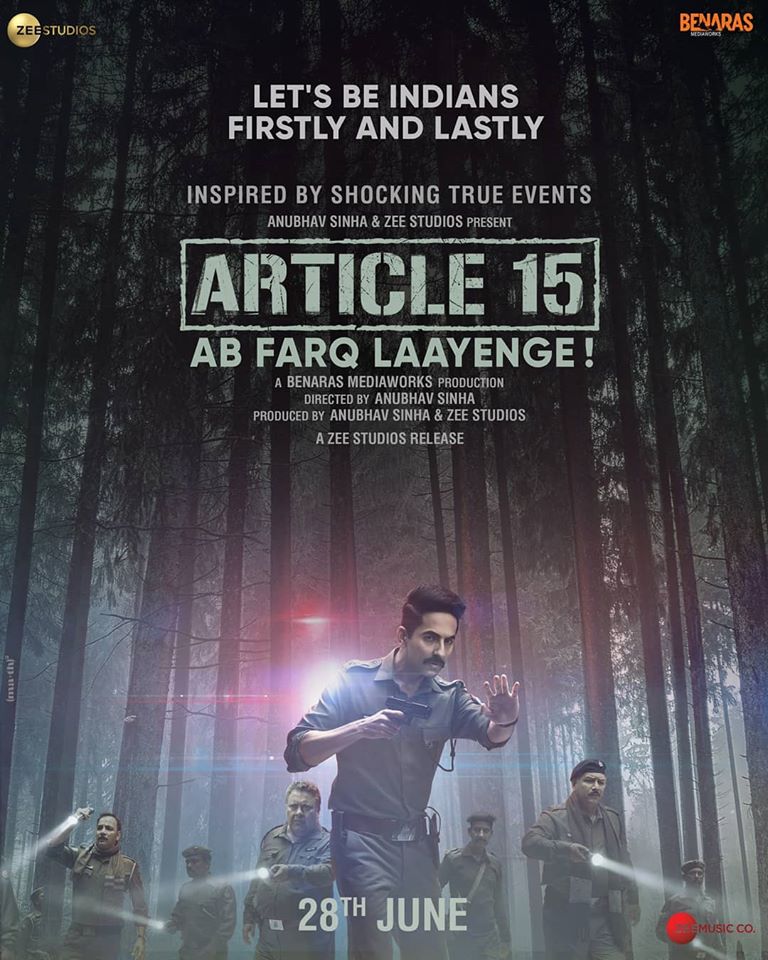
1: Article 15

Unlike India’s other film industries, Bollywood in recent decades has largely ignored the very existence of the caste system. The most powerful Hindi film of 2019 though put caste at the front and centre of its storyline. In Anubhav Sinha’s Article 15, Ayushmann Khurrana plays a Brahmin policeman who is schooled in this oppressive social practice when two Dalit girls are raped and murdered in a UP village where he is posted. Among a bouquet of beautifully written, beautifully acted characters, the ones whose journey ought to spawn a sequel, prequel or both are the Dalit activists Gaura and Nishad, played by Sayani Gupta and Mohammed Zeeshan Ayyub. 

Article 15 combines great courage with great storytelling. I choke up even now at the thought of Vande Mataram woven into the narrative in a soul-stirring scene that vehemently reclaims it from today’s aggressive nationalists who have weaponised patriotism and patriotic songs. 

(For the full review of Article 15, click here)


2: Gully Boy 

A marginalised genre of the arts meets a poor man from a marginalised community in Zoya Akhtar’s stunning Gully Boy inspired by the lives of Mumbai rappers Naezy and Divine. In spite of rap’s massive popularity, many traditionalists still do not acknowledge it as literature or music. Akhtar snubs them through the medium of a Muslim driver from a Mumbai slum who dreams of being a rapper. Ranveer Singh is flawless as the shy youngster whose seething resentment towards those who seek to invisibilise him erupts in his rebellious writing. Alia Bhatt is superb as his  girlfriend who is fighting massive battles with patriarchy. The top-notch cast also includes one of the big discoveries of this year: young Siddhanth Chaturvedi. 

Gully Boy is technically slick, unapologetic about its politics and brimful of brilliant poetry. One of the joys to be derived from it comes from watching the hero’s creative process, from actually watching his songs take birth on screen. In its own unique way then, it is a procedural. At a time when most of Bollywood is bowing and scraping before the present government, it takes a special person to feature Jingostan beatbox in a mainstream commercial film. And Apna time aayega (Our time will come) is an anthem for every human being who has known what it is to be discriminated against, sidelined or ignored by a dominant social group. Gully Boy is gut-wrenching cinema from a gutsy filmmaker.  

(For the full review of Gully Boy, click here)


3: Mardaani 2

Rani Mukerji returned this year as the genius cop Shivani Shivaji Roy from 2014’s Mardaani who wastes no time on hollow politeness and bruised egos. The off-putting title notwithstanding, writer-director Gopi Puthran’s Mardaani 2 is a sharp, incisive critique of how patriarchy reacts when it encounters a questioning woman. Mukerji’s immersive performance in this suspenseful thriller makes for a potent combination with the antagonist played by TV’s Vishal Jethwa who gives us one of the eeriest, creepiest, most convincing villains seen on the Hindi screen in a long while. For a change, a genuinely feminist film from Bollywood, not a film pretending to be feminist while camouflaging a conservative core.  

(For the full review of Mardaani 2, click here)

4: Sonchiriya 

Banditry in the Hindi heartland is resurrected on the big screen in one of the most underrated, under-marketed and therefore, sadly, under-seen films of the year. Abhishek Chaubey’s Sonchiriya stars a spectacular cast – Sushant Singh Rajput, Bhumi Pednekar, Manoj Bajpayee and Ashutosh Rana among them – inhabiting a story of outlaws traversing a dusty north Indian hinterland. These are not the conventional daakus (dacoits) commonly seen in an earlier Bollywood. They are not fearsome and lionised, but instead tired of this off-the-grid existence. And baaghi (rebel) is the label they prefer for themselves.

Sonchiriya’s stark messaging is enhanced by Anuj Rakesh Dhawan’s austere cinematography. The film has the courage to speak truths that even most liberals avoid: such as the fact that women are subordinated across all castes including by the most exploited. It also reminds us of a reality that too many men fail to see while they enjoy the powers most societies bestow on them: the reality that while patriarchy marginalises all women, it also extracts a heavy price from men. 

(For the full review of Sonchiriya, click here)

5: The Sky Is Pink 

Priyanka Chopra Jonas and Farhan Akhtar show remarkable restraint playing parents of a child born with a potentially fatal disorder in Shonali Bose’s The Sky Is Pink. Despite being a saga of death foretold, the film is about hope as much as it is about despair, the value of every second we have on earth as much as it is about our inevitable ends. Grief and positivity are life-long partners in this poignant account of a couple whose relationship survives every loving parent’s worst nightmare.

(For the full review of The Sky Is Pink, click here)


6: Saand Ki Aankh 

Two women in rural north India happen to pick up guns for the first time in their 60s and end up becoming successful competitive sharpshooters. It is surprising that Bollywood took so long to chronicle the real-life story of UP’s now-octogenarian Shooter Daadis, Chandro and Prakashi Tomar, but when it finally did, the result was Tushar Hiranandani’s entertaining, uplifting, socially insightful film.

Bhumi Pednekar and Taapsee Pannu are in top form as Saand Ki Aankh’s leading ladies, and Viineet Kumar is sensational as their supportive coach. The film has drawn considerable flak for casting young female stars as the elderly leads, but even this starting-point flaw does not mar its heartening celebration of feminine fortitude. 

(For the full review of Saand Ki Aankh, click here)

7: Nakkash 

A Muslim artisan practising his craft in a temple in one of Hinduism’s holiest cities is the fulcrum of Zaigham Imam’s Nakkash. Inaamulhaq plays Allah Miyan who becomes an object of conservative Hindu wrath in Varanasi when his steadfast patron, the temple chief priest (Kumud Kumar Mishra), refuses to be influenced by bigots. Islamophobia is so rampant in today’s world that many well-meaning liberals now steer clear of addressing Muslim fundamentalism in their works. Imam, thankfully, has no such qualms. The director is as unsparing in his take on how Allah Miyan is ostracised by his fellow Muslims as he is in his indictment of fundamentalists from the majority community. Nakkash is a moving saga of love and hate, innocence and venom residing side by side in a communally charged universe. 

(For the full review of Nakkash, click here)

8: No Fathers In Kashmir 

The spotlight falls on half widows, missing men, sexually exploited women and conservatives with double standards in Ashvin Kumar’s No Fathers In Kashmir. It should surprise no one that this film came to theatres after a long battle with the Central Board of Film Certification which initially – unfairly – awarded it an A (Adults only) rating. Contrary to the current popular discourse that demonises Muslims, or for that matter an earlier Bollywood era that tended to paint the entire community with a positive brush, this film sees Kashmiri Muslims as regular people – good and bad, evil and virtuous, and all uniformly troubled.

Despite the harshness of the reality it examines, a tenderness pervades No Fathers In Kashmir because of its decision to explore the state through the wanderings of two artless children. Their charming sweetness ends up further underlining the bitterness and hopelessness that have beset care-worn Kashmir. 

(For the full review of No Fathers In Kashmir, click here)

9: Ek Ladki Ko Dekha Toh Aisa Laga

Of the very few Hindi films made on LGBT+ persons, most have chosen to focus on men. In that sense, Shelly Chopra Dhar’s Ek Ladki Ko Dekha Toh Aisa Laga this year breaks new ground by relating the story of two women in love. It goes many steps further by staying doggedly mainstream in its format and upbeat in its tone, busting prevailing stereotypes by casting a glamorous mainstream star as the lesbian heroine, and treating her neither as a source of comedy nor tragedy. Sonam Kapoor Ahuja plays Ek Ladki’s Sweety Chaudhary, while Anil Kapoor plays her father, a man whose heart lies in a profession considered unsuitable for men. Through his presence in the plot along with characters played by Juhi Chawla and Rajkummar Rao, the film stretches its discussion beyond gender in romantic relationships and extends it to the suffocating nature of all forms of gender stereotyping, prejudice and straitjacketing.  

The title harking back to the most iconic song of Kapoor Senior’s career, is among the many factors that makes Ek Ladki Ko Dekha Toh Aisa Laga one of 2019’s most heartwarming films. 

(For the full review of Ek Ladki Ko Dekha Toh Aisa Laga, click here)

Related links:


A VERSION OF THIS ARTICLE IS ALSO ON FIRSTPOST:

Photographs courtesy:


The Sky Is Pink  poster: Creeshul Media


Ek Ladki Ko Dekha Toh Aisa Laga poster: https://en.wikipedia.org/wiki/Ek_Ladki_Ko_Dekha_Toh_Aisa_Laga