Showing posts with label Bobby Deol. Show all posts

Wednesday, December 6, 2023

REVIEW 787: ANIMAL

Release date:

December 1, 2023

Director:

Sandeep Reddy Vanga

Cast:

Ranbir Kapoor, Rashmika Mandanna, Anil Kapoor, Bobby Deol, Tripti Dimri, Upendra Limaye, Suresh Oberoi, Saloni Batra  

Language:

Hindi with some English, Punjabi, Marathi etc 


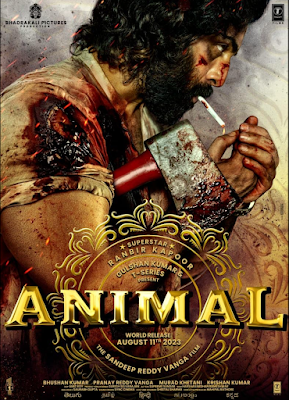
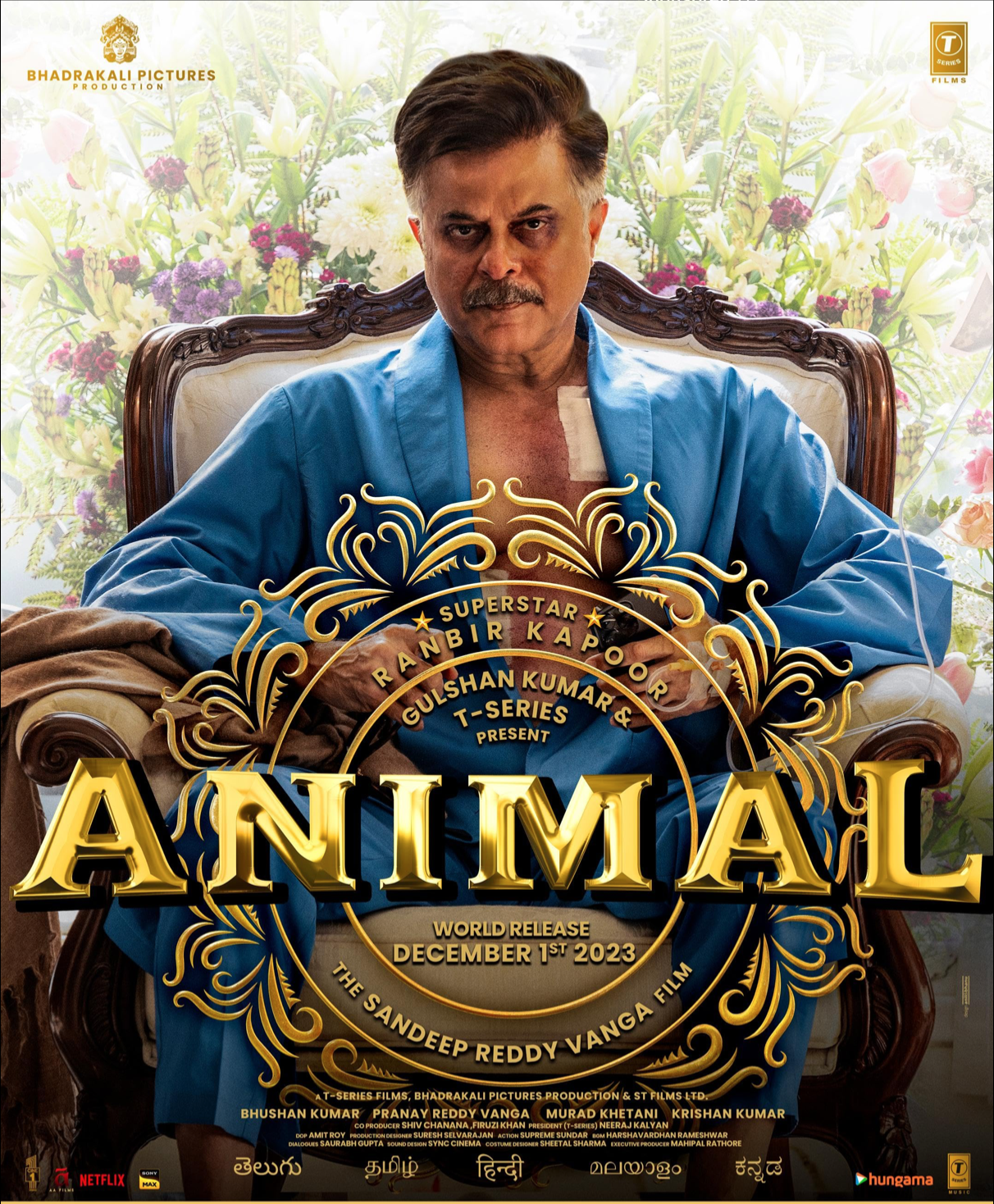
At one point in Animal, a stark naked Ranvijay Balbir Singh (Ranbir Kapoor in his nth role as a man-child) steps out of his mansion to stroll around the compound. (Don’t get too excited, his body is blurred out.) His team of male bodyguards first gawp at his nude frame, then a frisson of joy runs through them and they raise their guns in the air to let out several volleys of celebratory fire. This goes on till Ranvijay’s Daddy (Anil Kapoor) comes running out of the house to lead him away. The exhibitionism, it turns out, was in honour of a happy turn of events I won’t detail here. Beta, says Dad, I know you want to celebrate, but this is not the way. 


I cannot remember the last time the gifted veteran actor’s dialogue delivery was this strained and this unintentionally comical. Can’t blame him alone. That scene is so ridiculous, the phallic symbolism so in-your-face, the attempt at profoundness so laughable, and the sum and substance of the episode so juvenile that I burst out laughing. 


Ranvijay is fixated on his nether regions throughout Animal. He keeps drawing attention to the area by either pointing at his crotch or baring it or talking about it or griping about his underwear. In one scene, he speaks of both his “penis” and “anus” – his choice of words, not mine. It is all meant to be very very cool.


Animal is directed by Sandeep Reddy Vanga who debuted with Arjun Reddy (Telugu, 2017), and remade it in Hindi as Kabir Singh (2019). Animal – edited by Vanga and co-written by him with Pranay Reddy Vanga, Suresh Bandaru and Saurabh Gupta – seems bent on enraging those who slammed his earlier works. That goal is evident throughout this boring, blood-spattered film – in Ranvijay’s bizarre remarks and deeds, the all-pervasive violence, misogyny and gore. 


So that’s 3 hours and 21 minutes of revenge against those who criticise misogynistic cinema. 201 minutes of a desperate desire to shock and/or offend. 


Don’t be deceived into considering it mindless though. Bloodshed and immaturity may rage across Animal, but make no mistake about this: the film is steeped in messaging about victimhood – male victimhood and an allusion to the majority community too. 


Vanga’s film is a painfully long account of a boy longing for his father’s love. The said Dad is the industrialist Balbir Singh who has no time for his children. His neglect translates into anti-social behaviour and obnoxious cockiness only in Ranvijay who becomes an obsessive son and entitled lover, while his sisters somehow grow into women who don’t resent or bash up all and sundry.

 

Daddy issues have been the subject of numerous films. The re-release of the iconic Malayalam film Spadikam this February, 28 years after its initial run, was a troubling reminder that male-dominated industries have for decades used paternal rejection to justify and normalise male violence, including a hero beating up a female romantic partner or spouse. Spadikam’s protagonist (Mohanlal) was an anguished soul who repeatedly struck his lover (Urvashi), but it was all portrayed as no big deal. In Animal, Ranvijay is aggressive with his wife Geetanjali (Rashmika Mandanna), going so far as to injure and scar her in an extended scene of violence, but it is all insidiously presented with deftly camouflaged empathy – for him. 


For the zillionth time, let me pre-empt the clichéd question that always comes from defenders of such cinema: violent men do exist in the real world and a violent man can certainly be the central character in a film – the issue here, as always, is the manner of the portrayal, the script’s indulgence towards him, the humour and coolth written into his fictional character, and the various means used to give him an allure despite his violent ways.


The strategised depiction of Ranvijay and his arch enemy Abrar (Bobby Deol) – arriving late in the second half – illustrates how the difference between a film’s gaze on two equally violent characters is used to steer audience reactions to them. Both commit horrifying acts, both treat women terribly, yet there is never a doubt about who is the hero or with whom the director wants our sympathies to lie. Animal may call itself Animal with reference to Ranvijay, yet his animalism is preceded by scene after scene dwelling on his childhood pain, his protective brotherly conduct, his aversion to sexual harassment, his advocacy of marital fidelity and so on, thus establishing him as a traumatised man with innate goodness. By the time his beastly side is exposed, a point has been firmly made that everything he does that is seemingly wrong is in fact done for the greater good. In contrast, the only Abrar we get to know is the brute who kills, rapes and terrorises. 


For good measure, Abrar’s Muslimness is underlined by pointedly mentioning his family’s conversion to Islam. 


If Ranvijay rips up human flesh, it is to avenge an attack on his father. If Ranvijay cheats on his wife (mind you, after lecturing other men when they cheat on their wives), he does it for a noble cause. Poor misunderstood Ranvijay had sex only to save his family, you know. 


Ranvijay assaults Geetanjali and a defence is woven into the script. He proposes that just as there is a first kiss and a first time having sex in a relationship, so also there should be a first slap. And guess who gets slapped first? 


Sigh. Poor misunderstood, suffering, victimised Ranvijay.


Poor Ranvijay who has a solitary wife, and is up against evil, brutal Abrar with three wives. 
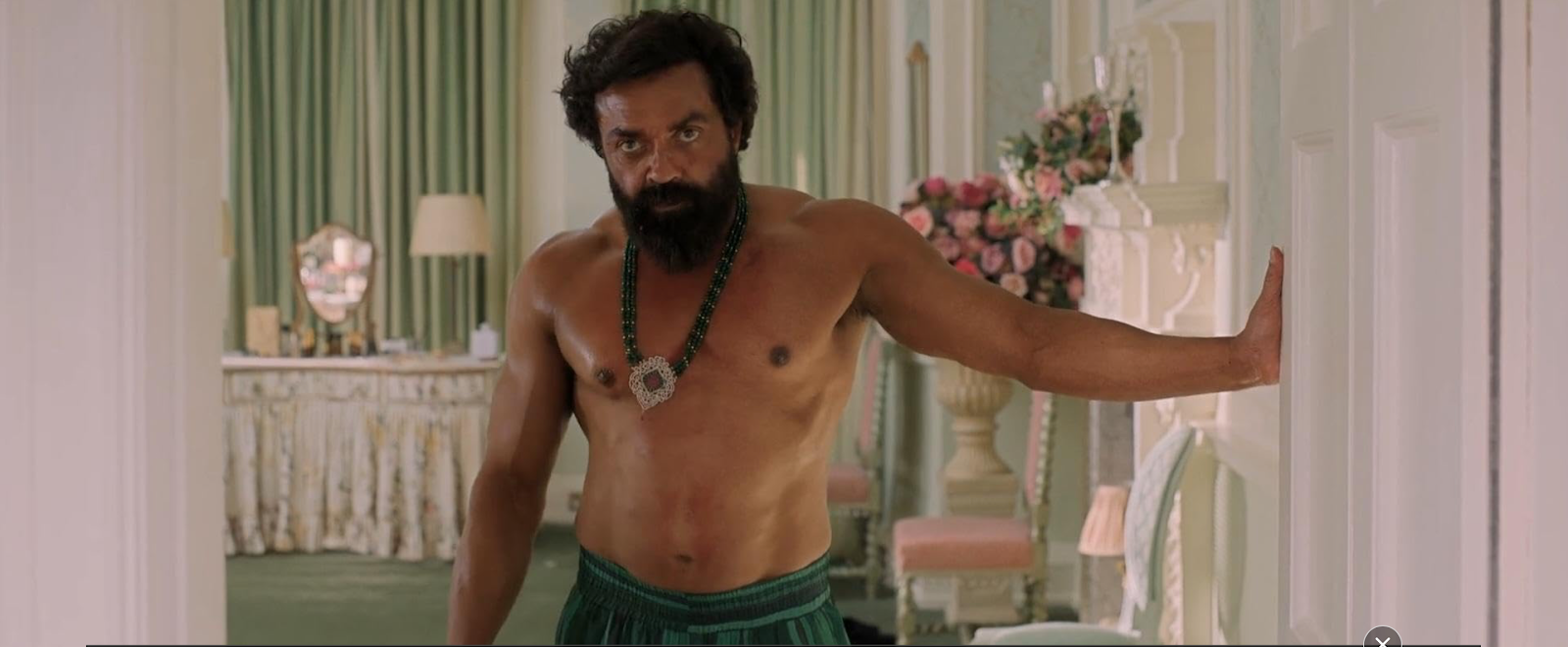
 

Bobby Deol’s Abrar has been shaped in the same mould as Alauddin Khilji from Padmaavat and other fictionalised interpretations of historical Muslim warriors who have dotted Hindi films in the past decade. Abrar eats cake in Animal in the way Padmaavat’s Khilji tore into meat. Abrar tears into his young wife in the way Padmaavat’s Khilji raped his wife. A filthy Abrar barges into a room filled with people and initiates sex with his bride, unmindful of the others’ presence.  


Now contrast this with the mellow tone of the scene in which Ranvijay converses with Geetanjali while examining the bruises he inflicted on her body. 


Note too that the relentless cruelty inflicted by Ranvijay on various people is bookended in this carefully constructed narrative by lengthy scenes emphasising his vulnerable nature. 


So, to circle back to that predictable question, “Violent men do exist, so what’s wrong with a film portraying reality?”, I repeat: yes, violent men do exist in the real world, and the issue here, as always, is the director’s gaze on them and their violence.


Animal brims with an intense dislike of women, outspoken women in particular, and evolved, gentle men. It begins with a derisive use of the word “toxic” in a fable narrated by Ranvijay about a monkey that harassed a princess. The contempt is obviously for the term “toxic masculinity”, popular in the feminist lexicon, that was widely applied to Vanga’s first two films. 


At one point, Ranvijay mocks Geetanjali for complaining because she has to change pads for four days in a month – he claims she complains, we don’t hear her doing so – while he, he tells her, has not complained though his body has been invaded by doctors during a life-threatening situation. Talk about false and stupid equivalences. Periods are a natural bodily function – often horribly painful, always incredibly inconvenient – that every woman bears for every single month of her entire reproductive life lasting for three to four decades. Ranvijay’s condition, on the other hand, is caused by a human aggressor; it is not the biological fate of all men. Here, Ranvijay is a version of misogynists who troll women for using the social media to raise awareness about cramps, excessive bleeding, agonising period pains and the trivialisation of these experiences by society. 


Oddly enough, the determinedly misogynistic Animal writes a feminist element into Ranvijay’s character – he explodes with anger when his brother-in-law roughs up his sister early in the film. There is no progression shown from that scene to his own extreme hostility to his wife. 


Animal’s terrible attitude to women runs alongside a cunning use of India’s religious minorities. 


Abrar and his cohorts are stereotypes diligently being peddled by Hindi cinema to echo the current Islamophobic national discourse. There is even a Muslim man in the picture who is described as a butcher from Istanbul. His sole contribution to Animal is a stomach-churning slaughter of men. 


The Sikhs in Animal are Ranvijay’s brethren and protectors, an extension of a positive stereotype: the fierce, fiercely loyal Sardarji. They are also his allies against Abrar’s marauding gang. All this leads up to a climactic confrontation between shirtless men on an airport tarmac – talk about Hindi film clichés! – in which a kirpan is handed to Ranvijay so that he can wrap up a fight unto death.
 

A Christian in Animal confuses Balbir Singh’s company logo with the Nazi Swastika. Since prominent Hindu religious symbols are ubiquitous in India, one assumes a Christian was chosen for that episode to play along with right-wing propagandists who project Indian Christians as alien Westerners. Presumably, the idea here is to hint at Hinduism being a globally misunderstood faith. 


Without giving away plot points, I can tell you this much: according to Animal’s underlying philosophy, Sikhs are family and very much in the Hindu fold, Muslims are family that chose the wrong path and are now out to destroy the mother clan, and Christians are the other. 


The mind games played by Animal are packaged in slick production design and cinematography, accompanied by a pulsating sound design, infectious music, and Ranbir’s immersive performance. 


Despite all this, I was bored stiff by the film. 


Startling violence is used here to compensate for a thin, trite storyline. In the first half hour, I was curious about where Vanga would take it, but I spent the remaining 171 minutes stifling yawns at the transparent effort to be disgusting. The camera zooms in on a pulverised human eye. A knife is run back and forth, back and forth, back and forth over a human neck in close-up instead of one swift slash that filmmakers usually favour. 


For the record, Animal is not the most violent film ever made in India. Others have done as bad or worse. It is ugly though – in both its use of violence and in its intent.


Ugly. Hate-filled. Tedious. Self-indulgent. And hawking a loathsome agenda. 


Misogynists insist that feminists hate men, although all that feminists want is gender equality. You know who hates feminist men? Answer: misogynists. You know who hates men in general? Answer: misogynists. I cannot for the life of me imagine a feminist – female or male – ever conceiving a film that makes men look as foolish, puerile, self-pitying and pathetic as Animal does. 


Rating (out of 5 stars): 0   


Running time:

201 minutes 


Poster courtesy: IMDB 

Sunday, June 17, 2018

REVIEW 610: RACE 3

Release date:
June 15, 2018
Director:
Remo D’souza
Cast:


Language:
Salman Khan, Anil Kapoor, Jacqueline Fernandez, Bobby Deol, Daisy Shah, Saqib Saleem, Freddy Daruwalla
Hindi


In a ritual that male stars of the Hindi film industry have followed with religious fervour for too long now, Salman Khan and Bobby Deol strip off their shirts in the closing minutes of Race 3 for an extended sequence of hand-to-hand combat. Some directors in recent years have managed to lend heat or humour to this over-familiar cliché, as Ali Abbas Zafar did last year with Tiger Zinda Hai when Khan’s character – hilariously and memorably – gave ISIS the full blast of his naked torso. Remo D’souza’s Race 3 lacks the panache to turn such triteness on its head and/or to keep it still interesting.

In 2008, Saif Ali Khan redefined “debonair” and directors Abbas-Mustan reinvigorated the action thriller genre in Bollywood with Race, in the able company of Bipasha Basu, Anil Kapoor, Akshaye Khanna and others. The film wove double crosses into double crosses into further double crosses in a novel fashion and was justifiably rewarded with massive box-office collections. The surprise element was gone in 2013’s Race 2, but it remained kinda fun albeit forgettable.

Race 3 is an example of a franchise failing to recognise its own strengths and shooting itself in the foot in the bargain.

One Khan’s entry into this money-spinning series resulted in another Khan’s exit. And Abbas-Mustan have been replaced by D’souza (F.A.L.T.U., ABCD: Any Body Can Dance). The loss is the film’s, entirely.

Salman Khan here plays Sikander Singh, nephew of the dubious billionaire business tycoon Shamsher Singh (Anil Kapoor). We are introduced to Sanjana (Daisy Shah) and Suraj (Saqib Saleem) as Shamsher’s twin children who resent the attention and affection he showers on Sikander. Yash (Bobby Deol) enters this explosive family mix as a fond employee, along with a beautiful traitor who goes by the name Jessica (Jacqueline Fernandez). Shamsher leads a life of luxury in the Middle East but has not forgotten his days in his village in Allahabad.

Since this is the Race series, it goes without saying that twists are piled upon twists unrelentingly from start to finish, and in the suspense department, this third instalment does fare better than Race 2 – which was too obviously conscious of its desire to startle the audience at every turn – although it is not a patch on Race 1. The best of Part 3’s mystery elements are not enough compensation though for the dilution of several pluses that made Race what it was.

In the matter of acting, it goes without saying that Salman is no match for Saif. In Race 3, his face appears even more immobile than it has been in his earlier films. That alone might have been excusable since Salman has in recent years made up for what he lacks in the histrionics department with charming self-deprecation and amusing quirks. Not here.

Race 3’s screenplay by Shiraz Ahmed and the dialogues by Ahmed with Kiran Kotrial have been written not with commitment to the story at hand, as much as a deep and abiding commitment to the leading man (whose company has co-produced this film with Tips) and his by now legendary connect with his core fan following – the rest of the audience be damned.

This is never clearer than in the finale when Khan looks at the camera and directly addresses his fans, as has been his wont through most of his career. Khan a.k.a. Sikander makes them a thinly veiled promise that there will be a Race 4 and teases them by refusing to confirm that he will be a part of it. The problem with this device is that it assumes everyone in the hall is a devotee, and effectively excludes the rest.

In a similar scene just moments earlier, Kapoor too confirms that there will be a Race 4 and he will feature in it. Yet, he remains in character as Shamsher while delivering those lines, he does not stare at the camera and the lines are written in such a way that though the intent is clear, they simultaneously also take the story forward. This is the difference between a star and an actor, a star who is playing to the gallery and an actor whose sincerity to his craft extends to immersing himself in his role even in the silliest of works.

Further emphasising this film’s Salmania is a comment about the dispensability of women – whether in big-banner commercial ventures (as producers, directors and analysts have openly said in the past) or in men’s lives is unclear. When Jessica saves Sikander’s neck in Race 3, she asks him: Main nahin hoti toh kya karte (If I weren’t around, what would you have done)? Koi aur hoti (there would have been another woman), he replies without batting an eyelid, giving her a speaking look.

Read: women don’t matter. Yeah, we got that.

Fernandez and Shah are good with their stunts, and it is particularly nice to see Sanjana cocking a snook at those who are cynical about women and action by modifying her tight skirt for a fight scene in which she turns her stilettos – a constraint in such a scenario, you would assume – into a deadly weapon. Sadly, Shah lacks presence and it is exasperating to imagine that D’souza or his producers felt she could equal Basu’s charisma that was such an important part of Race.

Oh wait. I forgot. Women don’t matter?

Race 2 was replete with bombastic dialoguebaazi. Fortunately for Race 3, silly lines like, “Ise dil nahin Dell kholke dikhao (gist: instead of talking so much, show him the video we have on your Dell computer)” that Sanjana tosses at Suraj do not come too often.

The film has been released both in regular 2D and 3D. I watched the 3D version and I found it rewarding in the sense that it had the effect of drawing a viewer into its world while being intermittently shocking, even if the determination to impress in 3D got too glaring twice when Salman throws his sunglasses at the screen, once early on and once towards the end.

Kapoor is the best thing about this film, even though he is constrained by the not-so-imaginative writing and staccato rhythm of the screenplay that follows this pattern from beginning to end: high-adrenaline action, song, action, song, action, song, action, song. That arrangement is especially problematic because the soundtrack is packed with colourless compositions, redeemed only by Selfish with music by Vishal Mishra, sung by Atif Aslam and Iulia Vantur. “Ek baar baby, selfish hoke, apne liye jiyo na (Just once, baby, be selfish and live for yourself),” it goes. I approve of the sentiment.

The Allah duhai hai reprise retains the original robust tune, but much of its impact is watered down by the way songs are used in the film.

For the record, Kapoor looks handsome and immensely dignified with a grey beard and hair. That he is playing his age ends up underlining the fact that 52-going-on-53-year-old Khan is not. Sikander is 35 years old. Seriously? Why?

Race 3 is perhaps Khan’s way of assuring fans that he does not intend to make a habit of films like the gutsy, politically subversive Bajrangi Bhaijaan (2015) and the thoughtful even if flawed Tubelight (2017).

To be fair to him and to D’souza, some of the whodunnitandwhy in Race 3 is genuinely engaging, but the film needed more where that came from. Besides, the narrative style is tired and ends up adding nothing new to the Race franchise. Everyone and everything looks pretty and is dressed pretty in Race 3. The evidently expensive production design and the visuals by DoP Ayananka Bose – especially that aerial shot of vehicles in a desert looking like ants from high up above – give the film its polish.

You know what would have added depth to that polish? Saif Ali Khan and a better laid out screenplay.

Rating (out of five stars): *3/4

CBFC Rating (India):
UA
Running time:
160 minutes

A version of this review has also been published on Firstpost:


Saturday, June 8, 2013

REVIEW 194: YAMLA PAGLA DEEWANA 2


Release date:
June 7, 2013
Director:
Sangeeth Sivan
Cast:


Language:

Dharmendra, Sunny Deol, Bobby Deol, Annu Kapoor, Neha Sharma, Kristina Akheeva, Anupam Kher, Johnny Lever, Sucheta Khanna
Hindi


Yamla Pagla Deewana Part 1 was fun. Yeah yeah, it was nutty and over the top, but heck, I like nutty-and-over-the-top when it’s well done. Besides, Dharmendra and his sons – who starred in the first instalment of the franchise too – share a wonderfully warm on-screen chemistry, they play off each other well, Dharam Paaji’s comic timing remains impeccable all these years later, the supporting performances were gems, the songs were music to the ears and despite a slow start, YPD1 ended up being hilarious as hell. Boring as hell are the words that come to mind after watching Yamla Pagla Deewana 2 though.

YPD1 was directed by Samir Karnik who brought a certain freshness to the story of a no-good father (Dharam Singh played by Dharmendra) whose two sons are at extreme ends of the spectrum of virtue: Gajodhar (Bobby Deol), a confidence trickster in Benaras like his dad, and Paramveer (Sunny Deol), a respectable professional in Canada. YPD2 director Sangeeth Sivan takes the exact same premise, places the characters in formulaic situations in London, gives them barely anything amusing to do, and tries desperately to cash in on some of the gimmicks that worked well in Part 1 (such as Sunny sending people flying in all directions with a single scream and the self-deprecating quips about Deol trademarks including the famed left feet). He then throws in some dull songs, chucks in Salman Khan references ad nauseam (amusing the first couple of times but subsequently yawn-worthy), supplements that with a bunch of self-referential Deol jokes (including one in which Gajodhar uses the names of all Bobby’s films in a couple of sentences … yawn!), and stretches the boredom to almost three hours.

To make matters worse, Johnny Lever as the villain’s comic sidekick contorts his face as he’s done in a million films already and serves up (hold your breath for originality!) an SRK imitation… yawn yawn yawn! The director fails to give us even one well-shot, innovative action scene featuring Sunny whose USP all these years has been his ability to throw punches. Sucheta Khanna, who was lovely as a Canada-obsessed Punjabi kudi in YPD1, is tiresome as the sidekick’s sidekick here. And Mukul Dev, who was a revelation in YPD, makes an inexplicable appearance of a few seconds in this one. The low point of unfunniness in YPD2 though involves two orangutans making love as Sheela ki jawaani plays in the background.

Women, as you know, are dispensable in the eyes of Bollywood’s sequel makers. And so, Dharam’s and Param’s wives and Gajodhar’s girlfriend from YPD1 are relegated to the dustbin in YPD2, giving the sons an opportunity to fall in love with new girls played by actresses young enough to be their daughters. All this I guess is based on Bollywood’s much-touted assumption that audiences love established heroes but want to see “fresh faces” playing heroines, the way consumers demand fresh fruits and vegetables in the market.

The first half hour of Yamla Pagla Deewana 2 is bearable – it’s hard not to be charmed when Dharmendra smiles down at you from the screen, or when he pretends to be billionaire businessman Dharam Oberoi who insists on “Oberoi pranaam” instead of Namaste as a greeting. Hmm, this wouldn’t by any chance be a Deol pranaam to Subroto Roy Sahara’s infamous “Sahara pranaam”, now would it? But it’s mostly downhill from there. Annu Kapoor – who plays a London-based businessman being conned by Dharam and Gajodhar – does manage to rise above the mayhem each time he switches to a heavily British English accent. The half a dozen Sumo wrestlers who materialise for a fight had the potential to be funny, but by the time they arrive it’s too late to lift the film. There’s one original gag – yes, precisely one – that could and should have been the fulcrum of this story. It involves an orange ape called Einstein, a painting and a brilliant jibe at the pretentiousness of ‘serious’ art buffs. But Sangeeth Sivan and the writing team of Yamla Pagla Deewana 2 fail to take that forward, instead churning out all the elements that were mandatory in 1970s and ’80s masala fare: heroes, heroines whose primary job is to look pretty, comedians and a villain.

The story for what it’s worth… Actually it’s not worth much so let’s forget it. The lines delivered by the lead villain – played by Anupam Kher – epitomise the juvenility and tiredness of the film’s humour. “Both of you three keep quiet,” he yells at his flunkies, borrowing an over-used joke from generations of Indian schoolkids. When told by the aforesaid flunkies that his business plans will make him amar, he says, “Amar hi nahin, main Akbar aur Antony bhi ho jaaoonga.” He then forces everyone to laugh at the joke, saying, “C’moooon, it’s a joke. Clap clap.” The words should have been flashed on screen through the rest of the film as a reminder that this was meant to be a comedy. Could someone please write a genuinely funny script for Dharmendra? He deserves better than this.

Rating (out of five): *1/2

CBFC Rating (India):
U/A
Running time:
161 minutes