Showing posts with label Sandeep Reddy Vanga. Show all posts

Wednesday, December 6, 2023

REVIEW 787: ANIMAL

Release date:

December 1, 2023

Director:

Sandeep Reddy Vanga

Cast:

Ranbir Kapoor, Rashmika Mandanna, Anil Kapoor, Bobby Deol, Tripti Dimri, Upendra Limaye, Suresh Oberoi, Saloni Batra  

Language:

Hindi with some English, Punjabi, Marathi etc 


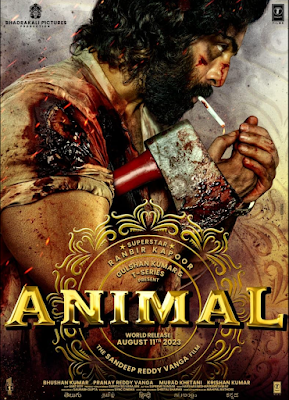
At one point in Animal, a stark naked Ranvijay Balbir Singh (Ranbir Kapoor in his nth role as a man-child) steps out of his mansion to stroll around the compound. (Don’t get too excited, his body is blurred out.) His team of male bodyguards first gawp at his nude frame, then a frisson of joy runs through them and they raise their guns in the air to let out several volleys of celebratory fire. This goes on till Ranvijay’s Daddy (Anil Kapoor) comes running out of the house to lead him away. The exhibitionism, it turns out, was in honour of a happy turn of events I won’t detail here. Beta, says Dad, I know you want to celebrate, but this is not the way. 


I cannot remember the last time the gifted veteran actor’s dialogue delivery was this strained and this unintentionally comical. Can’t blame him alone. That scene is so ridiculous, the phallic symbolism so in-your-face, the attempt at profoundness so laughable, and the sum and substance of the episode so juvenile that I burst out laughing. 


Ranvijay is fixated on his nether regions throughout Animal. He keeps drawing attention to the area by either pointing at his crotch or baring it or talking about it or griping about his underwear. In one scene, he speaks of both his “penis” and “anus” – his choice of words, not mine. It is all meant to be very very cool.


Animal is directed by Sandeep Reddy Vanga who debuted with Arjun Reddy (Telugu, 2017), and remade it in Hindi as Kabir Singh (2019). Animal – edited by Vanga and co-written by him with Pranay Reddy Vanga, Suresh Bandaru and Saurabh Gupta – seems bent on enraging those who slammed his earlier works. That goal is evident throughout this boring, blood-spattered film – in Ranvijay’s bizarre remarks and deeds, the all-pervasive violence, misogyny and gore. 


So that’s 3 hours and 21 minutes of revenge against those who criticise misogynistic cinema. 201 minutes of a desperate desire to shock and/or offend. 


Don’t be deceived into considering it mindless though. Bloodshed and immaturity may rage across Animal, but make no mistake about this: the film is steeped in messaging about victimhood – male victimhood and an allusion to the majority community too. 


Vanga’s film is a painfully long account of a boy longing for his father’s love. The said Dad is the industrialist Balbir Singh who has no time for his children. His neglect translates into anti-social behaviour and obnoxious cockiness only in Ranvijay who becomes an obsessive son and entitled lover, while his sisters somehow grow into women who don’t resent or bash up all and sundry.
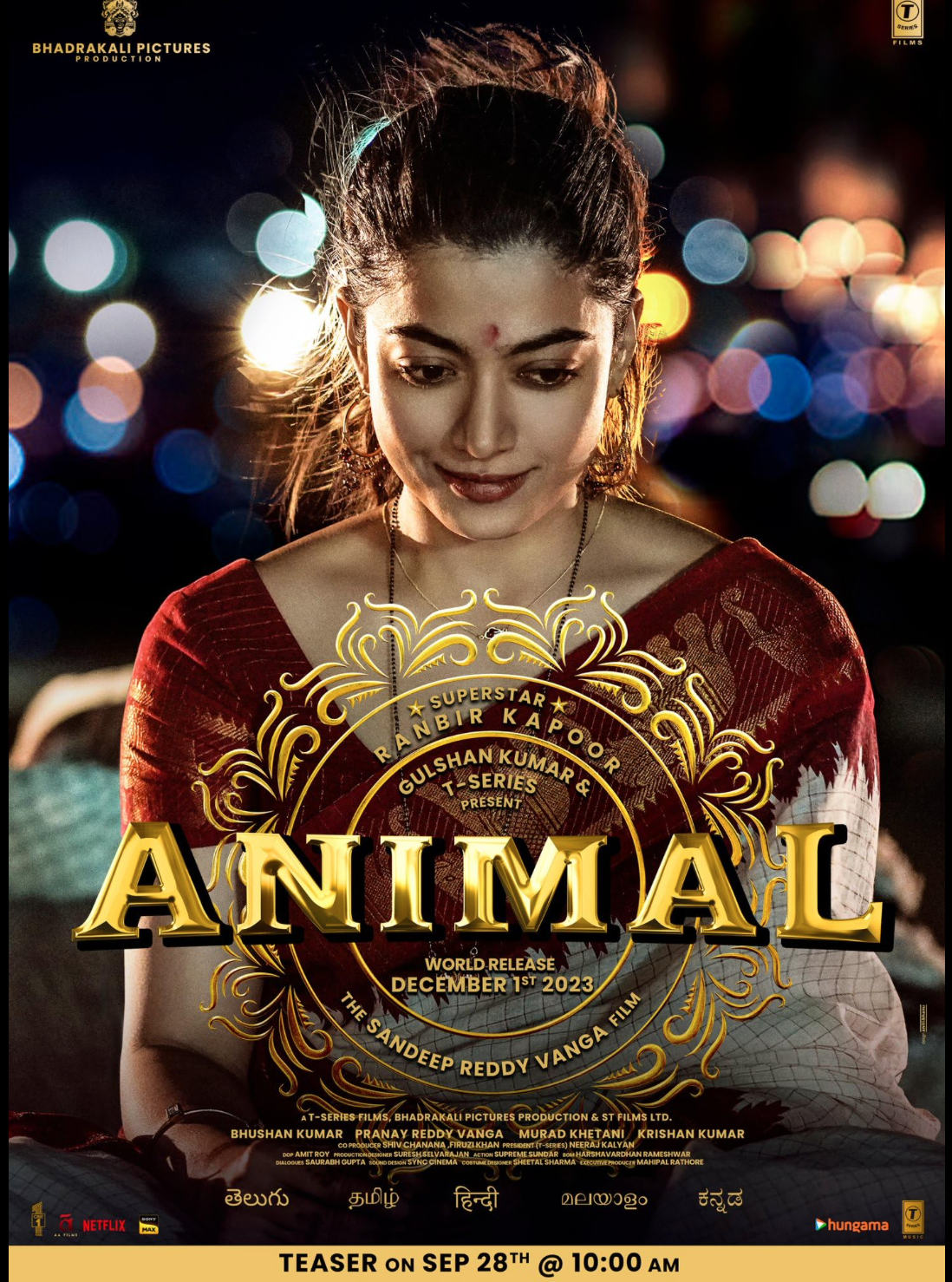
 

Daddy issues have been the subject of numerous films. The re-release of the iconic Malayalam film Spadikam this February, 28 years after its initial run, was a troubling reminder that male-dominated industries have for decades used paternal rejection to justify and normalise male violence, including a hero beating up a female romantic partner or spouse. Spadikam’s protagonist (Mohanlal) was an anguished soul who repeatedly struck his lover (Urvashi), but it was all portrayed as no big deal. In Animal, Ranvijay is aggressive with his wife Geetanjali (Rashmika Mandanna), going so far as to injure and scar her in an extended scene of violence, but it is all insidiously presented with deftly camouflaged empathy – for him. 


For the zillionth time, let me pre-empt the clichéd question that always comes from defenders of such cinema: violent men do exist in the real world and a violent man can certainly be the central character in a film – the issue here, as always, is the manner of the portrayal, the script’s indulgence towards him, the humour and coolth written into his fictional character, and the various means used to give him an allure despite his violent ways.


The strategised depiction of Ranvijay and his arch enemy Abrar (Bobby Deol) – arriving late in the second half – illustrates how the difference between a film’s gaze on two equally violent characters is used to steer audience reactions to them. Both commit horrifying acts, both treat women terribly, yet there is never a doubt about who is the hero or with whom the director wants our sympathies to lie. Animal may call itself Animal with reference to Ranvijay, yet his animalism is preceded by scene after scene dwelling on his childhood pain, his protective brotherly conduct, his aversion to sexual harassment, his advocacy of marital fidelity and so on, thus establishing him as a traumatised man with innate goodness. By the time his beastly side is exposed, a point has been firmly made that everything he does that is seemingly wrong is in fact done for the greater good. In contrast, the only Abrar we get to know is the brute who kills, rapes and terrorises. 


For good measure, Abrar’s Muslimness is underlined by pointedly mentioning his family’s conversion to Islam. 


If Ranvijay rips up human flesh, it is to avenge an attack on his father. If Ranvijay cheats on his wife (mind you, after lecturing other men when they cheat on their wives), he does it for a noble cause. Poor misunderstood Ranvijay had sex only to save his family, you know. 


Ranvijay assaults Geetanjali and a defence is woven into the script. He proposes that just as there is a first kiss and a first time having sex in a relationship, so also there should be a first slap. And guess who gets slapped first? 


Sigh. Poor misunderstood, suffering, victimised Ranvijay.


Poor Ranvijay who has a solitary wife, and is up against evil, brutal Abrar with three wives. 
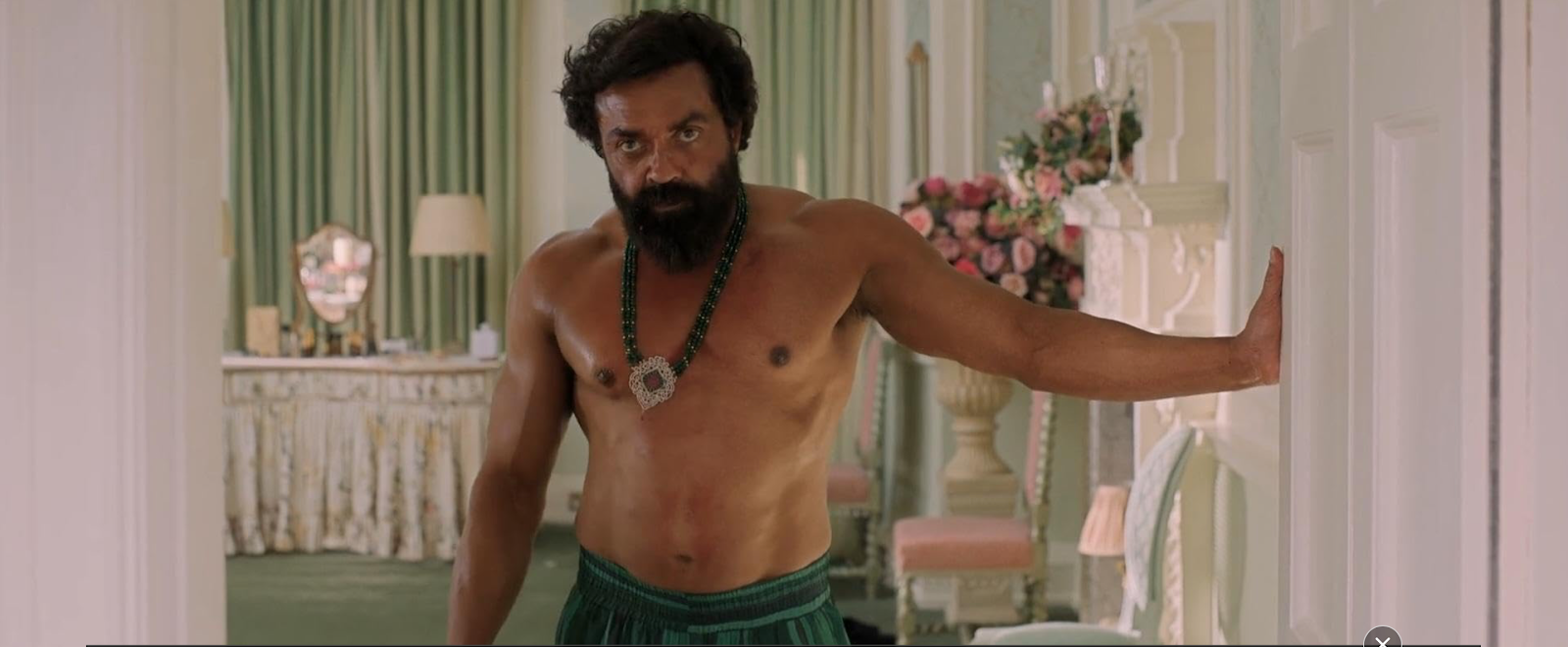
 

Bobby Deol’s Abrar has been shaped in the same mould as Alauddin Khilji from Padmaavat and other fictionalised interpretations of historical Muslim warriors who have dotted Hindi films in the past decade. Abrar eats cake in Animal in the way Padmaavat’s Khilji tore into meat. Abrar tears into his young wife in the way Padmaavat’s Khilji raped his wife. A filthy Abrar barges into a room filled with people and initiates sex with his bride, unmindful of the others’ presence.  


Now contrast this with the mellow tone of the scene in which Ranvijay converses with Geetanjali while examining the bruises he inflicted on her body. 


Note too that the relentless cruelty inflicted by Ranvijay on various people is bookended in this carefully constructed narrative by lengthy scenes emphasising his vulnerable nature. 


So, to circle back to that predictable question, “Violent men do exist, so what’s wrong with a film portraying reality?”, I repeat: yes, violent men do exist in the real world, and the issue here, as always, is the director’s gaze on them and their violence.


Animal brims with an intense dislike of women, outspoken women in particular, and evolved, gentle men. It begins with a derisive use of the word “toxic” in a fable narrated by Ranvijay about a monkey that harassed a princess. The contempt is obviously for the term “toxic masculinity”, popular in the feminist lexicon, that was widely applied to Vanga’s first two films. 


At one point, Ranvijay mocks Geetanjali for complaining because she has to change pads for four days in a month – he claims she complains, we don’t hear her doing so – while he, he tells her, has not complained though his body has been invaded by doctors during a life-threatening situation. Talk about false and stupid equivalences. Periods are a natural bodily function – often horribly painful, always incredibly inconvenient – that every woman bears for every single month of her entire reproductive life lasting for three to four decades. Ranvijay’s condition, on the other hand, is caused by a human aggressor; it is not the biological fate of all men. Here, Ranvijay is a version of misogynists who troll women for using the social media to raise awareness about cramps, excessive bleeding, agonising period pains and the trivialisation of these experiences by society. 


Oddly enough, the determinedly misogynistic Animal writes a feminist element into Ranvijay’s character – he explodes with anger when his brother-in-law roughs up his sister early in the film. There is no progression shown from that scene to his own extreme hostility to his wife. 


Animal’s terrible attitude to women runs alongside a cunning use of India’s religious minorities. 


Abrar and his cohorts are stereotypes diligently being peddled by Hindi cinema to echo the current Islamophobic national discourse. There is even a Muslim man in the picture who is described as a butcher from Istanbul. His sole contribution to Animal is a stomach-churning slaughter of men. 


The Sikhs in Animal are Ranvijay’s brethren and protectors, an extension of a positive stereotype: the fierce, fiercely loyal Sardarji. They are also his allies against Abrar’s marauding gang. All this leads up to a climactic confrontation between shirtless men on an airport tarmac – talk about Hindi film clichés! – in which a kirpan is handed to Ranvijay so that he can wrap up a fight unto death.
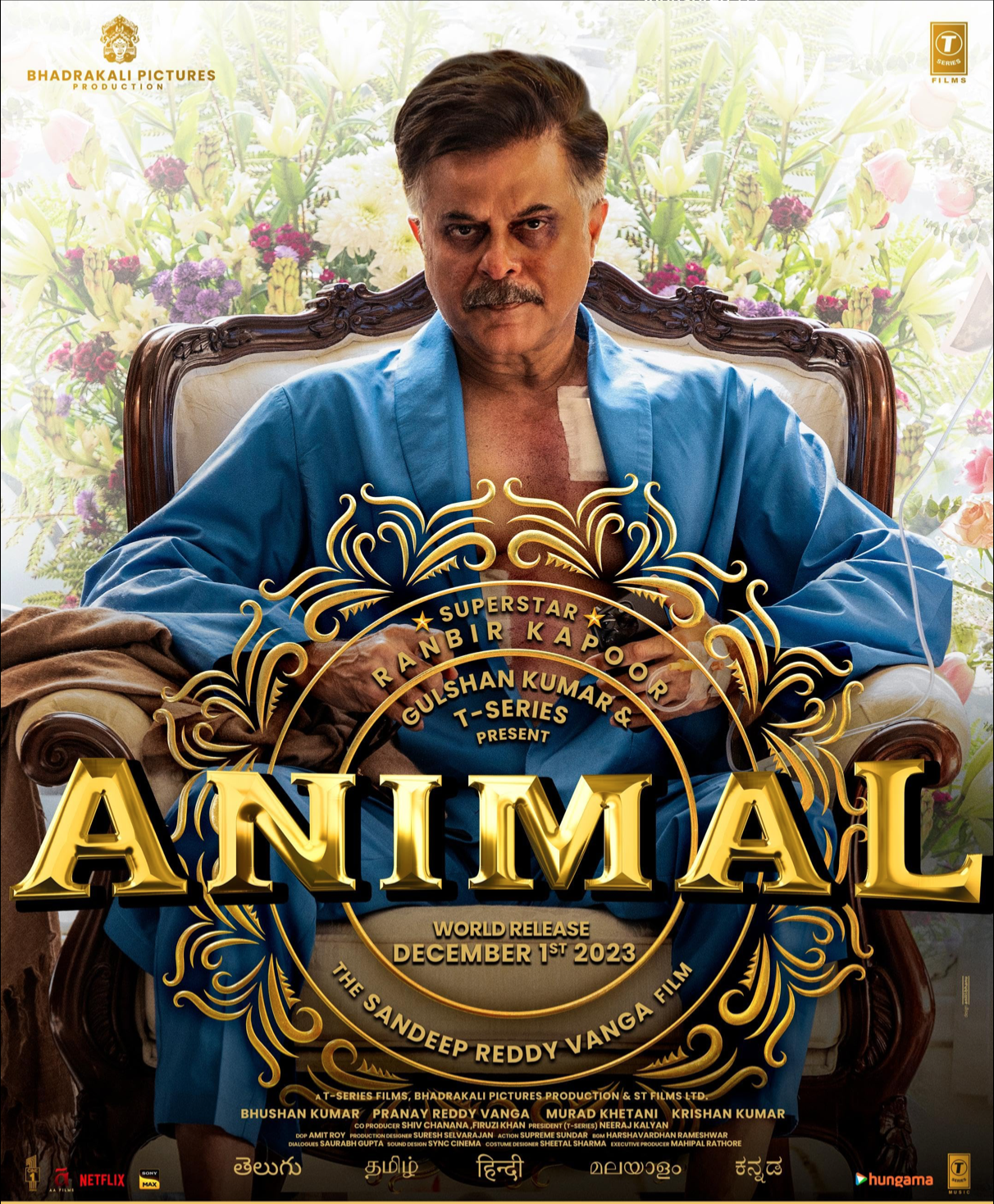
 

A Christian in Animal confuses Balbir Singh’s company logo with the Nazi Swastika. Since prominent Hindu religious symbols are ubiquitous in India, one assumes a Christian was chosen for that episode to play along with right-wing propagandists who project Indian Christians as alien Westerners. Presumably, the idea here is to hint at Hinduism being a globally misunderstood faith. 


Without giving away plot points, I can tell you this much: according to Animal’s underlying philosophy, Sikhs are family and very much in the Hindu fold, Muslims are family that chose the wrong path and are now out to destroy the mother clan, and Christians are the other. 


The mind games played by Animal are packaged in slick production design and cinematography, accompanied by a pulsating sound design, infectious music, and Ranbir’s immersive performance. 


Despite all this, I was bored stiff by the film. 


Startling violence is used here to compensate for a thin, trite storyline. In the first half hour, I was curious about where Vanga would take it, but I spent the remaining 171 minutes stifling yawns at the transparent effort to be disgusting. The camera zooms in on a pulverised human eye. A knife is run back and forth, back and forth, back and forth over a human neck in close-up instead of one swift slash that filmmakers usually favour. 


For the record, Animal is not the most violent film ever made in India. Others have done as bad or worse. It is ugly though – in both its use of violence and in its intent.


Ugly. Hate-filled. Tedious. Self-indulgent. And hawking a loathsome agenda. 


Misogynists insist that feminists hate men, although all that feminists want is gender equality. You know who hates feminist men? Answer: misogynists. You know who hates men in general? Answer: misogynists. I cannot for the life of me imagine a feminist – female or male – ever conceiving a film that makes men look as foolish, puerile, self-pitying and pathetic as Animal does. 


Rating (out of 5 stars): 0   


Running time:

201 minutes 


Poster courtesy: IMDB 

Friday, June 21, 2019

REVIEW 706: KABIR SINGH

Release date:
June 21, 2019
Director:
Sandeep Reddy Vanga
Cast:


Language:
Shahid Kapoor, Kiara Advani, Kamini Kaushal, Suresh Oberoi, Arjan Bajwa, Adil Hussain, Nikita Dutta, Soham Majumdar, Kunal Thakur
Hindi and English with (unsubtitled) Punjabi


It takes almost 50 minutes for the heroine of Kabir Singh to utter her first sentence. “Kabir, what do you like in me?” says this fragile-looking child-woman who was a mute puppet in his hands until then. “I like the way you breathe,” he replies. Ooh, keh diya na dil ko touch kar jaane waali baat!

Okay, my apologies for the flippant tone, but please excuse it as a defence mechanism against one of the most horrific, harrowing, horrendous odes to misogyny and patriarchy ever created by Indian cinema in any language – humourised and romanticised for our viewing pleasure.

Kabir Singh is the Bollywood remake of the 2017 Tollywood blockbuster Arjun Reddy starring Vijay Sai Deverakonda and Shalini Pandey in the roles played in this Hindi version by Shahid Kapoor and Kiara Advani. To call both problematic is an understatement. As I watched Kabir Singh, I could already hear in my head the tired clichés that are rolled out as rebuttals to criticism of such films and are likely to be regurgitated for this one.

“C’mon ya, men like that do exist.”

“Are you saying films should not depict reality?”

“If negative characters could influence people to become bad then how come positive characters do not immediately reform society?”

Or, as Kapoor himself pre-emptively said earlier this week in a newspaper interview: “If we start judging characters, we can’t make movies that are real.”

Oh brother, stop. Please stop. This is exhausting, but for the zillionth time: it is not the depiction of reality that is objectionable here, it is precisely because violent, destructive misogynists do exist and women for centuries have suffered at their hands that it is deeply troubling when a film portrays such a person as cool, funny, and, as Kapoor puts it, a man with “a good heart” who “loves purely” and “wears his emotions on his sleeve”.

Again brother, stop. Stop with the euphemisms, please. Call the Kabir Singhs of the world what they are and show them up for what they are: obnoxious, ugly sociopaths.

Kapoor plays Kabir Rajdhir Singh, an ill-tempered, aggressive albeit academically brilliant medical college student who one day sees a pretty girl on campus and decides she is his. Her name is Preeti Sikka (Kiara Advani) but he does not know that then. They have yet to even have a conversation, but like a dog urinating to mark his territory, Kabir goes to an all-men junior class, announces to the students that they can have their pick of the other women in the college but this one is his woman, and demands that they spread the word on his behalf.

Mind you, all this and everything that comes thereafter (he is a chain-smoking alcoholic and drug taker who descends further into a spiral of substance abuse and sex addiction when he is forcefully separated from Preeti) is depicted in a comical tone and projected as intensity, passion and profound emotion. Every one of the despicable Kabir’s actions is portrayed as the handiwork of a loveable, mad genius. Besides, the heroine who seems initially intimidated by him soon falls in love with him, he treats another woman like meat and she too promptly tells him she loves him, his friends – male and female – adore him, he is popular with the nurses in his hospital on whom he threatens to vent his horniness... I mean, c’mon ya, if so many people are smitten by him he must be having “a good heart”, no?

Judge for yourself the heart so good that Kabir kisses Preeti for the first time while she stands statue-like, having not expressed any interest in him till then, he physically imposes himself on her subsequently too, he orders her around like one might a pet animal that one is fond of, after they have sex for the first time he instructs her in a proprietorial manner to cover up in public, after she falls for him he roughs her up, treats her like shit, repeatedly hits her and tells her she was a nobody in college whose identity rested entirely on her being known as his girl, and worse.

As if none of this was enough, a song titled Tera Ban Jaunga has lyrics that go thus:

Meri raahein tere tak hain

Tujhpe hi toh mera haq hai

(Translation: my path, every path I take, leads to you / I have a right over just you.)

The point about a “right” over a lover is re-asserted in the song Tujhe Kitna Chahne Lage, in which the words go, “Tere ishq pe haan haq mera hi toh hai” (I alone have a right over your love).

From the 1990s, Hindi cinema gradually bade goodbye to the portrayal of violence, molestation and stalking as legitimate forms of courtship. It never went away entirely, but for the most part, if a leading man was a stalker, he was categorically slotted as the villain of the piece as he was in Yash Chopra’s Darr. The romanticisation of stalking and the mistreatment of women while wooing them has made a big comeback this decade, epitomised by Raanjhanaa (2013) and various Salman Khan, Akshay Kumar starrers. Kabir Singh is in the same league: dangerous to the core because it is such a slick production.

For one, it is well acted, especially by Kapoor, Advani (known so far for M.S. Dhoni: The Untold Story, Lust Stories, Bharat Ane Nenu), Arjan Bajwa playing Kabir’s brother and Soham Majumdar in the role of the hero’s best buddy Shiva. Kapoor, in fact, is so good here that it is heart-breaking to see him use his gift thus, to see the spectacular star of Vishal Bhardwaj’s spectacular Haider (2014) descend to this cinematic abomination.

The cast is one of Kabir Singh’s many pluses. The cinematography by Santhana Krishnan Ravichandran is plush, the editing by Aarif Sheikh and Vanga himself is truly slick, and the songs are attractive. That said, those numbers are ruined by the manner in which they are used in the narrative along with the overbearing, ear-splitting background score. The songs are pleasant when heard separately, but they are slammed into the film’s soundscape like whiplashes akin to the screechy effects used in bad Bollywood thrillers to startle the audience.

Most insidious is the writing of Kabir Singh, which uses humour to lull us into an acceptance of its terrible, terrifying hero’s obnoxiousness. As offensive as his patriarchal, misogynistic attitude towards the heroine and other women is the fact that towards the end writer-director-editor Sandeep Vanga seems to be trying to evoke sympathy for him by getting him to tearfully confess that he is an alcoholic. Clearly with this goal in mind, a few bars from the nursery rhyme Twinkle Twinkle Little Star are also woven into the background score – in a silly and tacky fashion, it must be said – when Kabir is dealing with the death of a loved one.

Towards the end, Vanga even seems to be attempting a statement about the limits that supposed democracy places on us when a lawyer says of Kabir that such free-spiritedness in a democracy is not okay. Ah, so being a creep is “free-spiritedness”. Got it.

That line is one of many dialogues in Kabir Singh that are written to sound deep and intellectual, but mean little to nothing especially considering the context in which they are spoken.

The naming of the hero in Vanga’s Hindi remake seems to be a bow to the poet-saint Kabir, and to underline the point, in a voiceover in the opening scene the fellow’s grandmother (Kamini Kaushal) recites one of Kabir’s dohas. I do not know whether to laugh or cry at this desecration of the great man’s writing. Kabir Singh and its Telugu forebear Arjun Reddy must rank among the most disturbing examples of the obsessive stalker hero being glamourised by Indian cinema.

Rating (out of five stars): *

CBFC Rating (India):
A 
Running time:
175 minutes 

This review has also been published on Firstpost:


Poster courtesy: