Showing posts with label Aditi Rao Hydari. Show all posts

Monday, July 6, 2020

REVIEW 784: SUFIYUM SUJATAYUM

Release date:
July 3, 2020
Director:
Naranipuzha Shanavas
Cast:
Aditi Rao Hydari, Dev Mohan, Jayasurya, Siddique, Kalaranjini, Valsala Menon, Hareesh Kanaran, Mammukoya
Language:
Malayalam


This is not the first time star-obsessed India has witnessed such an occurrence, and it is unlikely to be the last. Back in 2008, Kuselan – a Tamil remake of Mollywood’s Katha Parayumpol – was heavily marketed as a Rajinikanth-starrer though the iconic actor only had a cameo in it. Now in 2020, the promotions of Sufiyum Sujatayum have created the impression that Jayasurya, one of the leading lights of contemporary Mollywood, is the film’s male protagonist. Fact: Jayasurya plays a supporting part. He is not the lead. 

Such deceptive marketing might have been partly forgiven if Sufiyum Sujatayum had something worthwhile to offer. It does not. This story of a dance teacher called Sujata in love with a young Sufi at a Muslim shrine in her town is not just superficial in its treatment of inter-community romance and tensions, it is also pretentious and dull. 

Aditi Rao Hydari plays Sujata who happens to be mute. Jayasurya plays the man her father forces her to marry. And first-timer Dev Mohan has been cast as the Sufi. 

Writer-director Naranipuzha Shanavas uses silences, close-ups of Sujata’s delicate face and feet, religious chants and mood cinematography as a substitute for writing depth. The first half of Sufiyum Sujatayum takes too long to establish the heroine’s love story. The second half wanders too long before taking us to an interesting twist involving a graveyard in the final half hour, but Shanavas squanders that plot development when he immediately circles back to the unexciting relationship between Sujata and the Sufi.

Frankly, that pre-climactic twist by itself had the potential to be expanded into a brilliant socio-political satire on Hindu-Muslim strife in today’s India, but Shanavas clearly failed to recognise his own clever idea. What he gives us then is a listless, unremarkable film.

Although the credits feature a bunch of respected character artistes, no one stands out since no one’s talent is put to great use. Dev Mohan is given little to do beyond look pretty and occasionally, briefly whirl as dervishes do. It is a measure of Jayasurya’s charisma that although his character is mostly confined to the second half, he still manages to leave a stronger impression than the lead pair. 

As for Rao Hydari, she fails to live up to the hype generated around her in the run-up to this release. The marketing team’s decision to tomtom Sufiyum Sujatayum as her “return to Malayalam cinema after 14 years” is almost embarrassing for two reasons: first, because her role (on debut) in the Mammootty-starrer Prajapathi in 2006 was minuscule, clichéd, unmemorable and insignificant; and second, because since then she has spent most of her career in Bollywood where she has struggled to make an impact. Despite the promise she showed in Yeh Saali Zindagi (2011) and London, Paris, New York (2012), she has packed her CV largely with Hindi films in which she has barely had anything to do beyond look sweet and fragile on the sidelines while men go about their business. 

Don’t get me wrong: Rao Hydari is good-looking, moves with dancerly grace, and if the aforementioned Hindi films are a barometer, is a capable actor. But the problematic marketing of Sufiyum Sujatayum has ended up drawing attention to the faults in her filmography that make it hard to assess this performance. You see, her characters in most of her Hindi films have hardly had any spoken lines (for one, watch Wazir); as a result – and this is the harsh truth – when she plays a mute woman in Sufiyum Sujatayum, in terms of acting she is not actually doing anything vastly different from her earlier work. Yes, Sujata sometimes resorts to sign language, but Shanavas uses that aspect of her more for the visual appeal of the actor’s attractive, fluid hand movements than as a building block in what could have been a complex character.

Apart from its soulful music and overall prettiness, one of the nice touches in Sufiyum Sujatayum is the way languages other than Malayalam are woven into stray dialogues to indicate the somewhat cosmopolitan nature of the town in which the story is set; it is also nice that the subtitler lets us know when a character has spoken a non-Malayalam tongue. However, considering that the main characters all converse with each other in Malayalam, there is something odd about the way a couple of lines from a Hindi song run in the background out of the blue when Sujata experiences heartbreak, and Hindi lyrics pop up again with the end credits – the switch in language makes no sense here, it has no contextual relevance, but it places Shanavas in an expanding club of Malayalam filmmakers who seem to think Hindi is a signifier of coolth, in the way Hindi filmmakers once viewed English. The only contemporary Malayalam director who has been able to pull this off without any logic to support his choice is Lijo Jose Pellissery when he slipped Do Naina into Angamaly Diaries – it worked perhaps because the scene in question was overall so beautifully constructed. Not so in Sufiyum Sujatayum. 

Kerala may seem like an idyll of communal harmony when compared to the tattered social fabric of north India in 2020, but the troubling reality is that all is not well between communities in the state popularly described as God’s Own Country. Sufiyum Sujatayum was an opportunity to dwell on the opposition to Hindu-Muslim marriages in Malayali society, a theme that was so sensitively handled by another Shanavas – director Shanavas K. Bavakutty – in the terrific Kismath in 2016. Instead, Naranipuzha Shanavas devotes himself to the spectacle he is trying to create in Sufiyum Sujatayum, and just about skims the surface of his chosen theme. 

Rating (out of 5 stars): 1.5

Sufiyum Sujatayum is streaming on Amazon Prime Video India.

Running time:
122 minutes

This review has also been published on Firstpost:


Poster courtesy: IMDB

Friday, April 27, 2018

REVIEW 593: DAAS DEV


Release date:
April 27, 2018
Director:
Sudhir Mishra
Cast:


Language:
Rahul Bhat, Richa Chadha, Aditi Rao Hydari, Saurabh Shukla, Vipin Sharma, Dalip Tahil, Deepraj Rana, Anil George, Sohaila Kapur, Vineet Kumar Singh, Anurag Kashyap
Hindi


Text flashed on screen before the first scene rolls lets on that this film is inspired by both Sarat Chandra Chattopadhyay’s novella Devdas, arguably the most adapted home-grown literary work in Indian cinema, and William Shakespeare’s Hamlet. What common ground could there possibly be between the story of a weak-willed Bengali aristocrat drowning his unconsummated love in alcohol, and a Danish prince drowning in a desire for revenge against his scheming uncle and allegedly traitorous mother? What meeting point is there between a spineless fellow who wept at a fate he could have fashioned if he had had the courage to defy his convention-ridden, classist parents, and another so single-minded in his quest for vendetta that he let everything else in his life slip away as a result?

The answer is quite simple, actually: it lies in the self-destructiveness of both Hamlet and Devdas. In merging these two characters and turning each on its head in the end, Sudhir Mishra has conducted one of the most exciting writing experiments seen in a while for the Hindi film screen. The writer-director’s protagonist Dev Pratap Chauhan (played by Rahul Bhat) is melancholy like the legendary fictional men on whom he is based, but is not fatalistic like the foolish – and frankly, boring – Devdas, nor quite as mentally muddled as Hamlet.

Mishra’s Daas Dev might have been phenomenal then if its women characters – based on the Paro, Chandramukhi and Queen Gertrude prototypes – had been written as well as the leading man. Sadly, they are not.

Daas Dev is set in the political badlands of Uttar Pradesh where, in the opening scene in 1997, we see Dev’s father, the charismatic star politician Vishambhar Pratap Chauhan’s very public and untimely death before his little son’s eyes. Twenty years later, the boy is now a drug addict, an alcoholic and a laggard, in love with his childhood friend Paro (Richa Chadha), daughter of his late father’s right hand man Naval Singh (Anil George) who has been politically exiled by Dev’s uncle Awdesh Pratap Chauhan (Saurabh Shukla).

The Chauhan family wealth is managed by Shrikant Sahay (Dalip Tahil) and his Woman Friday cum fixer-about-town Chandni Mehra (Aditi Rao Hydari) who is in love with Dev. She watches over him through his tumultuous relationships, his desperate attempt to recover from his substance abuse and his journey from indifference to interest in politics, knowing that he does not reciprocate her feelings for him.

The first half hour of Daas Dev is intriguing. Chandni is the narrator, the one who has watched and seen more than anyone realises. Oddly enough though, she is completely marginalised halfway through the storyline, so that what remains of her in memory now is not her strength but Hydari’s flawless back to which Mishra has paid considerably greater attention than to the writing of her character.

Paro and Chandramukhi were far more appealing people than Devdas in the original text. The screenplay by Mishra and Jaydeep Sarkar does wonderful things to the main man but seems not to know what to do with these two strong women. Richa Chadha still manages to lend some spark to Paro, but Hydari seems unable to rise above her exquisite looks to invest herself in Chandni. More than ever, her limp performance made me long for Madhuri Dixit’s firecracker of a Chandramukhi in Sanjay Leela Bhansali’s 2002 extravaganza Devdas.

As for Gertrude, in this case Dev’s mother Sushila Devi (Sohaila Kapur) – she exists on the sidelines for so long that even the wonderful Kapur’s speaking eyes cannot save her from being anything other than a sidelight, albeit one who eventually turns out to be pivotal to the plot.

The men are better served by the writing, and some of them return the favour with gusto. Rahul Bhat has the remarkable ability to look bruised, damaged and torn when he gets into a character. His Dev, who is a slave (daas) of his own weaknesses until he finds his life’s purpose, is a beautifully broken fellow, still mourning the loss of a beloved father he idolised and deriving his earnestness towards politics from the memory of that idealistic man. Bhat gives his character both vulnerability and strength, making you wonder why we see him so rarely on the big screen and why he is so vastly underrated.

DoP Sachin K. Krishn’s use of darkness and shadows in Daas Dev enhances the air of intrigue in the plot and is especially dramatic around Dev. There are shots in which his face is completely black, his reactions therefore inscrutable if it weren’t for the actor’s body language.

Vipin Sharma playing a wily politician is fantastic as always, as is Saurabh Shukla. Producer-director-writer Anurag Kashyap makes a short but impactful appearance as Vishambhar, giving us yet another reminder – after 2016’s Akira – that he is an under-explored actor. Vineet Kumar Singh, who was astonishingly good on his debut as a lead earlier this year in Kashyap’s Mukkabaaz, is impressive in a brief role as a man in love with Paro.

The uneven characterisation apart, the plot too unfolds in a series of twists and turns that, though not unconvincing, play out in a narrative style that feels by now too familiar in the mould of films made by Prakash Jha, Kashyap and Mishra himself.

Someone on the team of Daas Dev seems to have assumed that you can compensate for inconsistent writing with an unrelenting soundtrack. Although several of the songs in Daas Dev are quite lovely (in particular Sehmi hai dhadkan composed by Vipin Patwa, Rangdaari by Arko and Challa chaap chunariya by Sandesh Shandilya) there are just too many musical interludes in the film, and the songs and background score are played too much and too loud so that at one point when a character snapped, “Can you shut off that damned song?” for a moment I thought someone in the audience had called out those words because the music had gotten so overbearing by then.

It is surprising that writing would be the Achilles heel of a film by Mishra, the man who co-wrote the screenplay of Kundan Shah’s cult classic Jaane Bhi Do Yaaro, but that is the way the cookie crumbles in Daas Dev. When Mishra released Yeh Saali Zindagi in 2011, I remember writing that that film felt over-crowded with characters and complications. Ditto for this one. A Devdas-cum-Hamlet story still feels like it is worth a shot, perhaps even another shot by Mishra, but this one fails to live up to its promise  despite an excellent central performance and an unusual interpretation of two iconic literary characters.

Rating (out of five stars): *1/2

CBFC Rating (India):
UA
Running time:
140 minutes 

A version of this review has also been published on Firstpost:


Friday, August 5, 2016

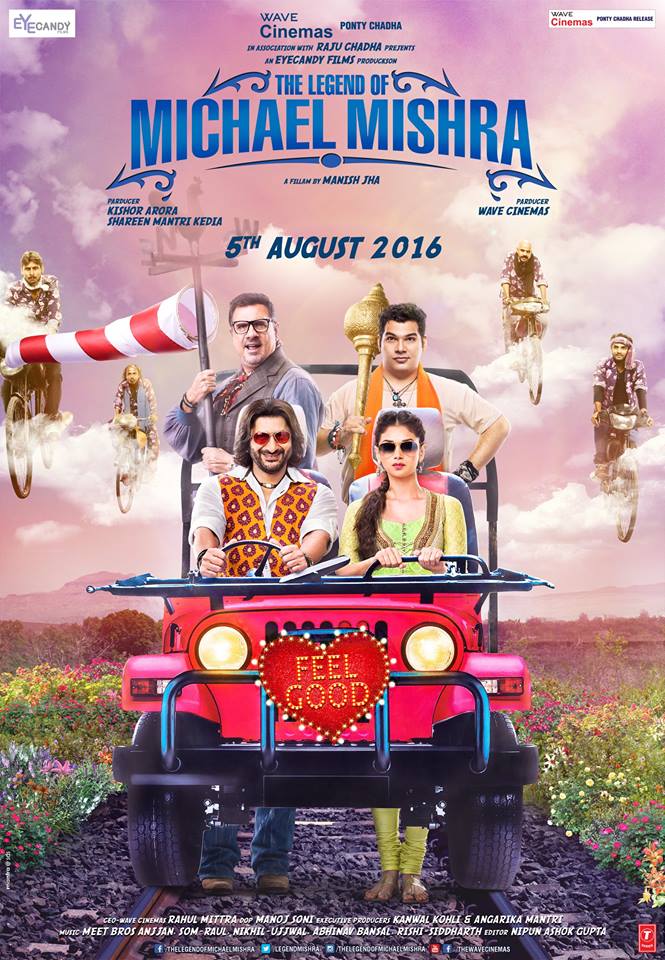
REVIEW 412: THE LEGEND OF MICHAEL MISHRA


Release date:
August 5, 2016
Director:
Manish Jha
Cast:

Language:
Arshad Warsi, Boman Irani, Aditi Rao Hydari, Kayoze Irani
Hindi


The word “quirky” was perhaps floating about in director Manish Jha’s head while he conceived and created this film. Two words, actually: “quirky” and “kitsch”.

Everything about this Bollywood film screams out the team’s effort to be both. It is neither.

The Legend of Michael Mishra (LOMM) starring Arshad Warsi and Boman Irani is about a hooligan/gangster whose ambitions and career are entirely shaped by his life-long quest for the girl he fell in love with – and lost – as a child. Their paths cross again as adults through a hare-brained set of circumstances that make Sajid Khan’s films seem well thought out.

He decides to become a better man for her, while she takes off to Mumbai to become an actress. Through another hare-brained set of circumstances, they meet again. There is a not-so-bad twist in the end, but by then LOMM is a lost cause. Watching this 124-minutes-and-5-seconds-long effort to be adorable, edgy and funny is a tiring, energy-sapping experience.

You can accuse many contemporary Bollywood comedies of being illogical and over the top, but there is something far far worse than that. LOMM is under the top – so under that it appears to be mining the earth for a new low in tedium.

The film opens with a build-up to Michael Mishra’s supposedly legendary status. Road signs mark the route to a dhaba that bears his name. A bus stops, and we finally see this rather large, brightly coloured eatery. A pretty white tourist is anxious to hear Michael’s story despite the cynicism of an academic in their group. The dhaba manager (Boman Irani) obliges and we are introduced to a petty crook who encounters a little girl dancing under a tree and falls in love.

Drum rolls, please. You have just met young Michael Mishra and little Varsha Shukla.

You know you have a problem on your hands when the director seems not to have spotted the icky touch that the casting lends to that scene. The boy is played by actor Mohit Balchandani who has a relatively very mature face in comparison with actress Gracevera Kaur, who plays Varsha, and looks 10-12 years old. Shudder. Still, we are informed that they are both children, so we must believe it. (See postscript) They are separated, and a grown-up Michael (Warsi) spends many years searching for her. He finally spots a grown-up Varsha (Aditi Rao Hydari) at a contest called Bihar Is Full of Talent, singing a song in horribly wrong English. There is some potential there, but someone involved seems to have decided that the mere mention of Bihar and the use of poor grammar in that scene is enough to get laughs through the rest of the film. It is not.

Michael then sets out to court Varsha with the cooperation of his gang (played by a bunch of really bad, uninvolved, unenthusiastic actors) and his sidekick named Half Pant (Kayoze Irani). Much blah later, they are – spoiler alert – united in love. 

Even the presence of Warsi in the film makes no difference to its pace or appeal. The Legend of Michael Mishra is flat from start to finish, and one of Bollywood’s most charming actors can do nothing to save it. The script is daft, to say the very least. It boggles the mind that it took five writers to come up with this nothingness (credits: story – Jha himself, Radhakrishnan and Sneha Nihalani, dialogues – Anshuman Chaturvedi, additional screenplay – Vijay Kapoor).

Besides, Warsi and Hydari are terribly mismatched, not just because of the obvious age gap, but because there is no spark between them. None. Zero. Zilch. Shunya. It is sad to see Hydari – she who played Rama Bua in Rakeysh Omprakash Mehra’s Delhi-6 (2009), a gangsta’s dynamite of a wife in Sudhir Mishra’s Yeh Saali Zindagi (2011) and the heroine in Anu Menon’s sweetly likeable London, Paris, New York (2012) – reduced to this.

Sadder still is the memory of Manish Jha’s early promise. The spotlight first fell on Jha over a decade back when his short, A Very Very Silent Film, won a prize at the Cannes Film Festival. This was followed by critical acclaim for the feature film Matrubhoomi – A Nation Without Women which, ideologically debatable though it may be, displayed commitment to his chosen genre and his concerns about female infanticide.

As the great philosopher Barney Stinson once said…

Okay, I tried to keep a straight face for that sentence but could not. Revise that: as Barney Stinson from the hit American sitcom How I Met Your Mother might have said, you cannot use the word “legend” lightly. There is a big distance between trying to be clever and being clever. If you fail to bridge that distance, you have a disaster on your hands. If you fail to bridge that distance but do not even realise it, and instead present the end product for public viewing, the result is cringe-worthy. Such as that scene in this film in which Michael saves his jailor from almost certain death, and they are later shown seated on a rocky hillock in the twilight with the said jailor playing what sounds like Elvis Presley’s Can’t help falling in love with you on his harmonica. Was that scene intentionally referencing Sholay? Was that a Jai-Veeru moment with a homosexual overtone? Was it meant to be humorous, moving or deep? Clearly Jha was trying to make some sort of a cool, smart-alec point there, but who knows what it is.

The Legend of Michael Mishra, just like the non-existent chemistry between its lead couple, is a big naught.

Postscript: After writing this review, I checked with the team of the film and learnt that Gracevera Kaur is 13 while Mohit Balchandani is 20. What was the director thinking while casting a minor with a child-like face as the romantic interest of an evidently adult male, in a film that is not about paedophilia? Or was he not thinking at all?

Rating (out of five): 0 stars

CBFC Rating (India):
U
Running time:
124 minutes and 5 seconds 

This review has also been published on Firstpost: