Showing posts with label Anil Kapoor. Show all posts

Sunday, January 28, 2024

REVIEW 792: FIGHTER

Release date:

January 25, 2024

Director:

Siddharth Anand 

Cast:

Hrithik Roshan, Deepika Padukone, Anil Kapoor, Karan Singh Grover, Akshay Oberoi, Ashutosh Rana 

Language:

Hindi 


“PoK ka matlab hai Pakistan Occupied Kashmir. Tumne occupy kiya hai. Maalik hum hai (PoK stands for Pakistan Occupied Kashmir. You have occupied it. But we are the actual owners),” says Hrithik Roshan’s character in the midst of raging fisticuffs with a Pakistani terrorist in the new Hindi film Fighter


For the record, the dictionary defines maalik as: owner, master, lord, proprietor, husband. In the subtitles given in the trailer, the producers opt for “owner”. 


“We are the actual owners.” Never before has a Hindi film spelt out its proprietorial attitude towards Kashmir in such black-and-white terms.


Director Siddharth Anand’s Fighter – based on a story by Anand and Ramon Chhib, with a  screenplay by Chhib and dialogues by Hussain Dalal and Abbas Dalal – pretends to be a romance, the saga of an Indian Air Force (IAF) officer whose over-confidence cost him the life of someone dear to him as a result of which he denies himself the right to love and be loved again. Behind that emotive, humane camouflage though, Fighter is just another loud, jingoistic affair in which India and Pakistan battle over Kashmir while the voices of Kashmiris are entirely erased. 


That’s precisely what 2023’s Shah Rukh Khan starrer Pathaan (2023) did too, so what’s new with Fighter, you may ask? 


Not very much. For one, this abhorrent line on ownership in Fighter is delivered by an A-list star who has not overtly aligned himself with BJP-RSS off screen in the way so many of his Hindi film colleagues have. Pathaan played it safer on this front, to create the false impression of being a progressive film (read my review here) although it was just old wine in a bottle of deceptive dialogues, insidious and intentional ambiguity about the religious identity of the protagonist and the primary antagonist, cleverly disguised pandering to majoritarian sentiments and SRK’s charm. 


Second, Fighter is pegged on actual news developments: the suicide bombing in Jammu and Kashmir’s Pulwama district in 2019 that killed 40 members of the Central Reserve Police (CRPF), and the IAF’s retaliatory air strike on an alleged terrorist training camp in Balakot, Pakistan.


In tenor and spirit nevertheless, Fighter really does feel like Pathaan 2, while Pathaan itself felt like War 2. That Pathaanand War (2019) were also directed by Anand is no coincidence. Reminder: Roshan was the co-lead in War, which might have been nothing more than a noisy, slick action flick if it weren’t for its condescension towards the Muslim patriot played by Tiger Shroff.


In Fighter, Roshan is Shamsher Pathania a.k.a. Patty, an ace fighter pilot who is in the bad books of his boss (Anil Kapoor). The latter believes Patty is prone to prioritising personal glory over the interests of his team. Patty is part of a crack team of IAF pilots that includes Minal Rathore (Deepika Padukone) a.k.a. Mini. Obviously these two are drawn together like magnet to metal, but Patty’s past keeps him from openly expressing his feelings for her. 


In Chapter 1 we get hackneyed introductory scenes stressing Roshan’s sexiness in a white towel and in pilot’s uniform, and Padukone’s sexiness in uniform, followed by extensive passages of bonhomie between all the members of Patty and Mini’s team. There’s light-hearted teasing, songs, a couple gazing at each other across a space filled with people while music plays in the background, incremental revelations about the enigmatic hero’s painful back story that, as it turns out, lacks novelty, and other familiar elements that are often used in Indian films to superficially establish a sense of fraternity and a pivotal romance. In the background is the Pakistan government and a deadly terrorist – a snarling chap with a bloody red eye called Azhar Akhtar (Rishabh Sawhney) – who they recruit to target Kashmir.


Chapter 2 deals with Pulwama and Balakot. 


Despite the hyperbolic cartoonishness of Azhar Akhtar and the blatant cover-up that Fighter pulls off on behalf of the Indian government in Pulwama, despite the surfeit of clichés and decibels, the film until this point is carried on the shoulders of Roshan’s good looks, the sparks between him and Padukone, Satchith Paulose’s exquisite cinematography in stunning locales, the adrenaline high that comes from watching pilots in combat in skilfully executed action scenes and the sadness of knowing that those CRPF jawans were indeed murdered in real life. 


None of this is enough though to save Chapter 3 from its deafening volume, silliness, unoriginal storytelling, formulaic characterisation, inexorable length and the lies that begin in Chapter 2. 


First let’s deal with the cover-up. When the Pulwama terror strike occurred, corporate-owned news media largely avoided asking the obvious questions raised by the public on social media and some experts regarding the massive intelligence failure involved. Many have even ignored the statements by Satyapal Malik who was Jammu and Kashmir’s governor at the time of the Pulwama attack – Malik has said at multiple forums that the attack resulted from the incompetence” of the Indian establishment, the Union Home Ministry in particular, and the CRPF, while also calling out the Prime Minister himself for his response. 


Obviously, Fighter does not have the guts to show any of this. Like every government-pleasing Hindi film since 2014, Fighter is disinterested in introspection, fixated on chest-thumping and backs the position that all acts of courage and all innovation in India have been initiated in the past 10 years. Mirroring the bombast of Uri: The Surgical Strike’s “Hindustan ab chup nahi baithega. Yeh naya Hindustan hai. Yeh ghar mein ghusega bhi, aur maarega bhi (India will no longer remain silent. This is a new India – it will not only enter your house, but it will kill you there),” in Fighter we get a politician, one assumes the PM, surveying the coffins of dead CRPF jawans and saying: “Picchle pachaas saalon mein kisi sarkar ne unki inn harkaton ka muh-thod jawaab nahin diya. Lekin ab bas. Unhe dikhana padega ke baap kaun hai (For the past 50 years, no government has given them a befitting reply. But now…enough. It’s time to show them who’s the boss).” 


Fighter kills whatever emotional resonance it had until the Balakot episode by following it up with endless screaming, ridiculously conceived confrontations between the IAF and Pakistani terrorists, and dialoguebaazi that peaks with the “maalik hum hai” line and Patty yelling a threat at the top of his voice that India will turn Pakistan into – wait for it, it’s every aggressive nationalist’s wet dream – “India Occupied Pakistan”. It’s not that Hindi filmdom is incapable of delivering credible battlefield sequences involving India and Pakistan. For a recent example within the commercial Hindi space, refer to Vishnu Varadhan’s Shershaah starring Siddharth Malhotra. 


In this segment, the sole Muslim on Patty and Mini’s team, Basheer Khan (Akshay Oberoi), has that inevitable conversation about Islam with a terrorist that has by now been made mandatory for loyal-to-the-vatan Muslims in propagandist Hindi films. 


And in the end, Fighter trivialises itself with a steaming hot song ‘n’ dance by the sea that has zero connect with the flavour of the rest of the narrative. Yes of course all those body-baring outfits on Roshan and Padukone are titillating, but the entire package is too imitative to be impactful and is anyway terribly out of place in a film in which it was preceded by bloodshed, a beloved character’s mutilated body and immeasurable heartbreak. In fact, the inclusion of this song, Ishq Jaisa Kuchh, indicates a lack of commitment on the part of the filmmaker to his chosen theme. 


Like the entire ensemble cast, Roshan’s acting in Fighter is as okay as it can be in such a film, barring a scene in which, while shouting something like “Main aa raha hoon” in a life-and-death situation, he adopts a trademark tone reminiscent of his character in Koi... Mil Gaya – a tone that few directors have managed to completely control in his dialogue delivery. 


Padukone does better but make no mistake about this: she plays an ordinarily written supporting character who ultimately amounts to little more than the leading man’s romantic sidekick and sensual drapery, in a film designed as a showcase for Roshan. 


Uri was dangerous because it peddled its agenda with a blend of originality, finesse and craft. WarPathaan and Fighter are recycled versions of each other and of the entire multitude of war-mongering deshbhakt films of the present era. Fighter actually has some good things going for it to begin with, but gradually squanders those positives by resorting to lazy storytelling to fulfil its agenda. Yawn.


Rating (out of 5 stars): 2   


Running time:

167 minutes 


Visuals courtesy: IMDB 

Wednesday, December 6, 2023

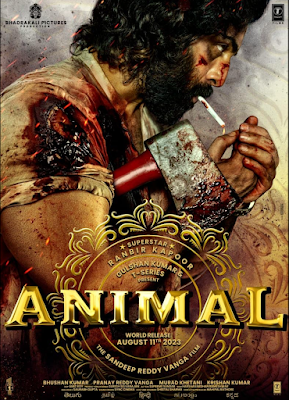
REVIEW 787: ANIMAL

Release date:

December 1, 2023

Director:

Sandeep Reddy Vanga

Cast:

Ranbir Kapoor, Rashmika Mandanna, Anil Kapoor, Bobby Deol, Tripti Dimri, Upendra Limaye, Suresh Oberoi, Saloni Batra  

Language:

Hindi with some English, Punjabi, Marathi etc 


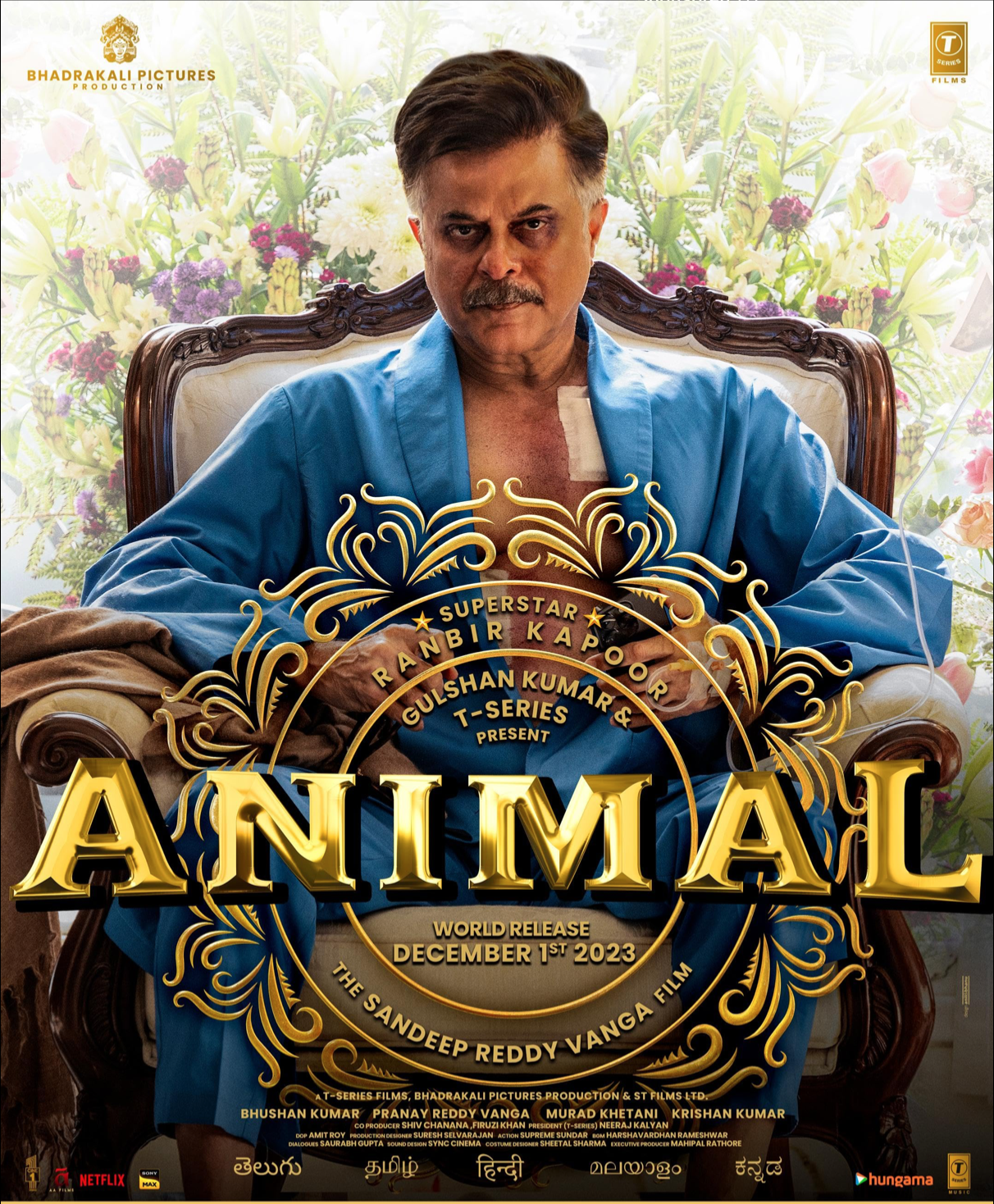
At one point in Animal, a stark naked Ranvijay Balbir Singh (Ranbir Kapoor in his nth role as a man-child) steps out of his mansion to stroll around the compound. (Don’t get too excited, his body is blurred out.) His team of male bodyguards first gawp at his nude frame, then a frisson of joy runs through them and they raise their guns in the air to let out several volleys of celebratory fire. This goes on till Ranvijay’s Daddy (Anil Kapoor) comes running out of the house to lead him away. The exhibitionism, it turns out, was in honour of a happy turn of events I won’t detail here. Beta, says Dad, I know you want to celebrate, but this is not the way. 


I cannot remember the last time the gifted veteran actor’s dialogue delivery was this strained and this unintentionally comical. Can’t blame him alone. That scene is so ridiculous, the phallic symbolism so in-your-face, the attempt at profoundness so laughable, and the sum and substance of the episode so juvenile that I burst out laughing. 


Ranvijay is fixated on his nether regions throughout Animal. He keeps drawing attention to the area by either pointing at his crotch or baring it or talking about it or griping about his underwear. In one scene, he speaks of both his “penis” and “anus” – his choice of words, not mine. It is all meant to be very very cool.


Animal is directed by Sandeep Reddy Vanga who debuted with Arjun Reddy (Telugu, 2017), and remade it in Hindi as Kabir Singh (2019). Animal – edited by Vanga and co-written by him with Pranay Reddy Vanga, Suresh Bandaru and Saurabh Gupta – seems bent on enraging those who slammed his earlier works. That goal is evident throughout this boring, blood-spattered film – in Ranvijay’s bizarre remarks and deeds, the all-pervasive violence, misogyny and gore. 


So that’s 3 hours and 21 minutes of revenge against those who criticise misogynistic cinema. 201 minutes of a desperate desire to shock and/or offend. 


Don’t be deceived into considering it mindless though. Bloodshed and immaturity may rage across Animal, but make no mistake about this: the film is steeped in messaging about victimhood – male victimhood and an allusion to the majority community too. 


Vanga’s film is a painfully long account of a boy longing for his father’s love. The said Dad is the industrialist Balbir Singh who has no time for his children. His neglect translates into anti-social behaviour and obnoxious cockiness only in Ranvijay who becomes an obsessive son and entitled lover, while his sisters somehow grow into women who don’t resent or bash up all and sundry.


Daddy issues have been the subject of numerous films. The re-release of the iconic Malayalam film Spadikam this February, 28 years after its initial run, was a troubling reminder that male-dominated industries have for decades used paternal rejection to justify and normalise male violence, including a hero beating up a female romantic partner or spouse. Spadikam’s protagonist (Mohanlal) was an anguished soul who repeatedly struck his lover (Urvashi), but it was all portrayed as no big deal. In Animal, Ranvijay is aggressive with his wife Geetanjali (Rashmika Mandanna), going so far as to injure and scar her in an extended scene of violence, but it is all insidiously presented with deftly camouflaged empathy – for him. 


For the zillionth time, let me pre-empt the clichéd question that always comes from defenders of such cinema: violent men do exist in the real world and a violent man can certainly be the central character in a film – the issue here, as always, is the manner of the portrayal, the script’s indulgence towards him, the humour and coolth written into his fictional character, and the various means used to give him an allure despite his violent ways.


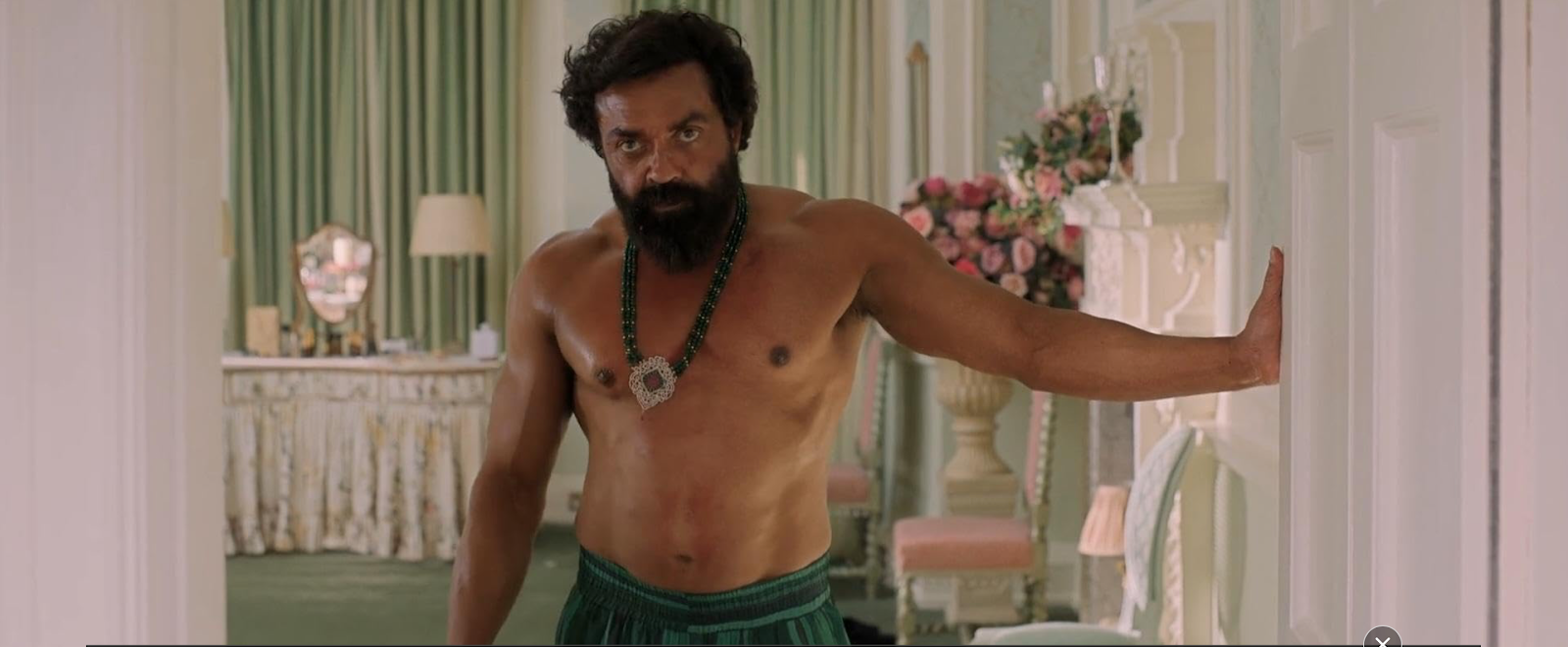
The strategised depiction of Ranvijay and his arch enemy Abrar (Bobby Deol) – arriving late in the second half – illustrates how the difference between a film’s gaze on two equally violent characters is used to steer audience reactions to them. Both commit horrifying acts, both treat women terribly, yet there is never a doubt about who is the hero or with whom the director wants our sympathies to lie. Animal may call itself Animal with reference to Ranvijay, yet his animalism is preceded by scene after scene dwelling on his childhood pain, his protective brotherly conduct, his aversion to sexual harassment, his advocacy of marital fidelity and so on, thus establishing him as a traumatised man with innate goodness. By the time his beastly side is exposed, a point has been firmly made that everything he does that is seemingly wrong is in fact done for the greater good. In contrast, the only Abrar we get to know is the brute who kills, rapes and terrorises. 


For good measure, Abrar’s Muslimness is underlined by pointedly mentioning his family’s conversion to Islam. 


If Ranvijay rips up human flesh, it is to avenge an attack on his father. If Ranvijay cheats on his wife (mind you, after lecturing other men when they cheat on their wives), he does it for a noble cause. Poor misunderstood Ranvijay had sex only to save his family, you know. 


Ranvijay assaults Geetanjali and a defence is woven into the script. He proposes that just as there is a first kiss and a first time having sex in a relationship, so also there should be a first slap. And guess who gets slapped first? 


Sigh. Poor misunderstood, suffering, victimised Ranvijay.


Poor Ranvijay who has a solitary wife, and is up against evil, brutal Abrar with three wives. 


Bobby Deol’s Abrar has been shaped in the same mould as Alauddin Khilji from Padmaavat and other fictionalised interpretations of historical Muslim warriors who have dotted Hindi films in the past decade. Abrar eats cake in Animal in the way Padmaavat’s Khilji tore into meat. Abrar tears into his young wife in the way Padmaavat’s Khilji raped his wife. A filthy Abrar barges into a room filled with people and initiates sex with his bride, unmindful of the others’ presence.  


Now contrast this with the mellow tone of the scene in which Ranvijay converses with Geetanjali while examining the bruises he inflicted on her body. 


Note too that the relentless cruelty inflicted by Ranvijay on various people is bookended in this carefully constructed narrative by lengthy scenes emphasising his vulnerable nature. 


So, to circle back to that predictable question, “Violent men do exist, so what’s wrong with a film portraying reality?”, I repeat: yes, violent men do exist in the real world, and the issue here, as always, is the director’s gaze on them and their violence.


Animal brims with an intense dislike of women, outspoken women in particular, and evolved, gentle men. It begins with a derisive use of the word “toxic” in a fable narrated by Ranvijay about a monkey that harassed a princess. The contempt is obviously for the term “toxic masculinity”, popular in the feminist lexicon, that was widely applied to Vanga’s first two films. 


At one point, Ranvijay mocks Geetanjali for complaining because she has to change pads for four days in a month – he claims she complains, we don’t hear her doing so – while he, he tells her, has not complained though his body has been invaded by doctors during a life-threatening situation. Talk about false and stupid equivalences. Periods are a natural bodily function – often horribly painful, always incredibly inconvenient – that every woman bears for every single month of her entire reproductive life lasting for three to four decades. Ranvijay’s condition, on the other hand, is caused by a human aggressor; it is not the biological fate of all men. Here, Ranvijay is a version of misogynists who troll women for using the social media to raise awareness about cramps, excessive bleeding, agonising period pains and the trivialisation of these experiences by society. 


Oddly enough, the determinedly misogynistic Animal writes a feminist element into Ranvijay’s character – he explodes with anger when his brother-in-law roughs up his sister early in the film. There is no progression shown from that scene to his own extreme hostility to his wife. 


Animal’s terrible attitude to women runs alongside a cunning use of India’s religious minorities. 


Abrar and his cohorts are stereotypes diligently being peddled by Hindi cinema to echo the current Islamophobic national discourse. There is even a Muslim man in the picture who is described as a butcher from Istanbul. His sole contribution to Animal is a stomach-churning slaughter of men. 


The Sikhs in Animal are Ranvijay’s brethren and protectors, an extension of a positive stereotype: the fierce, fiercely loyal Sardarji. They are also his allies against Abrar’s marauding gang. All this leads up to a climactic confrontation between shirtless men on an airport tarmac – talk about Hindi film clichés! – in which a kirpan is handed to Ranvijay so that he can wrap up a fight unto death.


A Christian in Animal confuses Balbir Singh’s company logo with the Nazi Swastika. Since prominent Hindu religious symbols are ubiquitous in India, one assumes a Christian was chosen for that episode to play along with right-wing propagandists who project Indian Christians as alien Westerners. Presumably, the idea here is to hint at Hinduism being a globally misunderstood faith. 


Without giving away plot points, I can tell you this much: according to Animal’s underlying philosophy, Sikhs are family and very much in the Hindu fold, Muslims are family that chose the wrong path and are now out to destroy the mother clan, and Christians are the other. 


The mind games played by Animal are packaged in slick production design and cinematography, accompanied by a pulsating sound design, infectious music, and Ranbir’s immersive performance. 


Despite all this, I was bored stiff by the film. 


Startling violence is used here to compensate for a thin, trite storyline. In the first half hour, I was curious about where Vanga would take it, but I spent the remaining 171 minutes stifling yawns at the transparent effort to be disgusting. The camera zooms in on a pulverised human eye. A knife is run back and forth, back and forth, back and forth over a human neck in close-up instead of one swift slash that filmmakers usually favour. 


For the record, Animal is not the most violent film ever made in India. Others have done as bad or worse. It is ugly though – in both its use of violence and in its intent.


Ugly. Hate-filled. Tedious. Self-indulgent. And hawking a loathsome agenda. 


Misogynists insist that feminists hate men, although all that feminists want is gender equality. You know who hates feminist men? Answer: misogynistsYou know who hates men in general? Answer: misogynistsI cannot for the life of me imagine a feminist – female or male – ever conceiving a film that makes men look as foolish, puerile, self-pitying and pathetic as Animal does. 


Rating (out of 5 stars): 0   


Running time:

201 minutes 


Poster courtesy: IMDB 

Wednesday, November 27, 2019

REVIEW 750: PAGALPANTI

Release date:
November 22, 2019
Director:
Anees Bazmee
Cast:


Language:
Anil Kapoor, John Abraham, Ileana D’Cruz, Arshad Warsi, Pulkit Samrat, Kriti Kharbanda, Saurabh Shukla, Brijendra Kala, Urvashi Rautela, Inaamulhaq, Zakir Hussain
Hindi


Pagalpanti (Madness) is what happens when Anees Bazmee gets a couple of good ideas in the middle of a creative drought, but does not quite know what to do with them. Bazmee is not someone who can be dismissed as a mindless, crude comic in the league of Sajid Khan. He is, after all, the director who served up Anil Kapoor and Nana Patekar in top goofy form in Welcome (2007), and brought a degree of freshness to the stereotypical Bollywood representation of boisterous Punjabis in Singh Is Kinng (2008). Just two years back, he did a ripping job with the Anil Kapoor, Arjun Kapoor, Ileana D’Cruz starrer Mubarakan.

Pagalpanti is not Bazmee’s worst. Gosh no, that distinction goes to No Problem. But it is not a patch on his funnest works either.

Bazmee appears to have been struggling when he kicked off Pagalpanti. Nothing else can explain why he and his co-writers Rajiv Kaul and Praful Parekh chose to rehash for this film so many elements from successful Hindi slapstick comedies of the past decade. For a start, they picked a hero who is a ‘panauti’, just like Akshay Kumar’s character in the first Housefull. They added to that a mansion housing a beautiful female ghost, as in Great Grand Masti, going so far as to cast that film’s bhootni, Urvashi Rautela, in this one too. And if stampeding camels wreaked havoc in the climax of Welcome Back, here that job falls on the shoulders of a trio of lions.

The screenplay does nothing to any of these tropes to elevate them to the level of tributes. Even the twist in the bhootni’s tale does not serve that purpose. In between the writers do have a couple of good ideas, but those and the ensemble cast that includes some fine actors are all overshadowed by the overall lack of novelty in the story and treatment of Pagalpanti.

Raj Kishore (John Abraham), Junky (Arshad Warsi) and Chandu (Pulkit Samrat) are friends and failed business partners. Raj is supposed to be an unlucky guy who destroys the fortunes of all those around him too, but his buddies stay with him. When their paths cross with the Indian gangster brothers Raja Sahab (Saurabh Shukla) and Wi-Fi (Anil Kapoor) in London, these two dreaded men choose to hire them despite knowing that Raj Kishore’s mere presence can spell doom in their lives. No credible reason is offered for their decision.

What follows is a series of financial disasters, chases, exploding cars, the escalation of Raja and Wi-Fi’s long-running feud with fellow gangsters Tulli and Bulli, and a new-found enmity with a crook called Niraj Modi (you read the name right) who cheated Indian banks of thousands of crores before fleeing the country.

That last chap is played by Inaamulhaq, styled very precisely to look like the actual Nirav Modi. The obvious allusion to a high-profile real-life fugitive is interesting at first, until the scenario wears thin once it becomes clear that the writers do not know where to go with what started out as a clever move.

There is a point at which humour unexpectedly makes way for patriotic fervour, when Wi-Fi is given a passionate lecture about love for the country (meaning, India – of course – and not the United Kingdom which he has made his home). Just when it seems like Team Pagalpanti may be getting subversive and having a giggle at the expense of Bollywood’s hyper-nationalist brigade who have been churning out loud deshbhakti films in the past three years or so, they chicken out, and the scene ends tamely. This particular passage is unwittingly amusing in its effort not to appear too fixated on its desh prem, especially since it is clearly fixated on the same market as those aforementioned films.

It is always nice to watch Kapoor and Warsi letting their hair down, and they do manage to extract some laughs in Pagalpanti’s best moments. Years of facing the camera have given even Abraham a certain comfort with comedy that he did not initially have, and that too is nice to see. The younger members of the cast acquit themselves reasonably well, although they have not that much to do. Besides, there is only so much that actors can achieve in the face of lack of innovation.

The one effective aspect of Pagalpanti is that it continuously laughs at its genre. It does this primarily through the medium of Junky (Warsi) who rhymes words while he speaks and delivers lines rather than having normal conversations with people – each time he says something he is particularly impressed with, he expresses disbelief at his own smartness. Later, when Raj Kishore vomits out a monologue, he too responds to his own words in a similar fashion.

It is hard to be totally angry with a self-mocking film, especially considering that Bazmee manages to run through 165 minutes without a single wisecrack about rape, disability, farts and faeces, which have been favoured fodder in Hindi film comedies for some years now. But not being angry with a film, not disliking it is not the same as enjoying it. Pagalpanti is sporadically entertaining, but for the most part it feels stale and ordinary. Even the appearance of a Méhul Choksi lookalike in the end cannot lift the film out of its plainness. References to current events work if you have a take on them. Pagalpanti has none.

Rating (out of five stars): 1.5

CBFC Rating (India):
UA 
Running time:
152 minutes 

This review has also been published on Firstpost:


Poster courtesy: