Showing posts with label Fatima Sana Shaikh. Show all posts

Saturday, December 2, 2023

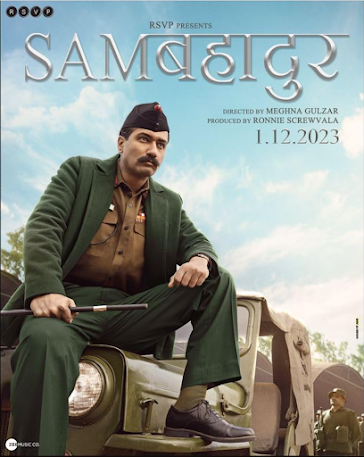
REVIEW 786: SAM BAHADUR


Release date:

December 1, 2023

Director:

Meghna Gulzar

Cast:

Vicky Kaushal, Fatima Sana Shaikh, Sanya Malhotra, Mohammed Zeeshan Ayyub, Neeraj Kabi, Govind Namdev 

Language:

Hindi with some English  


How do you make a film on a national icon whose image of coolth in his lifetime was built not solely on extreme courage and brilliant war-time strategising, nor even just his sense of humour and forthrightness, but also on widely disseminated accounts of his sexist condescension towards a prominent woman politician? The task is especially challenging when the man in question is Field Marshal Sam Hormusji Framji Jamshedji Manekshaw, a beloved Army Chief credited with India’s win in the 1971 war against Pakistan that led to the formation of Bangladesh.


A story that Manekshaw addressed the then Prime Minister Indira Gandhi as “sweetie” (She: Are you ready to go to war? He: I am always ready, sweetie) has assumed legendary proportions over time, with some fans repeating it as proof of his hipness and daring, while others have sought to deny it, and still others dismiss criticism of him by taking the position that women these days make much ado about nothing. Either way, the anecdote is an intrinsic part of the Manekshaw legend, and a truthful film about him cannot sweep it under a carpet. Would it be wisest for such a film to normalise sexism, or else to examine the subject through a critical, analytical lens even at the risk of irking Manekshaw’s adoring admirers?The dilemma is apparent in Meghna Gulzar’s Sam Bahadur that the director has co-written with Bhavani Iyer and Shantanu Srivastava, and is just one of the weak spots in an oddly pallid, superficial biopic. 


(Note: Manekshaw’s daughter has been quoted in the press this week praising the film after seeing two previews. This should put to rest the speculation about whether the “sweetie” saga is true.) 


Like most human beings, Sam Manekshaw was not easily definable. That patronising line to Gandhi is just a fraction of the abundant lore surrounding him, supplemented in Sam Bahadur by another not-so-well-known conversation: Manekshaw in the film tells Mrs G during an official, one-on-one meeting that she can always rest her worried head on his shoulders. Ugh! 


Since the film has not laid any ground for that exchange by suggesting a close friendship between them, his words are nothing less than an instance of over-familiarity and superciliousness that women at workplaces, including women leaders, are acquainted with. This is the same Manekshaw though who is known to have, and shown to have, unequivocally ordered his troops not to harm Bangladeshi women after India’s victory against Pakistan in 1971. To say he was complex, therefore, is an understatement, but Sam Bahadur’s script merely flits over various aspects of his personality and struggles to weave them into a comprehensible, relatable, engaging whole. 


The writers appear not to have come to terms with the troubling eternal reality that contradictory qualities often co-exist within the same person. Instead, in an ostensible bid to justify the unpalatable, they let on that “sweetie” was Manekshaw’s mode of address not just for India’s first woman PM, but for others too, both male and female. Err, talking down to another person does not become okay just because women are not the only ones at the receiving end. This was perhaps an opportunity to scrutinise society’s willingness to indulge distasteful conduct by men in power. Sadly, Sam Bahadur lacks the subtlety to handle this delicate point while simultaneously acknowledging Manekshaw’s incredible achievements.


The film is painfully conscious that its central figure was a giant among men. It declares that he was great, and expects us to believe it because it says so, but fails to distil the essence of who he was and why. In fact, Sam Bahadur is so acutely aware of his stature in Indian history, that initially it underlines a marginal brainwave as though it was an act of unprecedented genius. Later, when Manekshaw is accused of being anti-national, the charge is shown quickly collapsing under the weight of his grandiose pronouncements – this is another opportunity lost, if you consider the parallels with contemporary India, but for that resonance to be conveyed, a film would have to rise above the broad brush strokes that Sam Bahadur favours over nuance and detail.


The script jumps from one milestone in Manekshaw’s personal and professional journey to the next to the next to the next – from his marriage to his triumphs at various postings in the Army before and after Independence, internecine politics, his appointment as chief, 1971, his elevation to the position of India’s first field marshal, and finally, retirement – without getting to the beating heart of the celebrated soldier. It thus comes across as a listing of historical events rather than an in-depth exploration of the person behind the larger-than-life persona. 


If the goal was to offer a primer to students brushing up on their GK before a quiz, Sam Bahadur has served its purpose. As a biopic though, it is shallow.


The portrayal of Manekshaw’s relationship with his wife exemplifies the follies of the script in its entirety. They meet at a party, he is smitten at first sight, he says clever-sounding things, they gaze at each other through a long, moony song as they dance, we gather that they fall in love as that number plays at the party since that’s the purpose served by such musical interludes in Hindi films that feature a ‘heroine’ as a glamorous aside…cut to her in the bedroom of their home gazing at their sleeping child. That is literally how abrupt it is. That the director of the exemplary Raazi and Talvar would deliver a film this poorly structured and this lightweight is surprising.


Mrs Manekshaw, Silloo, gets a defining trait: an inexplicable animosity towards Indira Gandhi even before meeting her. The film implies that Silloo was insecure about Gandhi for no given reason, obviously playing into the stereotype that women don’t like attractive women. Eye roll! The antagonism results in some of Sam Bahadur’s silliest, unfunniest-albeit-meant-to-be-funny moments. It is disappointing that Mses Gulzar and Iyer, who co-wrote Raazi, opted to trivialise women in this film, first by giving an Army wife zero substance beyond her jealousy towards another woman, then compounding that diversion with a flash of what could be either innuendo or a genuine misunderstanding in at least one telephone conversation – presumably designed for comical effect – between Gandhi and Manekshaw. Worse, when he is shown patronising her, she has no reaction. Neither shock, nor confusion about how to react, neither anger, nor amusement. 


Are the writers implying that Gandhi was attracted to Manekshaw because he was a hottie? Can’t say for sure, but they’re certainly implying something. It is as if they could not fathom a normal working relationship between a good-looking, high-profile woman and man. 


No amount of contrived humour, no surface energy, no acting swag or rambunctious patriotic song – all of which we get here – can compensate for this passionless narrative.  


Not unexpectedly then, Vicky Kaushal’s performance as Manekshaw is as slight as the script. In Shoojit Sircar’s Sardar Udham (2021), Kaushal seemed to grasp the freedom fighter Udham Singh’s emotions and motivations. Here, he effectively captures Manekshaw’s posture, gait, intonation and the twinkle in his eye, but never gets past his skin. The fact that Manekshaw had a big personality is no excuse. For a recent example of an actor steering an audience beyond a real-life character’s overwhelming exteriority and flamboyance, Kaushal and the writers of Sam Bahadur would have done well to reference Ranveer Singh’s brilliant, non-caricaturish, immersive turn as the flashy former Indian cricketer Kapil Dev in Kabir Khan’s well-written 83.


The talented Sanya Malhotra (Dangal, Pagglait, Kathal) is wasted in Sam Bahadur, cast as an insipid Silloo. So is Mohammed Zeeshan Ayyub, who is unrecognisable after a while as Pakistan’s President Yahya Khan. Fatima Sana Shaikh delivers a stolid, dull Gandhi.  


The film is too much in awe of Manekshaw and too determined to lionise him to do justice to the other stalwarts on screen. Gandhi here, for instance, is nothing like the charismatic woman we saw in the public realm in reality, whose steely will earned her the nickname “Iron Lady of India”. 


Still, Sam Bahadur is not without qualities to recommend. The scenes of military action, for one, are captivating. In a decade when patriotism and even the national anthem have been weaponised by the Right, and Hindi cinema is bowing to prevailing winds by turning accounts of Indian heroes and their achievements into vehicles for chest-thumping desh prem, hatred of Pakistan and the stereotyping of India’s own religious minorities, this film is different. Sam Bahadur representspatriotism, not chauvinism. Shankar Ehsaan Loy’s song Badhte Chalo that runs through the 1971 war in the film is stirring, not jingoistic. This is not Akshay Kumar style aggressive nationalism, nor is it akin to the more polished propaganda of Uri: The Surgical Strike that Kaushal himself starred in. This is Meghna Gulzar style love for the country. This is cinema, not a war cry.  


Even when Sam Bahadur presents a broken Jawaharlal Nehru with Sardar Patel during the 1962 India-China debacle, it stops short of the right-wing ecosystem’s favourite trope that Nehru was a weakling and Patel the strong-willed one in the Cabinet. Their scenes are as broadly written as everything else in the film, nevertheless they are a marked contrast to the comically cowardly Nehru and gigantic Patel in Ketan Mehta’s Sardar (1994) and in the current dominant discourse. 


Ultimately though, anything that Sam Bahadur gets right is overshadowed by its sketchy scripting and bombast sans soul in the protagonist’s speech, demeanour and actions. The film tells us Manekshaw tended to downplay his troubles with the signature line “I’m okay”. Okay is not good. Okay is not great. Okay is just okay. Like the film. Sam Bahadur is okay, I guess. Just okay. 


Rating (out of 5 stars): 2


Running time:

150 minutes 


Poster courtesy: IMDB 

Saturday, November 10, 2018

REVIEW 653: THUGS OF HINDOSTAN


Release date:
November 8, 2018
Director:
Vijay Krishna Acharya
Cast:


Language:
Aamir Khan, Amitabh Bachchan, Katrina Kaif, Fatima Sana Shaikh, Mohammed Zeeshan Ayyub, Sharat Saxena, Ila Arun, Lloyd Owen, Gavin Marshall, Ronit Roy
Hindi


Amitabh Bachchan, Aamir Khan, Katrina Kaif, Fatima Sana Shaikh – this is the order in which the lead cast’s names are placed in the credits of Thugs of Hindostan. The ranking is representative of their star stature combined with seniority in the industry. A more truthful list reflecting the substance in the roles they play would have read: Khan, Bachchan, Shaikh, Kaif. And if you want to know which of these stars scores in terms of quality of performance and conviction, this is my list: Aamir Khan, Aamir Khan, Aamir Khan, Aamir Khan.

Vijay Krishna Acharya’s third directorial venture (the others being Tashan and Dhoom 3) might have been a lifeless parade of spectacular visuals without Khan. Whenever he is on screen though, the film develops a pulse. Khan is Thugs of Hindostan’s heart and soul, breath and blood.

The story is set in an India overrun by the British, and revolves around an unscrupulous rascal called Firangi Malla who serves only one master, himself, until he encounters the freedom fighter Azad (Bachchan). Torn between self-interest and patriotism, Firangi keeps his associates guessing about where his loyalties lie, swinging back and forth between the British led by Clive and his own people. The road he will ultimately take maybe obvious to the audience, but how he takes it is unpredictable enough to keep the film going.

If the mention of a Clive suggests that Thugs of Hindostan is historically accurate, then let it be placed on the record: it is not. “What’s in a name?” as that most famous of Englishmen once wrote. A white man by any other name would have smelt just as rotten. So yeah, in all their confrontations here, the Brits are made to look like incompetent, gullible asses, forever suffering defeat at the hands of Indians. Since India is the wronged party in the imperialist equation, it could be argued that taking this sort of liberty with the past can hardly be treated as a crime especially since this is nothing compared to Western cinema’s casual portrayal of true thugs of the colonial era, most recently Winston Churchill, with affectionate indulgence. In any case, Thugs of Hindostan is unapologetically commercial, characteristically masala-filled Bollywood fare, that does not ask to be taken seriously. It is an action adventure in the mould of Hollywood’s Pirates of the Caribbean series, and does not pretend to be anything but that.

Acharya’s actual crime lies in the weak writing of every character other than Firangi Malla. Azad is a pallid creature, and Bachchan invests nothing beyond his towering personality and baritone in his uninspired performance.

The women are laughable asides in the screenplay. Kaif as the courtesan Suraiyya gets to look sexy and dance mechanically, displaying technique but little grace in two lavish song and dance sequences on elaborate, eye-catching sets. She has a third scene but disappears for the rest of the proceedings, which is just as well since she seems unable to move even those few facial muscles that she has exercised in her earlier films.  


Shaikh, who made a mark as a skilled wrestler and rebellious daughter in Dangal, is not required to act at all. As Zafira who is part of Azad’s band of warriors, she barely has any lines, and most of her screen time is spent running across battlescapes, firing arrows and throwing punches. She is fair enough doing all this, but not outstanding, and since she lacks charisma it is hard not to wonder why she landed the job. She also has less chemistry with Khan than Lloyd Owen who plays Clive.

It is thus left to Khan and the technical departments to save this film, and they do. Thugs of Hindostan’s production designers (there are four) and DoP Manush Nandan ensure that the film is never short of pretty and grand. John Stewart Eduri serves up a throbbing background score and Ajay-Atul’s songs are all hummable.

Given the only well-written character in Thugs of Hindostan, with an abundance of mischievous dialogues and credible motivations, Khan throws himself into his role with gusto, summoning up Munna of Rangeela and Siddhu of Ghulam, imbuing Firangi with a relentless zest, and switching from good to bad to inexplicable to exasperating to lovable within a twinkling of those delightful kohl-lined eyes.

Thugs was promoted as the first film ever to pit him against the great Bachchan. The legendary superstar is a pale shadow here of the best he has been. Khan, on the other hand, crackles, pops and sparkles as a swashbuckling scoundrel. The writing of his character and his performance are the only reasons why Thugs of Hindostan does not turn out to be a stylishly produced but disastrously dreary repeat of Acharya’s first film, Tashan. Despite all its minuses, Thugs is light-hearted fun.

Rating (out of five stars): **

CBFC Rating (India):
UA 
Running time:
164 minutes 30 seconds 

This review has also been published on Firstpost:


Friday, December 23, 2016

REVIEW 451: DANGAL


Release date:
December 23, 2016
Director:
Nitesh Tiwari
Cast:


Language:
Aamir Khan, Fatima Sana Shaikh, Zaira Wasim, Sanya Malhotra, Suhani Bhatnagar, Sakshi Tanwar, Aparshakti Khurana, Girish Kulkarni, Vivan Bhathena
Hindi


Sweaty bodies gripping each other in places strangers should not touch, violence as a form of entertainment, our baser human instincts getting official and mass encouragement – if you ask me why I cannot stand contact sports, these would top my answer.

Young Geeta and Babita Phogat have far more mundane reasons for hating wrestling: no girl they know does it, so why should they? Dangal is the story of their father’s bulldog-like determination to make them gold medal winners for India, and the girls’ own passage from aversion to passion for the sport.

Nitesh Tiwari’s third film as director is based on the real-life story of Haryana’s Mahavir Singh Phogat, patriarch and coach of one of the country’s most unusual sporting families: his daughters are all wrestling champions, the eldest two – Geeta and Babita – are Commonwealth Games gold medallists, and Geeta is the first Indian woman wrestler to have ever qualified for the Olympics.

This achievement is particularly striking considering that Haryana has one of India’s worst child sex ratios and a horrifying track record in the matter of female foeticide and infanticide.

Dangal is about Mahavir’s single-mindedness which brings him into conflict with his wife, his community, the country’s sporting establishment and ultimately, even Geeta.

The first half of the film is riveting in every way imaginable. Mahavir (played by Aamir Khan) gives up his wrestling dreams to financially support his family. He then decides to turn his yet-to-be-born sons into wrestlers who will bring home golds for India. This dream too is crushed when he and his wife Daya have four daughters instead in succession. One day when Geeta and Babita bash up a couple of local boys for abusing them, Mahavir sees the light. He forgot, he says, that a gold medal is gold whether won by a boy or a girl.

The songs neatly woven into the narrative in these scenes are catchy, their lyrics steeped in hilarious colloquialisms. The acting is singularly flawless all around.

Geeta and Babita as children are played by two brilliant debutants, Zaira Wasim and Suhani Bhatnagar, who knock it out of the park in every scene (if I may borrow a phrase from another game). And the storytelling matches up.

No effort is made to gloss over Mahavir’s flaws: he is a dictator at home and a terror outside. This is, without question, a traditional set-up where the husband/father’s word matters more than anyone else’s opinions or beliefs. Even the local people are afraid of him, but that does not stop them from gossipping about this man who, they are convinced, will drive his daughters to ruin by forcing them into a field they believe no woman should touch with a barge pole.

But Mahavir soldiers on. The pre-interval portion is quick-paced, amusing and moving in equal parts. To see a son-crazed old villager metamorphose into a vocal advocate of women’s rights is extremely touching. To witness him in the conflicting roles of feminist and patriarch, traditionalist and visionary (note his understanding of celebrity brand endorsements) is insightful and educational. To watch the girls grow from reluctant wrestlers into committed, self-driven sportspersons is hugely engaging and poignant.

(Spoiler alert) The second half is not as assured in its writing. This is when Geeta and Babita – now played by the older and also gifted Fatima Sana Shaikh and  Sanya Malhotra – become their own persons, and Geeta clashes with Mahavir. The father-daughter conflict is absorbing until Dangal loses its way in the rationalisation of the resolution. Are we being convinced to root for Mahavir instead of Geeta’s new coach because Daddy is always right or because this particular Daddy happens to be a great coach with strategies better suited to Geeta’s game? It should be the latter, but in the conversations between the various players in this saga,  the reasoning is fuzzy.

This leaves us with the disturbing possibility that the fuzziness is a deliberately populist move in a nation that by and large still considers it the duty of children to never question their parents.

Equally troublesome is a portion of the climax that appears to be a bow to the loud nationalism prevailing in India right now. The nicely seamless fashion in which the national anthem is played – with relevance – at that point in the narrative is diluted by a moment of needless, cringe-worthy sloganeering that seems contrived to cash in on current public sentiment. (Spoiler alert ends)

These choices are what holds Dangal back from the greatness it could have achieved. That said it remains a film with numerous attractions, foremost among them being the superstar at the centre of the action. Aamir Khan as Mahavir Singh Phogat throws himself into the role with a conviction and commitment that mirror the real-life Mahavir’s own maniacal pursuit of perfection for his daughters. The changes Khan has made to his body for this part are impressive to the point of being intimidating, but what really wins the day is the way every cell of his being seems infused with the character. Hats off to him for being as obsessive about excellence as the man he has brought to life on screen in this film.

It is a measure of his confidence and his instinct for good cinema that although he is one of Dangal’s producers, he does not allow Mahavir to overshadow his daughters or his own superstardom to overshadow the newcomers in the film. The four young women who play Geeta and Babita are smashingly good. Casting director Mukesh Chhabra has really outdone himself in this film. The talented satellite cast is the icing on the cake – Sakshi Tanwar is credible in the small role of their mother, and a scintillating Aparshakti Khurana (who we recently saw in Saat Uchakkey) plays their sweet, supportive cousin.

A large part of the second half of Dangal is taken up by Geeta’s wrestling matches. The director has wisely chosen to show us these bouts in their entirety rather than just edited clips. The film then becomes a medley of matches that are so well shot, so well played by Fatima Sana Shaikh and the other performers, and so well choreographed that they take nothing away from Dangal’s cinematic value.

The ultimate test for this film is whether it can get a viewer (like me) who dislikes contact sports to bite her nails with tension through Geeta Phogat’s multiple encounters on the  mat. I do not know about others, but I can tell you I needed a nail file after watching Dangal. A personal salaam to Nitesh Tiwari for that.

During the Rio Olympics this year, the discourse on sporting achievement in India was dominated by those who were so frustrated by the corruption in the country’s sporting establishment and our poor show in the medals tally, that even non-medallists were held up as icons. No offence intended to those who disagree, but while we do need to laud our players for ever tiny step covered despite the huge odds they face, we must question the defeatist logic in taking out celebratory processions for those who do not win.

Dangal may be confusingly cautious around popular notions on the parental front, but in the matter of sporting achievement it does not mince words: silver is second best, it tells us unequivocally, and there is nothing wrong in aiming for gold. In an India that remains doubtful about the virtues of ambition, in a world that continues to consider ambition a dirty word for women in particular, such clarity is remarkable and inspiring.

Rating (out of five stars): ***

CBFC Rating (India):
U
Running time:
161 minutes 

This review has also been published on Firstpost: