Showing posts with label Vicky Kaushal. Show all posts

Saturday, December 23, 2023

REVIEW 789: DUNKI

Release date:

December 21, 2023

Director:

Rajkumar Hirani 

Cast:

Shah Rukh Khan, Taapsee Pannu, Boman Irani, Anil Grover, Vikram Kocchar, Cameo: Vicky Kaushal

Language:

Hindi 


There’s always a first time for everything. Your first love. Your first kiss. Your first paycheck. Even your first boring film. 


Now there’s a word I never expected to use for a Rajkumar Hirani venture. Yet “boring” is the aptest adjective for the director’s latest film Dunki that he has also co-written with Abhijat Joshi and Kanika Dhillon. Whatever criticism Hirani’s previous works may have deserved (3 Idiots featured that balaatkaar ‘joke’, it starred a 44-year-old as a teen, it favoured broad brush strokes over nuance as did PK, and Sanju was PR for Sanjay Dutt) none of them could be accused of dullness. Much about 3 Idiots was fun. PK was entertaining and brave. Ranbir Kapoor aced Sanju. Above all these, is the joyous Munnabhai series. Dunki feels like it was made by someone else. 


Taapsee Pannu here plays Manu Randhawa who wants to prove to her Dad that she’s as capable as a son of clearing the family’s debts and reclaiming the large house they lost. Buggu Lakhanpal (Vikram Kocchar) wants his Mum to quit the job she took after his Dad retired, because men leer at her when she wears pants as part of her work uniform. Balli Kakkad (Anil Grover) wants to release his Mum from toiling as a tailor, but sees no future in the barber shop where he’s employed. In this village where the West is viewed as El Dorado, and migration the fix for all problems, they begin single-mindedly chasing their goal of leaving India. 


One of them makes it to London. With no legal route in sight, the others risk death to swim, walk and stow away in vehicles, covering thousands of miles across Asia and Europe to get to their Promised Land. They do this without any idea how they will earn money abroad. They are guided on this perilous odyssey by Hardy a.k.a. Hardayal Singh Dhillon (Shah Rukh Khan). Their story dating back to 1995 is recounted in a flashback 25 years later. 


The film’s title is Punjabi for what are known as “donkey flight” 
methods used by Indians to gain illegal entry into rich Western countries. It’s a well-established term you will find in press reports, because Manus, Buggus and Ballis exist in large numbers. Just last year, for instance, the media covered the tragic tale of Vaishaliben and Jagdish Patel, a married couple in their 30s from Gujarat, who froze to death with their 11-year-old daughter and three-year-old son in a field near Canada’s border with the US. They were in Canada on visitor’s visas, and died while trying to illegally enter the US on foot. The Patels were not impoverished, not from a beleaguered caste or religious minority, not activists or any category of folks victimised by their government. An excellent BBC profile explained that they were in fact a middle-class couple who probably fell for ‘the American dream’ peddled by human traffickers, had most likely not researched the plight of illegal migrants to the US, but succumbed to a bizarre social pressure to migrate that pervades their Gujarat village. 


It would take thoughtful scripting to make a candid yet compassionate film on those like the Patels whose unthinking quest ends in tragedy. The obliviousness to reality of aspiring immigrants from Punjab was captured with a blend of empathy and exasperation in the Canadian Indian director Deepa Mehta’s Heaven On Earth (English-Punjabi-Hindi, 2008). Preity Zinta was remarkable in that film as a woman who leaves the middle-class comfort of her home for what her community deems a prized catch, an NRI groom, only to find that he had hidden the truth that he was struggling for survival in Canada. Heaven On Earth’s heroine was certainly financially better off in Punjab than Manu, Buggu and Balli, but the point is, all four were socially conditioned or pressured not to look before leaping, to emigrate without planning for what lay on the other side of that journey. Unlike Mehta’s film, Dunki does not scrutinise this desperation but romanticises it. 


So, worse than Dunki’s tedium is its political immaturity. The script avoids any tricky ground that would require intricate characterisation. It does not examine why the trio did not pursue options in India with the doggedness that they invested in putting their lives on the line to reach the UK. It does not train a critical lens on the patriarchy that drove Buggu and Balli to prefer possible death over earning mothers, nor have the finesse to envisage a situation where a man may understandably worry about a mother he loves, yet not see nearly killing himself as the only alternative. 


One character says sorrowfully that strugglers like them are driven to do work in the UK that locals do not want to, like mopping floors and scrubbing toilets. These are tasks that Dalits in India undertake (and are often forced to stick with) because upper castes are contemptuous of such jobs, although the latter are known to take them up when in dire straits abroad. Dunki does not stop to look at whether Manu, Buggu and Balli would have been willing to clean floors and toilets in India, and what the answer to that question says about them and the society they come from. 


To effectively address such complex points and still elicit warmth towards the three would have been a challenge, therefore Dunki steers clear of these issues completely. 


The film does not even do enough to generate that warmth organically. Maudlin music is played loudly to manipulate the audience into weeping, since the writing lacks flesh and insight. 


Dunki’s tone deafness to casteism extends to race too. One ‘joke’ involves the trio’s confusion and stress on sighting a black man when they reach what they think is the UK. They are relieved when they spot a white couple immediately after. Cringe. 


Dunki’s arguments favouring illegal immigrants are half-baked, and its poorly reasoned comments on British imperialists unwittingly suggest an equivalence between colonialism and migration. 


It is not clear whether subconscious prejudice or a conscious desire to pander to the dominant national mood is at the heart of certain script elements, or these were just instances of mindless writing. Such as the fact that the violence and sadism that Hardy, Manu and Buggu encounter while crossing borders comes from men in Muslim-majority countries. Or that the only kindness they face in this arduous process comes from a white male judge at their court hearing in the UK. 


(Spoiler alert) Hardy and his companions are told by the judge that they can get asylum in the UK if they claim they faced persecution in India. He refuses, the rest give in. Was this meant to be a meta moment blurring the line between SRK’s character and SRK himself, as Pathan and Jawan repeatedly did? If so, the writers might consider the meaning that scene takes on in a real-world context in which Muslims in particular and minorities at large are expected to prove their loyalty to India while members of the majority community are not. (Spoiler alert ends)


Like all Hindi films aspiring to be mainstream, a romance between the biggest male and female star in the cast is rammed into the script, which brings up the point that the actors playing SRK’s wives and girlfriends are getting younger with each film. Pannu at 36 looks like she might be the nearly 60-year-old Khan’s daughter in reality, and no, saying so does not make this an ageist review – this is a criticism of the ageism that producers, directors and male stars direct at women actors in their 50s who they do not consider attractive enough for a man in his 50s. C’mon SRK, you position yourself as being better than this, so why don’t you do better by women artistes?


The sexual chemistry between Khan and Pannu is zilch, which makes the blaring song “Ho aisa waisa ishq nahin, yeh ishq hai Raanjhe waala” sound ridiculous in a painfully unconvincing romantic scene. The fault lies not with the song, but with the scenario. 


Frankly, the chemistry between all the characters in Dunki is down to zero. 


Still, Pannu gets the space she deserves, which is unusual for a male-superstar-led Indian film (case in point: the short shrift given to Nayanthara in Jawan). She and Grover are good. So is Vicky Kaushal in a cameo. Kocchar and Boman Irani (who plays the English coach Geetu Gulati) can be excused for hamming in their intentionally OTT comedy scenes, but Khan cannot be given such leeway. His over-acting is especially jarring in intense exchanges, and is shown up by successive scenes in which he and Pannu are emotional, she with restraint, he with face all a-quiver. 


Pannu is even given weirdly drastic ageing makeup, causing her to advance what looks like 50 years in 25, no doubt to match Manu with Hardy in the present day. Seriously? 


Someone please revive the more controlled SRK of SwadesChak De! India and Fan, or the star who was comfortable enough with his age to make it look sexy in Dear Zindagi


Dunki’s only truly sharp passage comes early on, cocking a snook at Far Right nationalists’ obsessive reverence for Jana Gana Mana. There’s also fun to be had with Balli’s barbering, Geetu’s classes and the students’ jugaadu solution to their English problem. The latter is hilarious, actually. But there is only so far that these scattered rays of sunshine can take the film. 


For a truly intelligent recent account of an Indian illegal immigrant in the US, try catching Danish Renzu’s heart-wrenching The Illegal (English, 2021) starring Suraj Sharma.  


Dunki is an over-wrought, over-stretched, over-crowded sample of cinematic mediocrity, marked by clunky writing and puerile politics – an inexplicably incompetent film coming from one of the most successful teams in Hindi film history.


Rating (out of 5 stars): 1.75   


Running time:

161 minutes 


Poster courtesy: IMDB 

Saturday, December 2, 2023

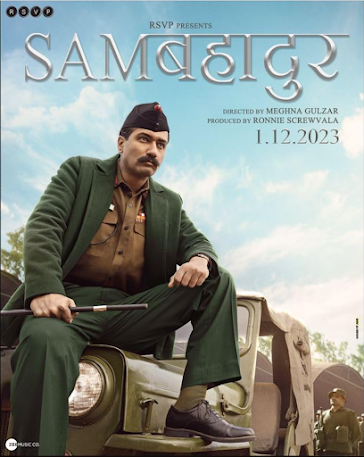
REVIEW 786: SAM BAHADUR


Release date:

December 1, 2023

Director:

Meghna Gulzar

Cast:

Vicky Kaushal, Fatima Sana Shaikh, Sanya Malhotra, Mohammed Zeeshan Ayyub, Neeraj Kabi, Govind Namdev 

Language:

Hindi with some English  


How do you make a film on a national icon whose image of coolth in his lifetime was built not solely on extreme courage and brilliant war-time strategising, nor even just his sense of humour and forthrightness, but also on widely disseminated accounts of his sexist condescension towards a prominent woman politician? The task is especially challenging when the man in question is Field Marshal Sam Hormusji Framji Jamshedji Manekshaw, a beloved Army Chief credited with India’s win in the 1971 war against Pakistan that led to the formation of Bangladesh.


A story that Manekshaw addressed the then Prime Minister Indira Gandhi as “sweetie” (She: Are you ready to go to war? He: I am always ready, sweetie) has assumed legendary proportions over time, with some fans repeating it as proof of his hipness and daring, while others have sought to deny it, and still others dismiss criticism of him by taking the position that women these days make much ado about nothing. Either way, the anecdote is an intrinsic part of the Manekshaw legend, and a truthful film about him cannot sweep it under a carpet. Would it be wisest for such a film to normalise sexism, or else to examine the subject through a critical, analytical lens even at the risk of irking Manekshaw’s adoring admirers?The dilemma is apparent in Meghna Gulzar’s Sam Bahadur that the director has co-written with Bhavani Iyer and Shantanu Srivastava, and is just one of the weak spots in an oddly pallid, superficial biopic. 


(Note: Manekshaw’s daughter has been quoted in the press this week praising the film after seeing two previews. This should put to rest the speculation about whether the “sweetie” saga is true.) 


Like most human beings, Sam Manekshaw was not easily definable. That patronising line to Gandhi is just a fraction of the abundant lore surrounding him, supplemented in Sam Bahadur by another not-so-well-known conversation: Manekshaw in the film tells Mrs G during an official, one-on-one meeting that she can always rest her worried head on his shoulders. Ugh! 


Since the film has not laid any ground for that exchange by suggesting a close friendship between them, his words are nothing less than an instance of over-familiarity and superciliousness that women at workplaces, including women leaders, are acquainted with. This is the same Manekshaw though who is known to have, and shown to have, unequivocally ordered his troops not to harm Bangladeshi women after India’s victory against Pakistan in 1971. To say he was complex, therefore, is an understatement, but Sam Bahadur’s script merely flits over various aspects of his personality and struggles to weave them into a comprehensible, relatable, engaging whole. 


The writers appear not to have come to terms with the troubling eternal reality that contradictory qualities often co-exist within the same person. Instead, in an ostensible bid to justify the unpalatable, they let on that “sweetie” was Manekshaw’s mode of address not just for India’s first woman PM, but for others too, both male and female. Err, talking down to another person does not become okay just because women are not the only ones at the receiving end. This was perhaps an opportunity to scrutinise society’s willingness to indulge distasteful conduct by men in power. Sadly, Sam Bahadur lacks the subtlety to handle this delicate point while simultaneously acknowledging Manekshaw’s incredible achievements.


The film is painfully conscious that its central figure was a giant among men. It declares that he was great, and expects us to believe it because it says so, but fails to distil the essence of who he was and why. In fact, Sam Bahadur is so acutely aware of his stature in Indian history, that initially it underlines a marginal brainwave as though it was an act of unprecedented genius. Later, when Manekshaw is accused of being anti-national, the charge is shown quickly collapsing under the weight of his grandiose pronouncements – this is another opportunity lost, if you consider the parallels with contemporary India, but for that resonance to be conveyed, a film would have to rise above the broad brush strokes that Sam Bahadur favours over nuance and detail.


The script jumps from one milestone in Manekshaw’s personal and professional journey to the next to the next to the next – from his marriage to his triumphs at various postings in the Army before and after Independence, internecine politics, his appointment as chief, 1971, his elevation to the position of India’s first field marshal, and finally, retirement – without getting to the beating heart of the celebrated soldier. It thus comes across as a listing of historical events rather than an in-depth exploration of the person behind the larger-than-life persona. 


If the goal was to offer a primer to students brushing up on their GK before a quiz, Sam Bahadur has served its purpose. As a biopic though, it is shallow.


The portrayal of Manekshaw’s relationship with his wife exemplifies the follies of the script in its entirety. They meet at a party, he is smitten at first sight, he says clever-sounding things, they gaze at each other through a long, moony song as they dance, we gather that they fall in love as that number plays at the party since that’s the purpose served by such musical interludes in Hindi films that feature a ‘heroine’ as a glamorous aside…cut to her in the bedroom of their home gazing at their sleeping child. That is literally how abrupt it is. That the director of the exemplary Raazi and Talvar would deliver a film this poorly structured and this lightweight is surprising.


Mrs Manekshaw, Silloo, gets a defining trait: an inexplicable animosity towards Indira Gandhi even before meeting her. The film implies that Silloo was insecure about Gandhi for no given reason, obviously playing into the stereotype that women don’t like attractive women. Eye roll! The antagonism results in some of Sam Bahadur’s silliest, unfunniest-albeit-meant-to-be-funny moments. It is disappointing that Mses Gulzar and Iyer, who co-wrote Raazi, opted to trivialise women in this film, first by giving an Army wife zero substance beyond her jealousy towards another woman, then compounding that diversion with a flash of what could be either innuendo or a genuine misunderstanding in at least one telephone conversation – presumably designed for comical effect – between Gandhi and Manekshaw. Worse, when he is shown patronising her, she has no reaction. Neither shock, nor confusion about how to react, neither anger, nor amusement. 


Are the writers implying that Gandhi was attracted to Manekshaw because he was a hottie? Can’t say for sure, but they’re certainly implying something. It is as if they could not fathom a normal working relationship between a good-looking, high-profile woman and man. 


No amount of contrived humour, no surface energy, no acting swag or rambunctious patriotic song – all of which we get here – can compensate for this passionless narrative.  


Not unexpectedly then, Vicky Kaushal’s performance as Manekshaw is as slight as the script. In Shoojit Sircar’s Sardar Udham (2021), Kaushal seemed to grasp the freedom fighter Udham Singh’s emotions and motivations. Here, he effectively captures Manekshaw’s posture, gait, intonation and the twinkle in his eye, but never gets past his skin. The fact that Manekshaw had a big personality is no excuse. For a recent example of an actor steering an audience beyond a real-life character’s overwhelming exteriority and flamboyance, Kaushal and the writers of Sam Bahadur would have done well to reference Ranveer Singh’s brilliant, non-caricaturish, immersive turn as the flashy former Indian cricketer Kapil Dev in Kabir Khan’s well-written 83.


The talented Sanya Malhotra (DangalPagglaitKathal) is wasted in Sam Bahadur, cast as an insipid Silloo. So is Mohammed Zeeshan Ayyub, who is unrecognisable after a while as Pakistan’s President Yahya Khan. Fatima Sana Shaikh delivers a stolid, dull Gandhi.  


The film is too much in awe of Manekshaw and too determined to lionise him to do justice to the other stalwarts on screen. Gandhi here, for instance, is nothing like the charismatic woman we saw in the public realm in reality, whose steely will earned her the nickname “Iron Lady of India”. 


Still, Sam Bahadur is not without qualities to recommend. The scenes of military action, for one, are captivating. In a decade when patriotism and even the national anthem have been weaponised by the Right, and Hindi cinema is bowing to prevailing winds by turning accounts of Indian heroes and their achievements into vehicles for chest-thumping desh prem, hatred of Pakistan and the stereotyping of India’s own religious minorities, this film is different. Sam Bahadur representspatriotism, not chauvinism. Shankar Ehsaan Loy’s song Badhte Chalo that runs through the 1971 war in the film is stirring, not jingoistic. This is not Akshay Kumar style aggressive nationalism, nor is it akin to the more polished propaganda of Uri: The Surgical Strike that Kaushal himself starred in. This is Meghna Gulzar style love for the country. This is cinema, not a war cry.  


Even when Sam Bahadur presents a broken Jawaharlal Nehru with Sardar Patel during the 1962 India-China debacle, it stops short of the right-wing ecosystem’s favourite trope that Nehru was a weakling and Patel the strong-willed one in the Cabinet. Their scenes are as broadly written as everything else in the film, nevertheless they are a marked contrast to the comically cowardly Nehru and gigantic Patel in Ketan Mehta’s Sardar (1994) and in the current dominant discourse. 


Ultimately though, anything that Sam Bahadur gets right is overshadowed by its sketchy scripting and bombast sans soul in the protagonist’s speech, demeanour and actions. The film tells us Manekshaw tended to downplay his troubles with the signature line “I’m okay”. Okay is not good. Okay is not great. Okay is just okay. Like the film. Sam Bahadur is okay, I guess. Just okay. 


Rating (out of 5 stars): 2


Running time:

150 minutes 


Poster courtesy: IMDB 

Saturday, February 22, 2020

REVIEW 767: BHOOT – PART ONE: THE HAUNTED SHIP

Release date:
February 21, 2020
Director:
Bhanu Pratap Singh
Cast:
Vicky Kaushal, Akash Dhar, Ashutosh Rana, Meher Vij, Bhumi Pednekar
Language:
Hindi


I can’t quite figure out why Bhoot Part One: The Haunted Ship allowed itself to waste away. It borrows part of its name from one of Ram Gopal Varma’s better post-2000 films, but squanders a promising start and fails to do justice to that supernatural thriller’s legacy.

This Bhoot stars Vicky Kaushal as a member of a government shipping department involved in clearing out an abandoned ship called Sea Bird that gets stuck on Mumbai’s Juhu beach. As it happens, the vessel is haunted. So is Kaushal’s character Prithvi – unable to let go of a tragedy involving his wife and child a while earlier. His unhappy past appears to have turned him into a man who will go to any lengths and risk his everything to help others, especially young women.

The first half of Bhoot Part One is actually very good, starting with a neat rejigging of the familiar Dharma Productions logo. Director Bhanu Pratap Singh manages to build up a spooky atmosphere on screen, and the initial sightings of the film’s spirit are terrifying. It all comes to nought though with the dwindling quality of the narration, loopholes and unaddressed questions gradually rearing their head, and in the second half, with a half-baked back story to the paranormal presence on that ship.

Among the familiar faces who show up in brief roles are Ashutosh Rana as a clichéd professor who studies the supernatural, Meher Vij from Secret Superstar who is part of the backgrounder and Bhumi Pednekar whose talent deserves better than two back-to-back ineffectual cameos in one weekend – in addition to this film, she is also in Shubh Mangal Zyada Saavdhan (SMZS). To be fair to Bhoot Part One, at least Pednekar’s character here has some significance – she is irrelevant in SMZS.

The visual effects in Bhoot Part One are fair enough, but their worth is diminished by the emptiness of the script in the second half.

Sometimes though, from the most unexpected quarters comes a point that needs to be desperately made in the disturbing times we live in. Prithvi’s best friend in Bhoot Part One is a man called Riyaz (played by Akash Dhar, the brightest spark in this cast). While names are not concrete proof of an individual’s religious identity, they do serve as indicators. Riyaz could well be Hindu or Christian, but it is a name you will usually find on Muslims or Parsis. That a vital character in a film belongs to a minority community without a shindig being thrown about their religion, without any of the stereotypical community markers that most Bollywood films consider mandatory, without them being demonised in the way one particular minority group is increasingly being demonised by post-2014 Bollywood, yet without their presence being used to deliver a speech on secularism, is a crucial statement on representation.

This positive is hardly enough to salvage the wreckage of Bhoot Part One though.

As if it is not bad enough that they made an entire film without compelling the writing team to improve the script, it turns out the producers are planning a Bhoot Part Two. Oh dear.

Rating (out of 5 stars): 1.5

CBFC Rating (India):
A 
Running time:
117 minutes 

Poster courtesy: IMDB


Friday, September 14, 2018

REVIEW 635: MANMARZIYAAN


Release date:
September 14, 2018
Director:
Anurag Kashyap
Cast:


Language:
Taapsee Pannu, Vicky Kaushal, Abhishek Bachchan, Arun Bali, Ashnoor Kaur, Neelu Kohli, Vikram Kochhar
Hindi and Punjabi


When Anurag Kashyap hits the ball out of the park, he has the ability to get it across an ocean and over to another continent. When he is good he is so smashingly good, it becomes hard to remember the occasions when he is not. His last two films – Raman Raghav 2.0 and Mukkabaaz – were gripping to such a beautifully excruciating degree, that it hurts to acknowledge how tepid Manmarziyaan is (except when its killer humour rears its head).

Kashyap’s new film – with a story, screenplay and dialogues by Kanika Dhillon – is about the tempestuous relationship between Rumi (Taapsee Pannu) and Vicky (Vicky Kaushal). She is a hockey player who helps in the family’s small business in Amritsar, he is a deejay. Their sexual escapades are barely hidden from the elders in her family and since poore Amritsar ko pata hai about them, she is under pressure to marry him. Vicky loves Rumi but is not ready for that step. Furious at him, she agrees to an arranged marriage. Enter: London-based banker Robbie (Abhishek Bachchan). Vicky, however, refuses to exit the picture.

The commitment phobia (in some cases marriage phobia) of the young has been a recurrent theme in Hindi cinema of the past decade. Bachna Ae Haseeno, Love Aaj Kal, Break Ke Baad, Yeh Jawaani Hai Deewani – the list is long. At first it was interesting to see contemporary films examining the reluctance of India’s urban youth to “settle down” in the conventional sense, until it became clear that when push came to shove, each of these filmmakers was on the side of convention. Shakun Batra’s Ek Main Aur Ekk Tu was among the honourable exceptions that had the courage to be truly different. Manmarziyaan’s bid to be more open-minded than the rest translates into some rather odd interpretations of liberalism, among them the portrayal of Robbie as a modern-day Maryada Purushottam Ram (quite literally – Rumi even asks him, “were you like this from your childhood, a Ramji type?”), not just glossing over Lord Ram’s decision to ditch his wife at the first whiff of gossip about her, but also somehow interpreting male goodness as a willingness to forgive a woman for repeatedly being an absolute jerk with you.

It is tough to buy into Robbie’s decency, more so his love for Rumi which seems to have taken birth at the sight of her photograph and survives her complete lack of consideration towards him and his family. The Rumi-Vicky-Robbie triangle loses steam before that though, when Vicky’s characterisation is neglected by the writing and Rumi’s is bathed in clichés. I enjoyed the energy of the first 30 minutes or so of the film, the heat between Rumi and Vicky, the quick succession of songs, actor Vicky Kaushal’s unrestrained dancing and Dhillon’s hilarious, earthy dialogues made all the better by the excellent comic timing of the cast. The humour is all that thrives till the end.

Among other things, I am trying to remember the last time Bollywood has pointedly projected a female character as tough and independent-minded, without writing her as a smoker, a consumer of alcohol, sexually wild occasionally to the point of being promiscuous and/or socially brusque to the point of being mean, and without choosing to underline these aspects of her as signifiers of her strength and rebellion. This is not to say that women – those who are tough and those who are not – are never any of the above, but that writers and directors who equate these specific habits and qualities with forward thinking, modernity and courage in the female half of the population would be well advised to examine their (possibly subconscious) conservatism that causes them to struggle to portray a woman’s inner strength. Shashanka Ghosh got it right in Veere Di Wedding when he was able to shock the living daylights out of a conservative Indian audience by showing a woman masturbating on screen, yet not making that her defining characteristic nor allowing that episode to overshadow her internal journey. He is an exception. The norm though is Aanand L. Rai whose Tanu is defined by her rude, boorish, foul-mouthed, alcohol-swilling ways. (Not surprisingly, Rai is a co-producer of this film.)

Interestingly, although writer Kanika Dhillon fails to rise above the routine with her female lead, she manages to portray the Sikh community minus Bollywood clichés. Clearly then, she has it in her to be more nuanced than the overall film would suggest. This is evident again in small touches such as the fact that all of Amritsar is gossiping about Rumi, her family too is well aware of her reputation, yet Vicky’s family knows nothing of what is going on, reminding us – without feeling the need to spell it out – that people are always far more preoccupied with a woman’s sex life than with a man’s. There is also an appealing warmth in the relationship between Rumi and her grandfather (Arun Bali). Over and above everything else is Dhillon’s sense of humour.

Abhishek Bachchan is sweet as paavam-bechara Robbie, though a little dull. Vicky Kaushal nails the externals of his character with great pizzazz, but has little to chew on in terms of who the man really is. Taapsee Pannu too cracks the many moods of Rumi up to a point, but cannot rise above the tired, unimaginative characterisation. You know there is a problem when the stand-out memories from a film just hours after having watched it are the crackingly funny verbal duels between two supporting characters (both members of Robbie’s household played by Neelu Kohli and Vikram Kochhar). For its stomach-achingly comical conversations and the infectious verve of Amit Trivedi’s music, Manmarziyaan gets a thumbs up. The storytelling deserves a big thumbs down though.

Rating (out of five stars): **

CBFC Rating (India):
UA
Running time:
157 minutes