|
Release
date:
|
April 12,
2019
|
|
Director:
|
Vysakh
|
|
Cast:
Language:
|
Mammootty, Jai,
Nedumudi Venu, Anusree, Vijayaraghavan, Salim Kumar, Siddique, Jagapathi
Babu, Aju Varghese, Sunny Leone, Suraj Venjaramoodu, Shamna Kasim, Santhosh
Keezhattoor, Anna Reshma Rajan
Malayalam, Tamil
and English
|

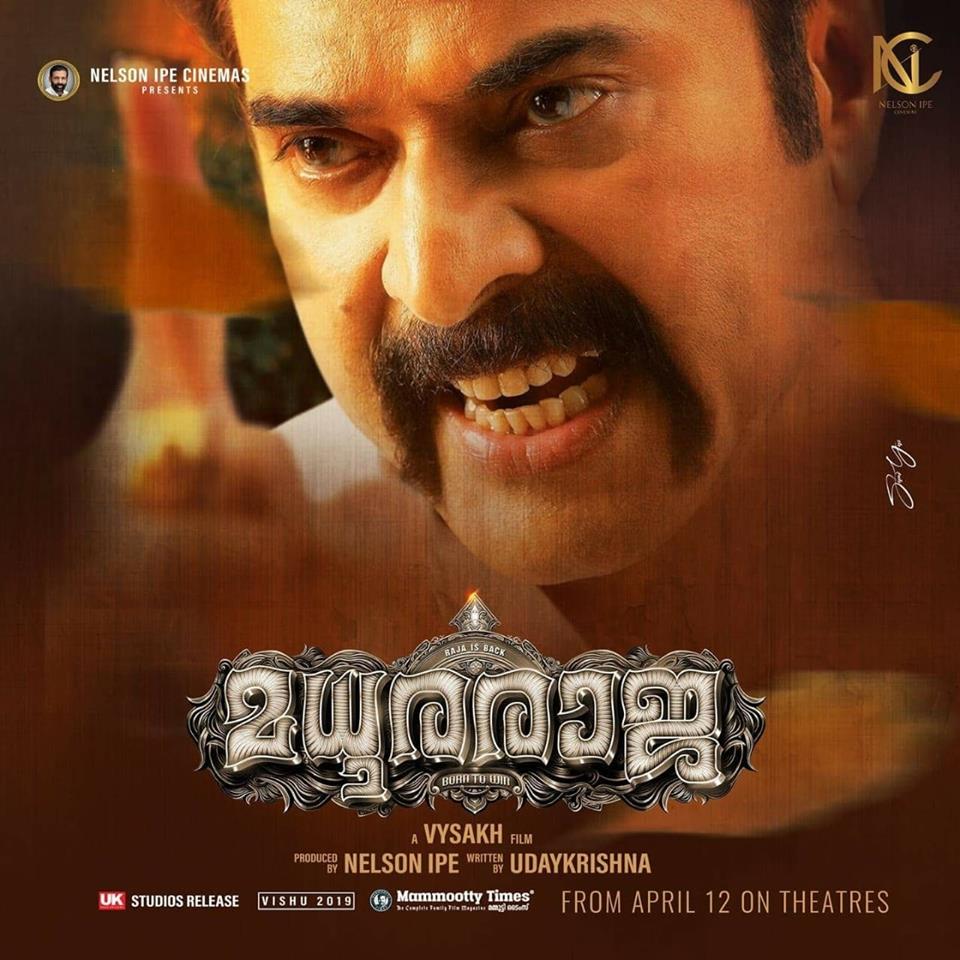
Almost a decade has passed since Pokkiri Raja’s hero Madurai Raja, in the
person of Mammootty, strode across the big screen mouthing the signature
refrain (roughly translated), “Raja does what he says he will do, and only
says what he can and will do”. Like most macho heroes of this genre of
commercial Indian cinema, he also had a signature song, with these words, “He
speaks English, he speaks Tamil, but Malayalam is his mother tongue,” highlighting
his character’s quirky insistence on spouting mangled English and the adolescence
spent in Madurai that led to his fluency in Tamil.
The man, his mantra and his song
are back this week in director Vysakh’s new release, Madhuraraja, this one too starring Mammootty. In the years since Pokkiri Raja, Vysakh has given Malayalam
cinema an even bigger blockbuster, the Mohanlal-starrer Pulimurugan. Madhuraraja is written by Pulimurugan’s
writer Udaykrishna, who was one half of the team that wrote Pokkiri Raja.
The press has been told that Madhuraraja is not a sequel to Pokkiri Raja, but it is.
The action here is set on the
island of Pambinthuruthu in Kerala, where the criminal businessman V.R.
Nadeshan’s writ runs large. For about a quarter of a century, Nadeshan
(Jagapathi Babu) has caused multiple deaths with the spurious liquor he
manufactures. He remains safe from the law though, because of his government
and police connections.
Madurai Raja’s father, the
schoolteacher Madhavan (Nedumudi Venu), is sent to Pambinthuruthu to inquire
into a complaint that unruly patrons of a bar owned by Nadeshan are creating
havoc with a local school next door. Obviously there is a clash between the
saintly old man and the bad guy, and of course this then compels Raja to drop
by.
Twists and turns follow, but for
the most part the plot is not extraordinary. What helps the film pull through
all the same are Mammootty’s energy, unabashed enthusiasm for this silly role
and comic timing, along with some thrilling, chilling action choreography by
Peter Hein.
Every time Raja enters the scene,
the camera goes low and the soundtrack volume goes sky high. This clichéd
method of establishing a male protagonist’s supremacy over all he surveys
was insufferable in the recent releases Mikhael and Lucifer, but
is less painful in Madhuraraja because
the megastar and the movie both convey the impression that they are not taking
themselves too seriously.
Besides, the sequences involving
a pack of ferocious canines owned by Nadeshan are so well conceptualised, so
slickly shot and edited, that no one would guess Mollywood works with a
fraction of the budget available to the average Hollywood film. The dogs are
hungry for human flesh, and Vysakh mines their ravenousness to terrifying effect.
This is not to suggest that Madhuraraja’s otherwise largely
formulaic nature or its stereotypical representation of masculinity is to
be excused.
As is usually the case with
Vysakh’s work, women here are only sidelights in a man’s world. The film features
a casual rape joke by Aju Varghese’s character, some double entendre and swipes
at feminism. A man who tries to deceive a young woman into giving him
mouth-to-mouth resuscitation is shortly thereafter shown lambasting another man
for laying a hand on the same woman – as it is in most commercial Indian cinema
of this sort, the message here is clear: that the woman who has been marked out
by the screenplay as the property of a hero (or in this case, the second lead
played by Jai) is fair game for him but will be protected from others by him.
Like Mera Naam Shaji last week, this one too makes a wisecrack about
Kerala’s vanitha mathal (women’s
wall), the massive human chain formed by women in the state earlier this year
as a symbolic show of solidarity in their fight against discrimination. For
good measure, in a passage involving Sunny Leone the film also muddies the
waters around #MeToo by implying that willing women whip out the slogan for
their convenience. Both potshots mirror the extreme resentment against feminism
expressed in real life by men of this patriarchal film industry, especially
since the formation of Kerala’s Women In Cinema Collective in 2017.
The significant difference
between Madhuraraja and 2016’s Kasaba is that in the latter, Mammootty’s
character himself was the purveyor of the misogyny that dominated the
screenplay. In Madhuraraja, he is a
benevolent patriarch who does not spew venom at women or mistreat them
– the instances described in the previous two paragraphs all involve other
characters and are all fleeting. The fact that even this counts as a step
forward is a measure of how slim the pickings are out there and how grim the
scenario is on this front in mainstream Malayalam cinema.
Unlike its rigid attitude to
gender, Madhuraraja seems fluid in
the matter of party politics. A line from Raja about the vacuum left in Tamil
Nadu by the death of Jayalalithaa would suggest one particular party
affiliation, but the assumption is nixed later in the film with a barb aimed at
political leaders who build gigantic statues to divert the electorate’s
attention from genuine issues (and we all know who is top of the mind in that
arena right now).
The battle between the political
rivals in Madhuraraja is enjoyable
stuff, as is DoP Shaji Kumar’s work on scenic Pambinthuruthu. I particularly
liked that point in the opening moments when a sketch of the island
accompanying the credits transitions to an actual aerial shot of the place.
Lovely.
Gopi Sundar’s songs are
moderately effective – the much hyped dance number featuring Leone is reasonably
catchy but frankly, it is more pleasing to the eye (thanks to Joseph Nellickal’s
production design) than the ears. That lavish set piece is one of many visually
rich elements in the film, though none is as memorable or as haunting as
Nadeshan’s waterfront hideout where he keeps his pet beasts.
Nedumudi Venu, Vijayaraghavan,
Siddique and Suraj Venjaramoodu here reprise their roles from Pokkiri Raja. (Their backstories remain
the same except in the case of Vijayaraghavan’s Krishnan Nair whose limp is
attributed to a different cause from the inter-clan violence cited in Pokkiri Raja.) Each of these men makes a
brief appearance in Madhuraraja, none
is offered any particular challenge, and therefore none of their performances
is particularly worth lauding.
Tamil actor Jai plays Raja’s
foster brother – he has a long role but lacks the charisma to pull it off in
the way Prithviraj Sukumaran managed to make his mark while sharing screen
space with a screen giant in the previous film.
The women are all unremarkable in
unremarkable roles, and that includes Anusree whose character Vasanthi gets
considerable screen time but is written in a most unappealing fashion.
To be fair to the rest of the
cast, most resources in Madhuraraja
are concentrated on Mammootty and the villainous Jagapathi Babu who is suitably
intimidating and angry throughout.
Since a potentially fine actor
like Mammootty seems to have decided that mass-pleasing projects mounted on a
massive canvas are the way to go for him, on a relative scale this one is
better than most films he has done in a long long while. He and the novelty of
those bloodthirsty beasts keep Madhuraraja
going.
The film is mostly quite
juvenile, if you think about it – I mean c’mooooon, the interval is announced
with the words “the real play begins: intermission” – but the saving grace is
that it is not pretentious. It knows what it is and does not demand that we see
it as anything more.
To borrow and play on the protagonist’s
words: Madhuraraja does what it
says it will do, and only says what it can and will do.
Rating (out
of five stars): **
|
CBFC Rating (India):
|
UA
|
|
Running time:
|
147 minutes
|
This review has also been published on Firstpost:
Posters
courtesy:


