Showing posts with label Ramesh Sippy. Show all posts

Sunday, October 19, 2014

REVIEW 298: SONALI CABLE


Release date:
October 17, 2014
Director:
Charudatt Acharya
Cast:


Language:

Rhea Chakraborty, Ali Fazal, Smita Jaykar, Anupam Kher, Swanand Kirkire
Hindi

If David doesn’t look like David in a David-vs-Goliath film, you know you have a problem.

The film shares its title with a small-time cable Internet agency in Mumbai, the owner of which refuses to sell her shop when a large corporate entity called Shining decides it wants to monopolise the broadband business in the city. Sonali Dattaram Tandel (Rhea Chakraborty) is a feisty, fiery creature who won’t brook nonsense from anyone. Abandoned by her mother in her childhood, now as an adult she mothers her alcoholic father (Swanand Kirkire). If you want to buy out her tiny enterprise, Sonali Cable, you don’t phone her and tell her to visit you in your humungous office building with the intimidatingly massive lobby; you don’t tell her, you make a polite request. Goes without saying that there’s nothing polite about the bullies in suits from Shining.

And thence commences the enmity that almost destroys this gutsy gali ki chhokri, her friendships and especially her relationship with her boyfriend Raghu (Ali Fazal), son of Mumbai politician Meenatai Pawar (Smita Jaykar).

Disappointingly for a film co-produced by veteran Ramesh Sippy and his son Rohan, the lady neta’s name is its only cheeky touch. The late Balasaheb Thackeray’s wife was Meenatai, and Pawar is, well, you know the Pawars. Looks like writer-director Charudatt Acharya was having fun there.

No idea what happened thereafter. The introduction to the disparate cast of characters working with Sonali and the basic plotline are successful in getting viewer interest piqued. Unfortunately, too much unravels too soon in this film.

There are many elements that appear promising – the father-daughter relationship minus the presence of a mother figure (not common in Bollywood films), the personal touch offered by small business operators, the potential collusion between politics and big business, the bleak future of small businesses when that collusion takes place, and more. All this is particularly relevant in the context of the continuing FDI-in-retail-vs-the-future-of-kirana-stores debate. Sadly, Acharya fails to flesh out these elements and take them forward, which is odd considering that his earlier co-writing credits include films vastly superior to this one: the unusual horror flick Vaastu Shastra, the interesting though inconsistent Dum Maaro Dum and the delightfully quirky, layered Ayushmann Khurrana-starrer Nautanki Saala (the last two directed by Rohan Sippy). Sonali Cable merely skims the surface of everything it deals with, while our little Ms David and the people at Shining end up looking like clichés.

Besides, though the actors in Sonali’s office and home settings are believable, and Smita Jaykar feels very real as a politician of questionable morals, Rhea Chakraborty sticks out like a sore thumb. She is just too glammed-up to fit the part of a young woman sweating it out in a narrow bylane in lower middle-class quarters in a congested city. She has an expressive face but her makeup is too flawless, her jewellery too well-matched to her stylish, figure-emphasising clothes. In a country where working women are extremely careful about the way they are turned out for fear of being misunderstood, I’m not saying a real-life Sonali Tandel shouldn’t dress like this woman, but that she wouldn’t dress like her on the job in the kind of job she does.

Sonali’s posture too is more like that of a professional model at a studio shoot than a woman running a corner shop. Notice how she stands, her dainty hands planted just above her hips to underline her tiny waist that is already highlighted by her impeccably cut tops. Let’s get real!

Ali Fazal is the cute-looking guy who played Vidya Balan’s boyfriend in Bobby Jasoos earlier this year. Fazal has a likeable screen presence and delivers a neat performance here, despite the half-baked screenplay. The redeeming factor for Chakraborty is that she has good chemistry with him. In fact, they’re hot together when they cuddle up.

The villains in the story never make the transition from cardboard cutouts to real human beings: there’s the sleazy corporation owner (Anupam Kher), his obsequious second-in-command who is out of his depth in the job throughout but is not fired anyway, and a third man who seems far wiser than the second-in-command but does not take over the job. At least Kher’s character boasts of an innovative quirk that is effectively icky: he has a earbud permanently stuck in his ear, thus constantly conjuring up visions of ear wax and – don’t ask me why – people who pick their noses or men who don’t wash their hands after peeing. This, his obsession with khakra and the ridiculous tasks he gives his ever-on-call gori firangi Woman Friday are amusing to begin with, but after a while they become yawn-worthy and you want to see evidence of action in his bustling mega-company beyond those three men mostly cooped up in a room.

The last thing you would expect from Ramesh and Rohan Sippy is a film that looks like it ran out of both money and imagination early on. In addition to better writing and casting, this one needed more extras in more frames and sets that weren’t trying hard to look like natural settings.

Sweetness of intent can’t make up for superficial content. Too much of Sonali Cable feels as if a section of the team lost interest in this project long before it was wrapped up.

Rating (out of five stars): *1/2

CBFC Rating (India):

U/A
Running time:
128 minutes


Thursday, April 10, 2014

RAMESH SIPPY UNPLUGGED / INTERVIEW PUBLISHED IN MAXIM MAGAZINE


(A shorter version of this interview by Anna MM Vetticad appeared in the August 2013 issue of Maxim magazine. The full text was first published in Maxim India’s online edition.)

“THE FILM INDUSTRY IS MARKET-DRIVEN. AND MARKETS ARE MALE-DRIVEN,” SAYS RAMESH SIPPY

There’s no generation since the 1970s that hasn’t been influenced by the brilliance of RAMESH SIPPY. He’s behind the film that’s considered by many—including Maxim—to be the most incredible Hindi action-drama ever, and he’s been in semi-hibernation for almost two decades. In an exclusive chat with Maxim, he says he’s ready for the next leap.
Does it make you happy or bother you that you are always identified as the director of Sholay although you’ve made many other successful films?
It makes me happy. In anyone’s career, there will be a film that stands out for many reasons for its achievements and milestones. After all, Sholay was a front-runner since it took cinema to a different level. It broke certain earlier barriers with its treatment of friendship, the suggestion of widow remarriage. It’s not like such things didn’t exist in movies before, but this one went as far as Sanjeev Kumar taking his widowed daughter-in-law to discuss marriage for her. So it’s not like it was just an action adventure or a revenge saga, but it was also touching upon several social issues very nicely which made it a wholesome film that had something important to say.
Okay, let me put that another way: Is Sholay a millstone around your neck, which overshadows your other successes?
No, it’s a bell around my neck, announcing itself wherever I go. It resonates everywhere, in TV and writings even today, but it hasn’t overshadowed my other work.
You mentioned Jaya Bachchan’s character in Sholay. The 1970s were a bad decade for women in Hindi films, so why did you break free from prevailing gender norms and risk a film like Seeta Aur Geeta with the heroine as the central character, that too in a double role?
Even when I made Andaz people wondered why I chose that as my first film. To me, the point was that anyone watching it would want those two people to get together. It’s a different matter that she was a widow so it was an important film for women, but I just saw it as a story that needed to be told.
Andaz’s hero was equally important but Seeta Aur Geeta was totally heroine-focused…
It’s always a risk. Even when Andaz was made it was a risk. Even Shammi Kapoor thought that. He said, “I’m supposed to be a rebel star and a dancing star. Everyone knows me for my songs and dances. Young man, are you sure you want to do this?” And I said, “Do you like it? Do you feel this kind of a story will make a good film?” And he said, “Yes.” I said, “Do you want to be a part of it?” And he said, “Yes, but are you sure you want to make it as your first film? It’s your career.” Obviously implied was the risk of it. And I said, “Yes I do. And I feel it’s important to make something different.” And it did help me a lot because people sat up and took notice that here is a young man who in his very first film has gone and made this, he seems to have a voice, he wants to say something. Of course, I didn’t see Seeta Aur Geeta as a women-oriented film the way we discuss it now. To me it was just that we keep making such films with men, and people had this attitude that an action film should star men. To me it was a Cinderella film. In a normal story the oppressed girl would turn around and become strong but to make it more enjoyable, we brought in her twin sister like in Ram Aur Shyam. I remember thinking that in Ram Aur Shyam it was unbelievable to see a man being cowed down that way, and a woman was more likely to be exploited in such a household. Salim-Javed wrote a highly enjoyable script from that idea and we had a huge success.
Why didn’t you make more women-centric films?
I didn’t want to be slotted as a crusader. I just wanted to make good films with good stories that people will enjoy.
Don’t good stories include the stories of women?
The film industry is market-driven. And markets are male-driven. This is largely true of the West too. You need to fight that system somewhere, but the reality is that films about women don’t excite the moneybags.
But as a producer, you are the moneybags yourself!
Tell me, should I not have made Shakti because it had no central woman character?
It’s not that stories of men should not be told but that stories of women are not being told…
Then I should not be the only crusader, no?
But the question comes to you because you did start off with Andaz and Seeta Aur Geeta.
I’m driven by a desire to make good films whether about women or men. If a good, woman-oriented story were to come to me even today, I’d do it.
An independent cinema movement is emerging. Mainstream Bollywood is getting experimental. What has led to all this?
People are making films with a certain freshness and younger actors want to do films that show them in a different light. Besides, actors once did 4-5, even 10-20 films a year, but now they’re doing one film a year because they have more avenues like endorsements to bring in money and power. Doing less films also helps maintain their exclusivity. So the number of stars available to producers at any given time is a handful. You can’t run an industry that way. So people are looking for ideas that will interest audiences but don’t need a big star to drive them.
What are you working on now?
I can’t reveal details but I’m working on a subject that I would like to direct.
Why haven’t you directed a film for 18 years?
Change was coming and I was missing it somehow. So I wanted to step back. And I feel now is a bloody good time in the industry when different ideas are working so I can think of ideas that satisfy me that also have a chance of box-office success.
Was it difficult for you, when it seemed like you no longer fitted into the changing scenario?
I suppose it was. Hindi cinema had entered a phase when only dishoom-dishoom, sex and violence were selling. I tried to make a couple of films like that but it didn’t feel right and they came out exactly the way I felt. So I thought it was better to step back.
Would you have an issue with any of your films being re-made?
I’m not particularly fond of remakes but if you can attack a subject in a completely fresh way, like Hollywood reinvented Sherlock Holmes with a whole new humour and approach, if you’ve really got something like that in your head then do it. Otherwise it’s better to go for fresh stuff.
Is there any film of yours about which you feel it would be absolutely a foolish mistake for anyone to try to remake it?
At the moment I’d say it’s Sholay. Because it’s still so much in people’s heads that I would not advise, I mean, what would you make of it if you remake it? How would you approach it differently? What would you say that’s new?
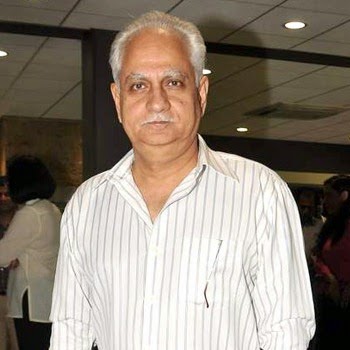
Photographs courtesy: (1) http://en.wikipedia.org/wiki/Ramesh_Sippy (Ramesh Sippy pic) (2) http://en.wikipedia.org/wiki/Sholay (Sholay poster)

Note: These photographs were not published in Maxim


Sunday, January 12, 2014

FOLLOW-UP TO REVIEW 237: SHOLAY (3D) - NEW POSTERS

Release date:
January 3, 2014
Director:
Ramesh Sippy
Cast:


Language:

Dharmendra, Amitabh Bachchan, Hema Malini, Jaya Bhaduri, Sanjeev Kumar, Amjad Khan, A.K. Hangal, Satyen Kappu, Viju Khote, Sachin, Asrani, Jagdeep, Mac Mohan, Iftekhar, Leela Mishra, Keshto Mukherjee, Helen, Jalal Agha
Hindi

On the re-release of  director Ramesh Sippy's Sholay in 3D, the film’s producers have brought out a series of new posters paying tribute to this classic and its third dimension. I’m uploading all of them here, because I think you will enjoy them. Have a nice day J

This poster is an ode to what is arguably the most iconic song on friendship in the history of Hindi cinema. Music director R.D. Burman's Yeh dosti hum nahin thodenge in Sholay featured Amitabh Bachchan and Dharmendra playing the rascal-ish bosom pals Jai and Veeru. Every aspect of this number is etched in the memory of film buffs of the time, from the motorbike to the side-car that is not visible in this picture, the harmonica and Jai-Veeru's incredible chemistry. Some analysts and academics see homo-erotic undertones in their relationship, but that's another story. 

Hema Malini's incredible beauty and comic timing made the taangewaali Basanti one of her most significant roles and performances. In 1975 when Sholay was released, Hema was already a massive star. A large contributor to that stardom was her team-up with Ramesh Sippy in two of his earlier films, his debut Andaz (in which she played a young widow) and Seeta aur Geeta in which she had a double role. Incidentally, Hema was the object of romantic interest of two of her leading male co-stars in Sholay: Dharmendra and Sanjeev Kumar. She married Dharmendra a few years after this film was released.

Danny Denzongpa was initially approached to play the role of the dacoit Gabbar Singh, but couldn't sign up because he was committed to another project. It was an interesting twist of fate. Amitabh Bachchan too has gone on  the record to say that he was interested in the part of Gabbar more than Jai. Ultimately, Amjad Khan went on to make Gabbar one of the most talked-about villains ever in Hindi filmdom, but in later years he was to complain that the role unfortunately overshadowed everything else he did thereafter.

"Yeh haath mujhe de de Thakur," said by Gabbar Singh to veteran Sanjeev Kumar's Thakur  Baldev Singh, remains one of the most quoted lines from Sholay. It was Thakur's desire for revenge against Gabbar that is at the centre of the action in Sholay. 

In a virtual non-speaking role, Jaya Bhaduri as the widowed Radha showed us that great actors will make their mark irrespective of the number of dialogues or screen minutes given to them.

Dharmendra's Veeru was the comic foil to Amitabh Bachchan's more silent Jai in the film. Times have changed, as have fortunes, but when Sholay was being made, Dharmendra was one of the industry's top heroes while Bachchan was just a rising star. This is why Bachchan got only fourth billing in the film's credits, behind Dharmendra, Sanjeev Kumar and Hema Malini, followed in fifth and sixth position by Jaya Bhaduri and Amjad Khan.

Jai is unarguably one of Amitabh Bachchan's most impactful roles. In fact, Sholay is widely considered the film that catapulted him from the star he became with the 1973 release of Zanjeer to superstardom. As it happens, 1975 is a landmark year in his illustrious career. It was in this year that Hrishikesh Mukherjee's Chupke Chupke and Mili, and Yash Chopra's Deewaar were released, in addition to Sholay, giving Indian audiences a display of AB's amazing versatility, from his comic timing in Chupke Chupke to the ability to play the gentle romantic hero in Mili, the brooding and lovable bad guy in Sholay and the avatar that has come to define him, the Angry Young Man of Deewaar


Posters courtesy: Everymedia PR