Friday, December 15, 2023

REVIEW 788: THE ARCHIES


Release date:

December 7, 2023

Director:

Zoya Akhtar

Cast:

Agastya Nanda, Khushi Kapoor, Suhana Khan, Vedang Raina, Mihir Ahuja, Aditi “Dot” Saigal, Yuvraj Menda, Suhaas Ahuja, Tara Sharma, Satyajit Sharma, Alyy Khan, Kamal Sidhu, Luke Kenny, Vinay Pathak  

Language:

Hindi and English


“I get a huge kick out of life. But I just don’t think about politics. What’s it got to do with my life?” Archibald/Archie Andrews asks his teacher Miss Grundy in reaction to his classmates’ concerns that the changes being wrought in their hill station, Riverdale, are driven by corporate interest, not public welfare. The year: 1964. But Archie echoes a standpoint adopted by so many people today too whose excuse for their silence on even fascism and genocide is, “I’m apolitical.”


The other students – all of them 17 – break into a song and dance to address Archie’s apathy, kicked off by Dilton Doiley singing: “In every fold of life, there’s politics.” It is with this lively passage that The Archies perks up, after a disappointingly bland 1 hour and 6 minutes. 


The Archies is the producer-writer-director Zoya Akhtar’s Hindi-English adaptation of the iconic US comic books. As you can imagine from the preceding paragraphs, Archie Comics – a frothy series about American high schoolers – provides just a sliver of a framework for Akhtar, Ayesha Devitre Dhillon and Reema Kagti’s script. The film’s updated politics, the decision to set it among Anglo Indians in north India and the non-stereotypical portrayal of the community are among The Archies’ exciting elements. Sadly, they are not effectively sewn together. The whimsicality Akhtar seems to have aimed at translates into low energy in the opening hour, and while the film picks up in the second half, it never fully recovers from the limpness of the first. 


Archie Comics began publication in the 1940s, revolving around an eponymous American teenager infatuated by the glamourous, wealthy and snobbish Veronica/Ronnie Lodge, and oblivious to the devotion of the pretty, golden-hearted and middle-class Betty Cooper. The vain and good-looking Reginald/Reggie Mantle was a flirt and Archie’s rival for Ronnie’s attentions. The other significant players included the gluttonous Jughead Jones, the muscular dimbulb Moose, the studious Dilton, and Ethel Muggs, a gawky girl smitten by Jughead who was repelled by her. 


In the early decades, “Archie and the gang” rarely rose above these basic characteristics. Their popularity was precisely because of this superficiality: the one-dimensional characters that did not strain the brain, a mild sense of humour, pretty outfits, pretty people, a clueless but non-malicious lead, and for Indian teens up to the 1980s, a glimpse into an alluring foreign land of tiny skirts and ice cream sundaes that were a rare sight here back then. Thankfully, Akhtar and her co-writers’ love of Archie Comics does not extend to the politics of the series that pitted two women against each other for a dull man’s affections, or the reductive gaze on the others. 


The manner in which the Ronnie-Archie-Betty triangle is turned on its head in The Archies is what intelligent adaptations are made of. (Spoilers: In the film, Archie dates multiple women without being honest with them. This quality is not pedestalised here unlike in conventional pop culture. Akhtar & Co’s Ethel calls Archie out for being a philanderer, and when Ronnie and Betty realise he is two-timing them, they tell him he’s not worth more than their friendship with each other.) It was also a smart move to situate the film among Anglo Indians, a community that traces its ancestry to the children of Indian and British parents in the colonial era. This allows The Archies to retain the names of the characters from the American comics – “Dilton Doiley” is a stretch, “Jughead Jones” required a backgrounder, but the rest could well be actual Anglo Indian names. Meanwhile, the north Indian location justifies the English-Hindi amalgam in the dialogues.


For the most part, however, the link between the film and the books is tenuous to the point of being superfluous. Reggie, for one, is nothing like the Reggie of the comics, barring a token allusion to an interest in Ronnie, and an introduction in which he makes out with a woman in a car. Akhtar’s Reggie is socially conscious, an aspiring journalist and a student activist. Sometimes the film introduces a connection to the books and promptly forgets it (the Archie-Ronnie-Reggie triangle, the Ethel-Jughead equation). Some characters are given short shrift (Mr Weatherbee, Pop Tate). Some are present but redundant (Moose). Akhtar and her team also seem not to have aimed for one of the hallmarks of Archie Comics, a sense of humour, unless you count Reggie’s Dad pooh-poohing his son’s prescient remark that comedy can be a career. Ha. Come visit us in 2023, Dad. 


Ultimately, there’s no satisfactory answer to why The Archies is an adaptation of Archie Comics rather than a brand new desi teen drama. This film is also no match for Akhtar’s track record as a director. It has neither the observational power of Luck By Chance, nor the ruminative depth and pizzazz of Zindagi Na Milegi Dobara and Dil Dhadakne Do, nor the grit, gumption and visceral energy of Gully Boy. It does, however, come across as a personal work in its own way. 


Zoya Akhtar is 51, which means she was a teenager when Archie Comics were all the rage among Indian teens. She turned 18 in a decade when the country transitioned to satellite television. MTV and the desi youth platform Channel V epitomised adolescent and young-adult coolth in the rapidly transforming India of the 1990s. If The Archies per se is her tribute to the comics, then the casting in part is a bow to the ’90s, with some of MTV and V’s earliest Indian VJs being roped in to play senior characters – Kamal Sidhu is Ronnie’s mother, Luke Kenny is Reggie’s Dad, Vinay Pathak is a villainous neta. When you think of it that way, it’s sweeta sort of love letter to a generation. 


The casting of the young leads seems just as personal to Akhtar. It comes across as a big fat middle finger to the online mobs hurling charges of nepotism at her industry. Unless you have been living under a rock, you know that Archie in The Archies is played by Agastya Nanda, grandson of Amitabh and Jaya Bachchan, and great grandson of Raj Kapoor; Ronnie is Shah Rukh Khan’s daughter Suhana Khan; in Betty’s role is Sridevi and Boney Kapoor’s daughter, Khushi Kapoor. 


The kids are neither great, nor awful. Khushi and Agastya are cute. She could be special. He lacks verve here, but comes alive while dancing. Suhana reveals a spark during Ronnie and Betty’s face-off over Mr Lodge. She could work on that. Would the trio have snagged such plum roles if it weren’t for their lineage? Unlikely. But it does not make sense to blame them entirely for the narrative’s limited vitality, which is a fault of the direction, although they do contribute to it. 


The rest of the cast are vastly better. The stand-out debutant is Vedang Raina playing Reggie. He can act, he can dance, he is handsome, but most important, he has screen presence and is born to be a star. Yuvraj Menda who plays Dilton and Dot i.e. Ethel are comfortable before the camera. 


The Archies is not a typical Bollywood musical. In terms of structure and sound, it is Bollywood’s nod to Hollywood/Broadway, although the background score (by Shankar Ehsaan Loy and Satya) and songs (by SEL, Ankur Tewari, The Islanders and Dot) are more distinctive and tuneful than what the average Hollywood/Broadway musical delivers. 


The most heart-warming aspect of The Archies is its depiction of Anglo Indians. Up to the 1990s, Hindi cinema inexorably stereotyped Christians, and confined the community to a clichéd notion of Goans and Anglo Indians. Christians almost disappeared from Hindi films thereon. The Archies’ characters are people, not cartoons. By not referencing their religion at all and focusing on their ethnic identity, Akhtar does something Hindi cinema has rarely done before: she points to diversity within a small religious minority. Anglo Indians, after all, are a minority within a minority. 


The diversity in this sub-group is also on display. While most women in The Archies wear dresses, as would have been the reality among 1960s Anglo Indians, note the women in saris and churidar kurtas especially in the opening montage and at the club. Farhan Akhtar’s dialogues are a smooth English-Hindi blend, with the kids mixing both, like city-bred youth across communities, while the adults are shown to have a spectrum of adeptness with Hindi – one parent struggles with “hoyenga” vs “hoga”, the others tease him about it. Sari/kurta-clad Anglo Indians who speak Hindi well are very much a reality, though you would not know that from Hindi cinema of a bygone era.  


The film even snubs its nose at the Right-wing that has always conflated Christians with British imperialists. The Archiescharacters are invested in India’s future and have contributed to our past. Reggie’s granddad, like many Christians, was a freedom fighter. The Archies is thus a lesson in showcasing patriotism truthfully, unlike the Akshay Kumar brand of propagandist cinema.


So, The Archies’ politics is worth rooting for. Normalised minority representation here extends to a gay boy who is not defined by his sexuality. Even the generic storyline is imbued with layers of meaning as it mimics real-world events in India today: big business buying politicians, corporates muzzling the press, and more. The storytelling is too flat for too long though to be redeemed.  


The kids in The Archies were born in 1947, and are 17 in the film. They embody an Independent India, but belong to a community that in today’s India is told they do not belong. The Archies has a lot to say about that and much else, but flubs its tone and tenor. When your source material is almost irrelevant to the point you wish to make, a floundering end product is perhaps inevitable. Akhtar could have heeded Archie’s father’s advice when the boy says he wishes to leave India for England to build a music career. “To make art,” says Dad, “you have to go in, not out.” 


Rating (out of 5 stars): 2.5   


Running time:

144 minutes 


Poster courtesy: IMDB 

Wednesday, December 6, 2023

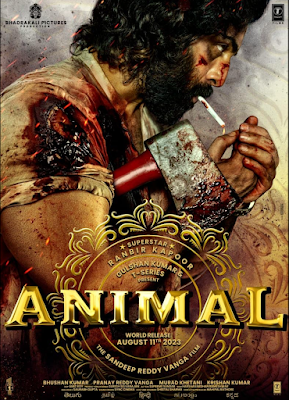
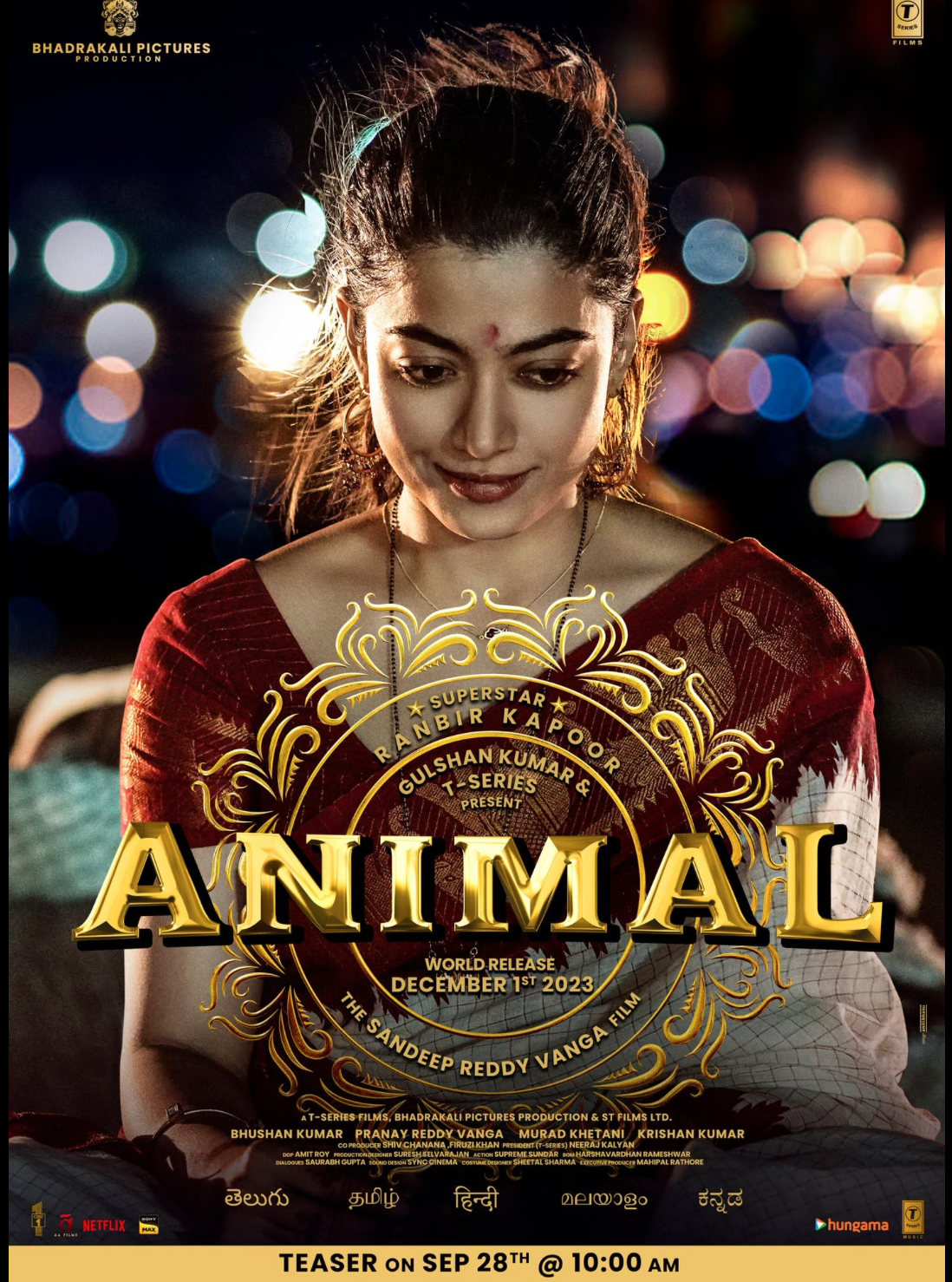
REVIEW 787: ANIMAL

Release date:

December 1, 2023

Director:

Sandeep Reddy Vanga

Cast:

Ranbir Kapoor, Rashmika Mandanna, Anil Kapoor, Bobby Deol, Tripti Dimri, Upendra Limaye, Suresh Oberoi, Saloni Batra  

Language:

Hindi with some English, Punjabi, Marathi etc 


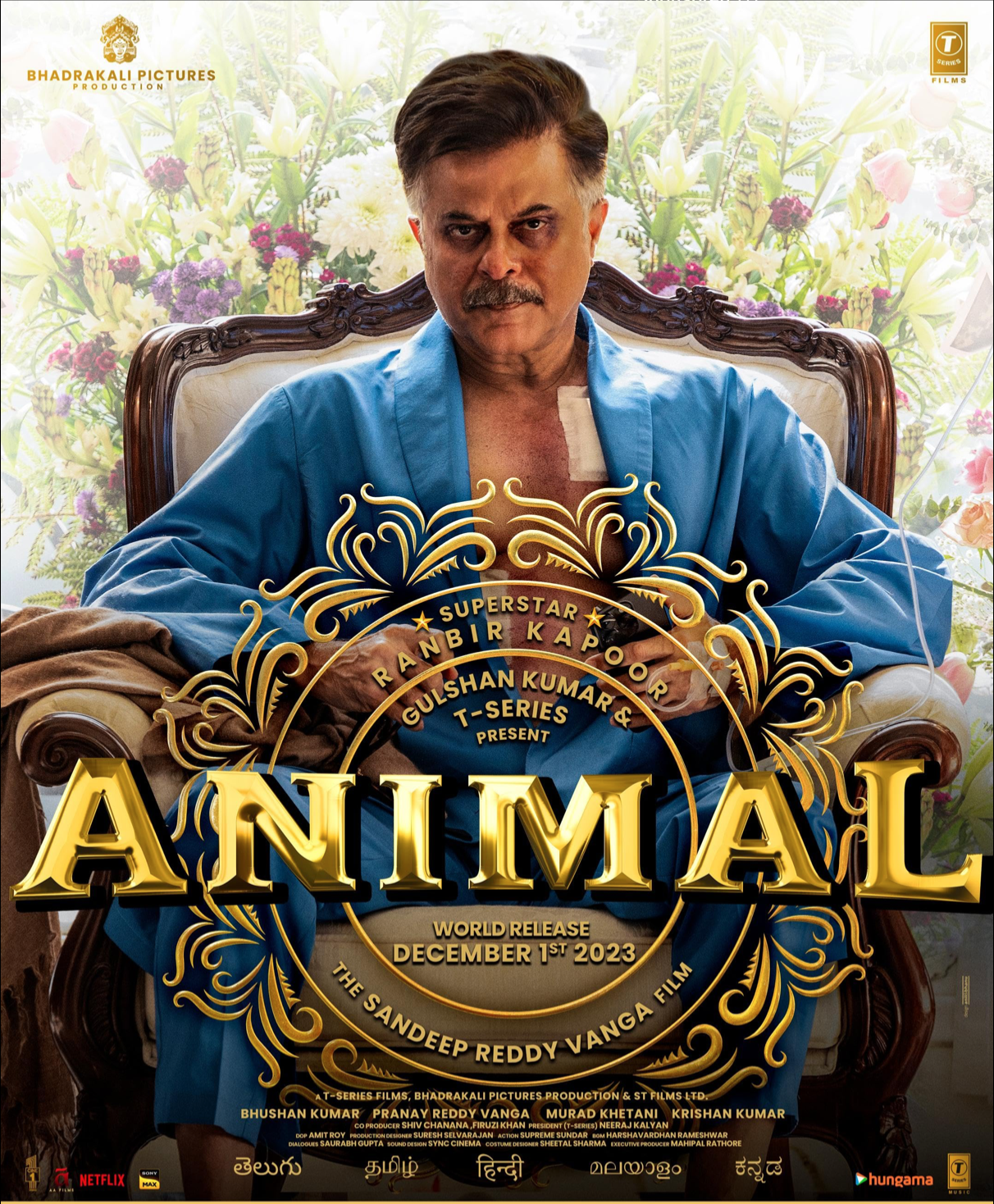
At one point in Animal, a stark naked Ranvijay Balbir Singh (Ranbir Kapoor in his nth role as a man-child) steps out of his mansion to stroll around the compound. (Don’t get too excited, his body is blurred out.) His team of male bodyguards first gawp at his nude frame, then a frisson of joy runs through them and they raise their guns in the air to let out several volleys of celebratory fire. This goes on till Ranvijay’s Daddy (Anil Kapoor) comes running out of the house to lead him away. The exhibitionism, it turns out, was in honour of a happy turn of events I won’t detail here. Beta, says Dad, I know you want to celebrate, but this is not the way. 


I cannot remember the last time the gifted veteran actor’s dialogue delivery was this strained and this unintentionally comical. Can’t blame him alone. That scene is so ridiculous, the phallic symbolism so in-your-face, the attempt at profoundness so laughable, and the sum and substance of the episode so juvenile that I burst out laughing. 


Ranvijay is fixated on his nether regions throughout Animal. He keeps drawing attention to the area by either pointing at his crotch or baring it or talking about it or griping about his underwear. In one scene, he speaks of both his “penis” and “anus” – his choice of words, not mine. It is all meant to be very very cool.


Animal is directed by Sandeep Reddy Vanga who debuted with Arjun Reddy (Telugu, 2017), and remade it in Hindi as Kabir Singh (2019). Animal – edited by Vanga and co-written by him with Pranay Reddy Vanga, Suresh Bandaru and Saurabh Gupta – seems bent on enraging those who slammed his earlier works. That goal is evident throughout this boring, blood-spattered film – in Ranvijay’s bizarre remarks and deeds, the all-pervasive violence, misogyny and gore. 


So that’s 3 hours and 21 minutes of revenge against those who criticise misogynistic cinema. 201 minutes of a desperate desire to shock and/or offend. 


Don’t be deceived into considering it mindless though. Bloodshed and immaturity may rage across Animal, but make no mistake about this: the film is steeped in messaging about victimhood – male victimhood and an allusion to the majority community too. 


Vanga’s film is a painfully long account of a boy longing for his father’s love. The said Dad is the industrialist Balbir Singh who has no time for his children. His neglect translates into anti-social behaviour and obnoxious cockiness only in Ranvijay who becomes an obsessive son and entitled lover, while his sisters somehow grow into women who don’t resent or bash up all and sundry.


Daddy issues have been the subject of numerous films. The re-release of the iconic Malayalam film Spadikam this February, 28 years after its initial run, was a troubling reminder that male-dominated industries have for decades used paternal rejection to justify and normalise male violence, including a hero beating up a female romantic partner or spouse. Spadikam’s protagonist (Mohanlal) was an anguished soul who repeatedly struck his lover (Urvashi), but it was all portrayed as no big deal. In Animal, Ranvijay is aggressive with his wife Geetanjali (Rashmika Mandanna), going so far as to injure and scar her in an extended scene of violence, but it is all insidiously presented with deftly camouflaged empathy – for him. 


For the zillionth time, let me pre-empt the clichéd question that always comes from defenders of such cinema: violent men do exist in the real world and a violent man can certainly be the central character in a film – the issue here, as always, is the manner of the portrayal, the script’s indulgence towards him, the humour and coolth written into his fictional character, and the various means used to give him an allure despite his violent ways.


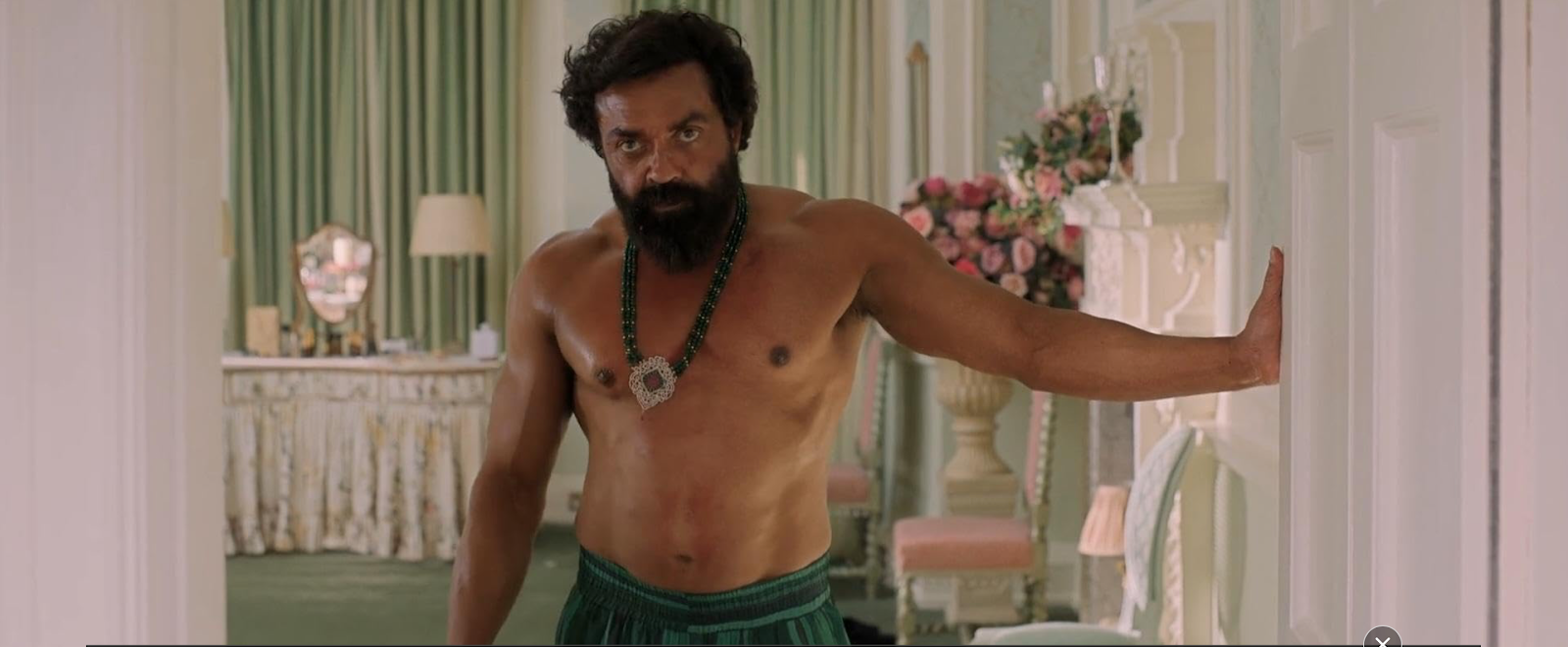
The strategised depiction of Ranvijay and his arch enemy Abrar (Bobby Deol) – arriving late in the second half – illustrates how the difference between a film’s gaze on two equally violent characters is used to steer audience reactions to them. Both commit horrifying acts, both treat women terribly, yet there is never a doubt about who is the hero or with whom the director wants our sympathies to lie. Animal may call itself Animal with reference to Ranvijay, yet his animalism is preceded by scene after scene dwelling on his childhood pain, his protective brotherly conduct, his aversion to sexual harassment, his advocacy of marital fidelity and so on, thus establishing him as a traumatised man with innate goodness. By the time his beastly side is exposed, a point has been firmly made that everything he does that is seemingly wrong is in fact done for the greater good. In contrast, the only Abrar we get to know is the brute who kills, rapes and terrorises. 


For good measure, Abrar’s Muslimness is underlined by pointedly mentioning his family’s conversion to Islam. 


If Ranvijay rips up human flesh, it is to avenge an attack on his father. If Ranvijay cheats on his wife (mind you, after lecturing other men when they cheat on their wives), he does it for a noble cause. Poor misunderstood Ranvijay had sex only to save his family, you know. 


Ranvijay assaults Geetanjali and a defence is woven into the script. He proposes that just as there is a first kiss and a first time having sex in a relationship, so also there should be a first slap. And guess who gets slapped first? 


Sigh. Poor misunderstood, suffering, victimised Ranvijay.


Poor Ranvijay who has a solitary wife, and is up against evil, brutal Abrar with three wives. 


Bobby Deol’s Abrar has been shaped in the same mould as Alauddin Khilji from Padmaavat and other fictionalised interpretations of historical Muslim warriors who have dotted Hindi films in the past decade. Abrar eats cake in Animal in the way Padmaavat’s Khilji tore into meat. Abrar tears into his young wife in the way Padmaavat’s Khilji raped his wife. A filthy Abrar barges into a room filled with people and initiates sex with his bride, unmindful of the others’ presence.  


Now contrast this with the mellow tone of the scene in which Ranvijay converses with Geetanjali while examining the bruises he inflicted on her body. 


Note too that the relentless cruelty inflicted by Ranvijay on various people is bookended in this carefully constructed narrative by lengthy scenes emphasising his vulnerable nature. 


So, to circle back to that predictable question, “Violent men do exist, so what’s wrong with a film portraying reality?”, I repeat: yes, violent men do exist in the real world, and the issue here, as always, is the director’s gaze on them and their violence.


Animal brims with an intense dislike of women, outspoken women in particular, and evolved, gentle men. It begins with a derisive use of the word “toxic” in a fable narrated by Ranvijay about a monkey that harassed a princess. The contempt is obviously for the term “toxic masculinity”, popular in the feminist lexicon, that was widely applied to Vanga’s first two films. 


At one point, Ranvijay mocks Geetanjali for complaining because she has to change pads for four days in a month – he claims she complains, we don’t hear her doing so – while he, he tells her, has not complained though his body has been invaded by doctors during a life-threatening situation. Talk about false and stupid equivalences. Periods are a natural bodily function – often horribly painful, always incredibly inconvenient – that every woman bears for every single month of her entire reproductive life lasting for three to four decades. Ranvijay’s condition, on the other hand, is caused by a human aggressor; it is not the biological fate of all men. Here, Ranvijay is a version of misogynists who troll women for using the social media to raise awareness about cramps, excessive bleeding, agonising period pains and the trivialisation of these experiences by society. 


Oddly enough, the determinedly misogynistic Animal writes a feminist element into Ranvijay’s character – he explodes with anger when his brother-in-law roughs up his sister early in the film. There is no progression shown from that scene to his own extreme hostility to his wife. 


Animal’s terrible attitude to women runs alongside a cunning use of India’s religious minorities. 


Abrar and his cohorts are stereotypes diligently being peddled by Hindi cinema to echo the current Islamophobic national discourse. There is even a Muslim man in the picture who is described as a butcher from Istanbul. His sole contribution to Animal is a stomach-churning slaughter of men. 


The Sikhs in Animal are Ranvijay’s brethren and protectors, an extension of a positive stereotype: the fierce, fiercely loyal Sardarji. They are also his allies against Abrar’s marauding gang. All this leads up to a climactic confrontation between shirtless men on an airport tarmac – talk about Hindi film clichés! – in which a kirpan is handed to Ranvijay so that he can wrap up a fight unto death.


A Christian in Animal confuses Balbir Singh’s company logo with the Nazi Swastika. Since prominent Hindu religious symbols are ubiquitous in India, one assumes a Christian was chosen for that episode to play along with right-wing propagandists who project Indian Christians as alien Westerners. Presumably, the idea here is to hint at Hinduism being a globally misunderstood faith. 


Without giving away plot points, I can tell you this much: according to Animal’s underlying philosophy, Sikhs are family and very much in the Hindu fold, Muslims are family that chose the wrong path and are now out to destroy the mother clan, and Christians are the other. 


The mind games played by Animal are packaged in slick production design and cinematography, accompanied by a pulsating sound design, infectious music, and Ranbir’s immersive performance. 


Despite all this, I was bored stiff by the film. 


Startling violence is used here to compensate for a thin, trite storyline. In the first half hour, I was curious about where Vanga would take it, but I spent the remaining 171 minutes stifling yawns at the transparent effort to be disgusting. The camera zooms in on a pulverised human eye. A knife is run back and forth, back and forth, back and forth over a human neck in close-up instead of one swift slash that filmmakers usually favour. 


For the record, Animal is not the most violent film ever made in India. Others have done as bad or worse. It is ugly though – in both its use of violence and in its intent.


Ugly. Hate-filled. Tedious. Self-indulgent. And hawking a loathsome agenda. 


Misogynists insist that feminists hate men, although all that feminists want is gender equality. You know who hates feminist men? Answer: misogynistsYou know who hates men in general? Answer: misogynistsI cannot for the life of me imagine a feminist – female or male – ever conceiving a film that makes men look as foolish, puerile, self-pitying and pathetic as Animal does. 


Rating (out of 5 stars): 0   


Running time:

201 minutes 


Poster courtesy: IMDB 

Saturday, December 2, 2023

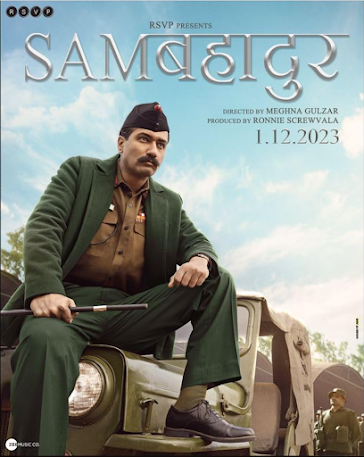
REVIEW 786: SAM BAHADUR


Release date:

December 1, 2023

Director:

Meghna Gulzar

Cast:

Vicky Kaushal, Fatima Sana Shaikh, Sanya Malhotra, Mohammed Zeeshan Ayyub, Neeraj Kabi, Govind Namdev 

Language:

Hindi with some English  


How do you make a film on a national icon whose image of coolth in his lifetime was built not solely on extreme courage and brilliant war-time strategising, nor even just his sense of humour and forthrightness, but also on widely disseminated accounts of his sexist condescension towards a prominent woman politician? The task is especially challenging when the man in question is Field Marshal Sam Hormusji Framji Jamshedji Manekshaw, a beloved Army Chief credited with India’s win in the 1971 war against Pakistan that led to the formation of Bangladesh.


A story that Manekshaw addressed the then Prime Minister Indira Gandhi as “sweetie” (She: Are you ready to go to war? He: I am always ready, sweetie) has assumed legendary proportions over time, with some fans repeating it as proof of his hipness and daring, while others have sought to deny it, and still others dismiss criticism of him by taking the position that women these days make much ado about nothing. Either way, the anecdote is an intrinsic part of the Manekshaw legend, and a truthful film about him cannot sweep it under a carpet. Would it be wisest for such a film to normalise sexism, or else to examine the subject through a critical, analytical lens even at the risk of irking Manekshaw’s adoring admirers?The dilemma is apparent in Meghna Gulzar’s Sam Bahadur that the director has co-written with Bhavani Iyer and Shantanu Srivastava, and is just one of the weak spots in an oddly pallid, superficial biopic. 


(Note: Manekshaw’s daughter has been quoted in the press this week praising the film after seeing two previews. This should put to rest the speculation about whether the “sweetie” saga is true.) 


Like most human beings, Sam Manekshaw was not easily definable. That patronising line to Gandhi is just a fraction of the abundant lore surrounding him, supplemented in Sam Bahadur by another not-so-well-known conversation: Manekshaw in the film tells Mrs G during an official, one-on-one meeting that she can always rest her worried head on his shoulders. Ugh! 


Since the film has not laid any ground for that exchange by suggesting a close friendship between them, his words are nothing less than an instance of over-familiarity and superciliousness that women at workplaces, including women leaders, are acquainted with. This is the same Manekshaw though who is known to have, and shown to have, unequivocally ordered his troops not to harm Bangladeshi women after India’s victory against Pakistan in 1971. To say he was complex, therefore, is an understatement, but Sam Bahadur’s script merely flits over various aspects of his personality and struggles to weave them into a comprehensible, relatable, engaging whole. 


The writers appear not to have come to terms with the troubling eternal reality that contradictory qualities often co-exist within the same person. Instead, in an ostensible bid to justify the unpalatable, they let on that “sweetie” was Manekshaw’s mode of address not just for India’s first woman PM, but for others too, both male and female. Err, talking down to another person does not become okay just because women are not the only ones at the receiving end. This was perhaps an opportunity to scrutinise society’s willingness to indulge distasteful conduct by men in power. Sadly, Sam Bahadur lacks the subtlety to handle this delicate point while simultaneously acknowledging Manekshaw’s incredible achievements.


The film is painfully conscious that its central figure was a giant among men. It declares that he was great, and expects us to believe it because it says so, but fails to distil the essence of who he was and why. In fact, Sam Bahadur is so acutely aware of his stature in Indian history, that initially it underlines a marginal brainwave as though it was an act of unprecedented genius. Later, when Manekshaw is accused of being anti-national, the charge is shown quickly collapsing under the weight of his grandiose pronouncements – this is another opportunity lost, if you consider the parallels with contemporary India, but for that resonance to be conveyed, a film would have to rise above the broad brush strokes that Sam Bahadur favours over nuance and detail.


The script jumps from one milestone in Manekshaw’s personal and professional journey to the next to the next to the next – from his marriage to his triumphs at various postings in the Army before and after Independence, internecine politics, his appointment as chief, 1971, his elevation to the position of India’s first field marshal, and finally, retirement – without getting to the beating heart of the celebrated soldier. It thus comes across as a listing of historical events rather than an in-depth exploration of the person behind the larger-than-life persona. 


If the goal was to offer a primer to students brushing up on their GK before a quiz, Sam Bahadur has served its purpose. As a biopic though, it is shallow.


The portrayal of Manekshaw’s relationship with his wife exemplifies the follies of the script in its entirety. They meet at a party, he is smitten at first sight, he says clever-sounding things, they gaze at each other through a long, moony song as they dance, we gather that they fall in love as that number plays at the party since that’s the purpose served by such musical interludes in Hindi films that feature a ‘heroine’ as a glamorous aside…cut to her in the bedroom of their home gazing at their sleeping child. That is literally how abrupt it is. That the director of the exemplary Raazi and Talvar would deliver a film this poorly structured and this lightweight is surprising.


Mrs Manekshaw, Silloo, gets a defining trait: an inexplicable animosity towards Indira Gandhi even before meeting her. The film implies that Silloo was insecure about Gandhi for no given reason, obviously playing into the stereotype that women don’t like attractive women. Eye roll! The antagonism results in some of Sam Bahadur’s silliest, unfunniest-albeit-meant-to-be-funny moments. It is disappointing that Mses Gulzar and Iyer, who co-wrote Raazi, opted to trivialise women in this film, first by giving an Army wife zero substance beyond her jealousy towards another woman, then compounding that diversion with a flash of what could be either innuendo or a genuine misunderstanding in at least one telephone conversation – presumably designed for comical effect – between Gandhi and Manekshaw. Worse, when he is shown patronising her, she has no reaction. Neither shock, nor confusion about how to react, neither anger, nor amusement. 


Are the writers implying that Gandhi was attracted to Manekshaw because he was a hottie? Can’t say for sure, but they’re certainly implying something. It is as if they could not fathom a normal working relationship between a good-looking, high-profile woman and man. 


No amount of contrived humour, no surface energy, no acting swag or rambunctious patriotic song – all of which we get here – can compensate for this passionless narrative.  


Not unexpectedly then, Vicky Kaushal’s performance as Manekshaw is as slight as the script. In Shoojit Sircar’s Sardar Udham (2021), Kaushal seemed to grasp the freedom fighter Udham Singh’s emotions and motivations. Here, he effectively captures Manekshaw’s posture, gait, intonation and the twinkle in his eye, but never gets past his skin. The fact that Manekshaw had a big personality is no excuse. For a recent example of an actor steering an audience beyond a real-life character’s overwhelming exteriority and flamboyance, Kaushal and the writers of Sam Bahadur would have done well to reference Ranveer Singh’s brilliant, non-caricaturish, immersive turn as the flashy former Indian cricketer Kapil Dev in Kabir Khan’s well-written 83.


The talented Sanya Malhotra (DangalPagglaitKathal) is wasted in Sam Bahadur, cast as an insipid Silloo. So is Mohammed Zeeshan Ayyub, who is unrecognisable after a while as Pakistan’s President Yahya Khan. Fatima Sana Shaikh delivers a stolid, dull Gandhi.  


The film is too much in awe of Manekshaw and too determined to lionise him to do justice to the other stalwarts on screen. Gandhi here, for instance, is nothing like the charismatic woman we saw in the public realm in reality, whose steely will earned her the nickname “Iron Lady of India”. 


Still, Sam Bahadur is not without qualities to recommend. The scenes of military action, for one, are captivating. In a decade when patriotism and even the national anthem have been weaponised by the Right, and Hindi cinema is bowing to prevailing winds by turning accounts of Indian heroes and their achievements into vehicles for chest-thumping desh prem, hatred of Pakistan and the stereotyping of India’s own religious minorities, this film is different. Sam Bahadur representspatriotism, not chauvinism. Shankar Ehsaan Loy’s song Badhte Chalo that runs through the 1971 war in the film is stirring, not jingoistic. This is not Akshay Kumar style aggressive nationalism, nor is it akin to the more polished propaganda of Uri: The Surgical Strike that Kaushal himself starred in. This is Meghna Gulzar style love for the country. This is cinema, not a war cry.  


Even when Sam Bahadur presents a broken Jawaharlal Nehru with Sardar Patel during the 1962 India-China debacle, it stops short of the right-wing ecosystem’s favourite trope that Nehru was a weakling and Patel the strong-willed one in the Cabinet. Their scenes are as broadly written as everything else in the film, nevertheless they are a marked contrast to the comically cowardly Nehru and gigantic Patel in Ketan Mehta’s Sardar (1994) and in the current dominant discourse. 


Ultimately though, anything that Sam Bahadur gets right is overshadowed by its sketchy scripting and bombast sans soul in the protagonist’s speech, demeanour and actions. The film tells us Manekshaw tended to downplay his troubles with the signature line “I’m okay”. Okay is not good. Okay is not great. Okay is just okay. Like the film. Sam Bahadur is okay, I guess. Just okay. 


Rating (out of 5 stars): 2


Running time:

150 minutes 


Poster courtesy: IMDB 

Sunday, August 2, 2020

REVIEW 785: RAAT AKELI HAI


Release date: July 31, 2020 (on Netflix) 

Director: Honey Trehan

Cast: Nawazuddin Siddiqui, Radhika Apte, Padmavati Rao, Shivani Raghuvanshi, Nishant Dahiya, Ila Arun, Shreedhar Dubey, Aditya Srivastava, Riya Shukla, Shweta Tripathi, Swanand Kirkire, Tigmanshu Dhulia

Language: Hindi


Sometimes a film has the power to grip you from the very second it takes off. Honey Trehan’s Raat Akeli Hai (RAH) does that, grabbing attention with a vice-like hold from the moment it opens with a chilling murder on a deserted highway in the inky blackness of the night. 

Fast forward to five years later, and there is another murder: a rich old man is found shot and with his face bashed up on his wedding night. Inspector Jatil Yadav is called in to investigate (yes, Jatil, not Jatin – there is an amusing story there).

The elderly victim had money and a wealth of people around him. Yadav realises within minutes of being inserted into their lives that no one is above suspicion: not the dead man’s pregnant daughter, not his drug-taking son or the son-in-law whose sole concern is his claim to the family fortune. Then there is the victim’s enigmatic sister and niece, an arrogant nephew, the young bride herself and the domestic help who seems to know more than she lets on. 

While sifting through clues and possible motivations, Yadav, who is edging towards middle age, must also deal with his pesky albeit well-meaning mother’s marriage goals for him.  

Trehan has so far been known as one of Bollywood’s top casting directors. The meticulousness with which he and his colleague Taran Bajaj have picked actors for even minuscule roles in RAH explains his reputation for excellence in that department. The confidence with which he has helmed this film belies the reality that it marks his directorial debut. 

Every frame of RAH, every technical aspect, has been handled with extreme care. The film plays out mostly in darkness. Open spaces late at night where fires are replicated by the reflective surfaces on which they fall and the red-tinted low-lit interiors of homes elegantly captured by DoP Pankaj Kumar set up, heighten and sustain the sense of intrigue and suspense in the narrative. It can be safely concluded that Kumar has superhuman abilities since his repertoire ranges from the visual philosophy of Ship of Theseus to the atmospherics of RAH.    

The writing by Smita Singh (who has been credited with the story, screenplay and dialogues) pays heed to even the minutiae in the life and demeanour of each character. RAH is an effective crime thriller, but goes well beyond that to also serve as a running commentary on state politics and the sociology of small-town north India. 

The most visceral statement emanating from Singh’s story is about the way society punishes women victims of sexual abuse, irrespective of class, and views them with suspicion while covering up the sins of their male predators. She also finds space for colourism, a telling reference to the double standards inherent in Hindutva politics, and a spectrum of hypocrisy where a target of prejudice may very well turn out to be prejudiced in their own way – like the man who is rejected by a woman because he is too dark-skinned for her taste, who in turn says her attire indicates that she is not as “susheel” (good, modest) as he would like his wife to be. 

Susheel” is translated as “virginal” in the subtitles, which is an interesting interpretation of the Hindi word. It is a measure of the importance Raat Akeli Hai gives to detail that the subs have been done by no less a personage than Abhishek Chaubey (director of Dedh Ishqiya and Udta Punjab, and one of this film’s producers) along with Utsav Maitra. 

 This team clearly has an affection for language and is aware that subtitles across Indian cinemas often wreck the director’s and writer’s intent. Singh’s dialogues merit every bit of that love. 

Despite the large ensemble of characters, Singh and Trehan make each one distinctive. 

Nawazuddin Siddiqui as Jatil Yadav switches with characteristic ease from hard-as-nails policeman to a softer version of himself. 

Radhika Apte as the much-hated bride, Radha, embodies an oppressed yet defiant, despairing yet still spirited woman wronged. 

Each actor stands out in their own right, though I must say it was a pleasure to see Riya Shukla – who earlier played Swara Bhasker’s acid-tongued daughter in Nil Battey Sannata – here playing a significant part as the terrified household help. 

In his role as a senior policeman, Tigmanshu Dhulia’s natural timing seems particularly well-suited to the local flavour of the dialogues. 

Shreedhar Dubey makes himself likeable as Yadav’s gossipy deputy who personifies casual misogyny with his assumptions about who done it – a reminder that patriarchy is perpetuated not necessarily by men with horns on their heads but by the ‘nice guys’ too. 

And Ila Arun is utterly loveable as Yadav’s mother. I melted into a puddle as I heard her explain what his father meant to her. 

In the midst of so much that is good, two points about RAH are a cause for concern. Firstly, the relationship Yadav tries to build with a woman in the film is exploitative because of the unequal power equation between them, far worse than perhaps even a doctor wooing a patient or a lawyer wooing a client because when he first makes an aggressive overture towards her, he is in a position to destroy her completely. This is not to say that no man would make such a move in real life, but that this particular man’s behaviour here seems inconsistent with his characterisation until then and thereafter, and that the script does not bat an eyelid in the matter, which becomes noteworthy considering the progressiveness of the rest of the writing. 

The finale gets stretched for over 20 minutes after the big reveal, partly due to the Agatha Christie-style gathering of all the players in a single room for the detective to say his piece (which is sweet) and partly due to a needless bow to the conventional definition of happily-ever-after. The closing scene feels odd not just because it is unnecessary but also because of the lack of chemistry between the two actors and characters involved. By this time though, RAH had me completely engrossed and in a forgiving mood.

It helps that the film closes right then with one of the mood songs Sneha Khanwalkar has created for it. Khanwalkar’s soundtrack and Karan Kulkarni’s background score play a crucial role in RAH’s pensive tone

Raat Akeli Hai (The Night Is Alone / Lonely / Solitary) marks the advent on the Hindi film scene of a bold new voice. Here is some breaking news of the happy variety: director Honey Trehan has arrived.  

Rating: 3.5 (out of 5 stars)

Running time: 150 minutes

Photo courtesy: IMDB